Key figures
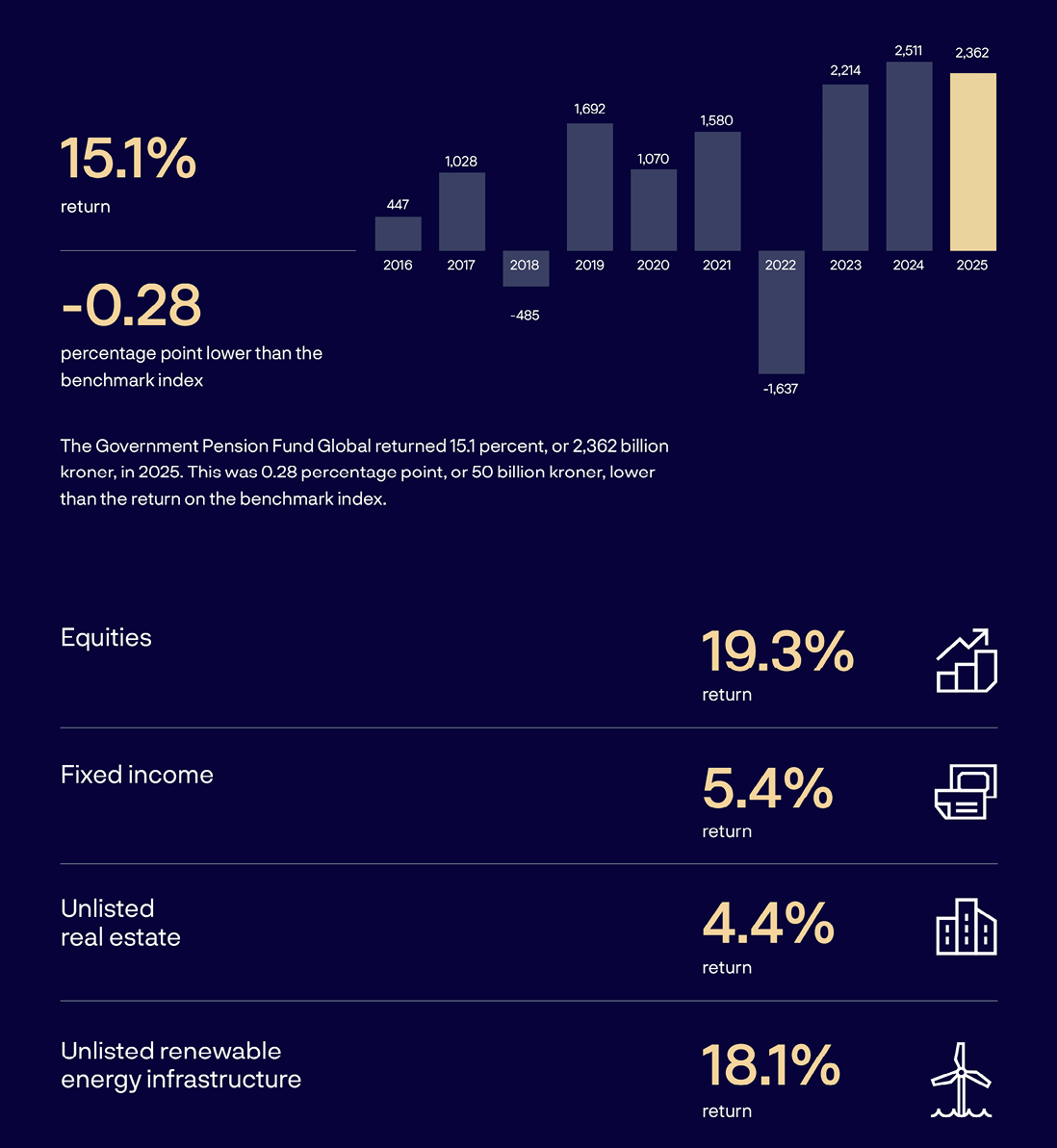
Return
The fund’s value
Translated from Norwegian for information purposes only. The Executive Board signs the official Norwegian version.
1. Results

The Executive Board’s assessment of the results
The investments in the Government Pension Fund Global returned 15.1 percent in 2025 following strong gains in global equity markets. The return was 0.28 percentage point below the fund’s benchmark index. This is within the range of variation in relative return that can be expected from one year to the next. The Executive Board emphasises the importance of assessing results over time and is satisfied that the return over time has been higher than the return on the fund’s benchmark index.
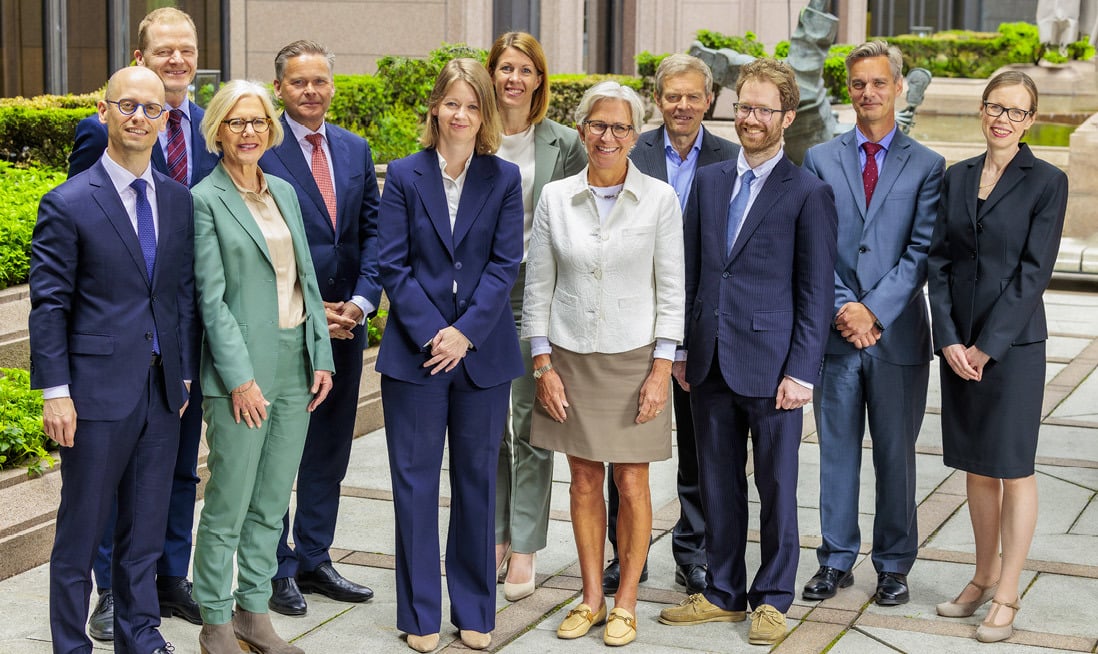
From the left: Øystein Børsum, Pål Longva, Kristine Ryssdal, Hans Aasnæs, Ida Wolden Bache, Ragnhild Janbu Fresvik, Nina Udnes Tronstad, Arne Hyttnes, Mats Bay Fevolden (employee representative), Thomas Ekeli, Guro Heimly (employee representative).
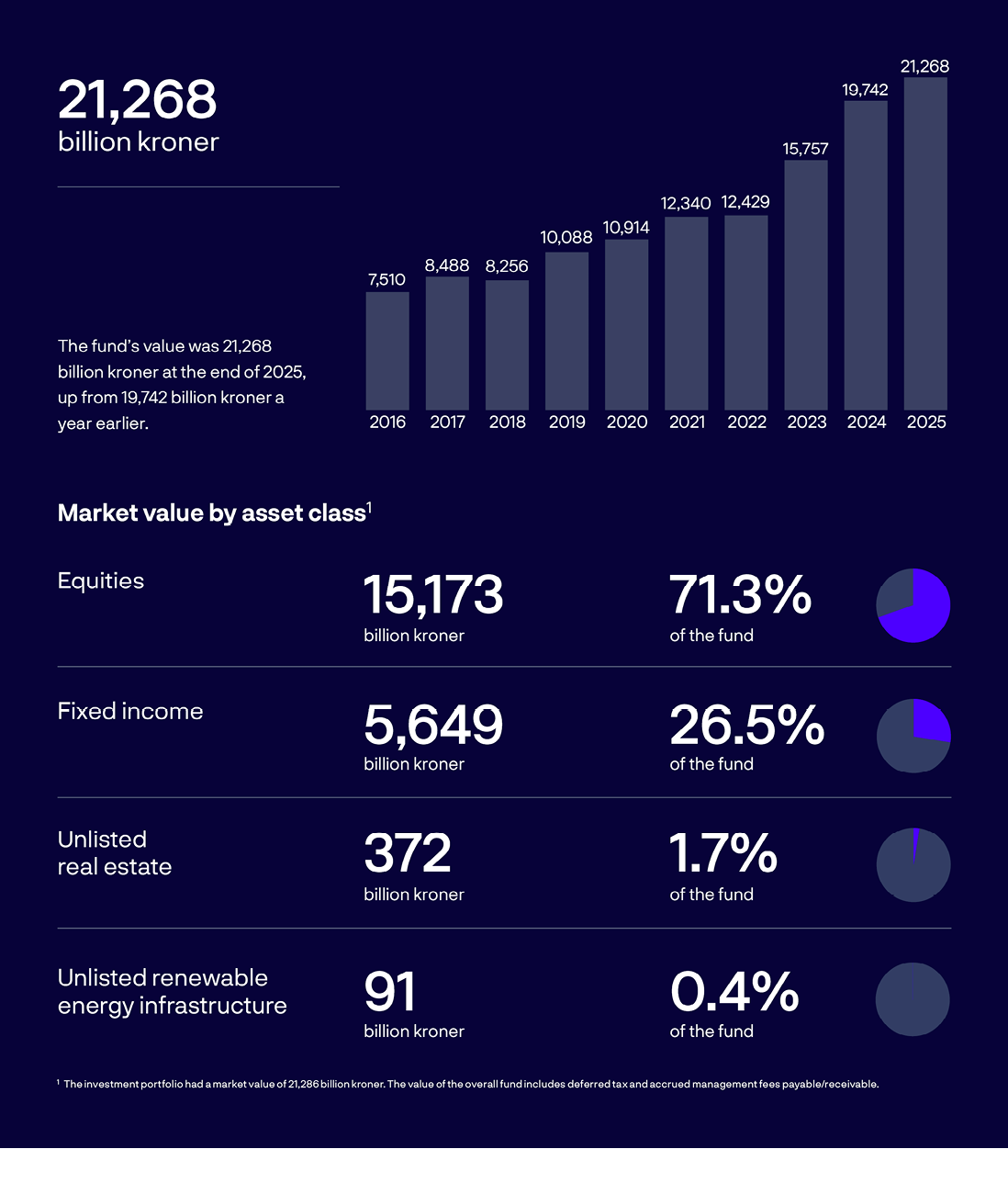
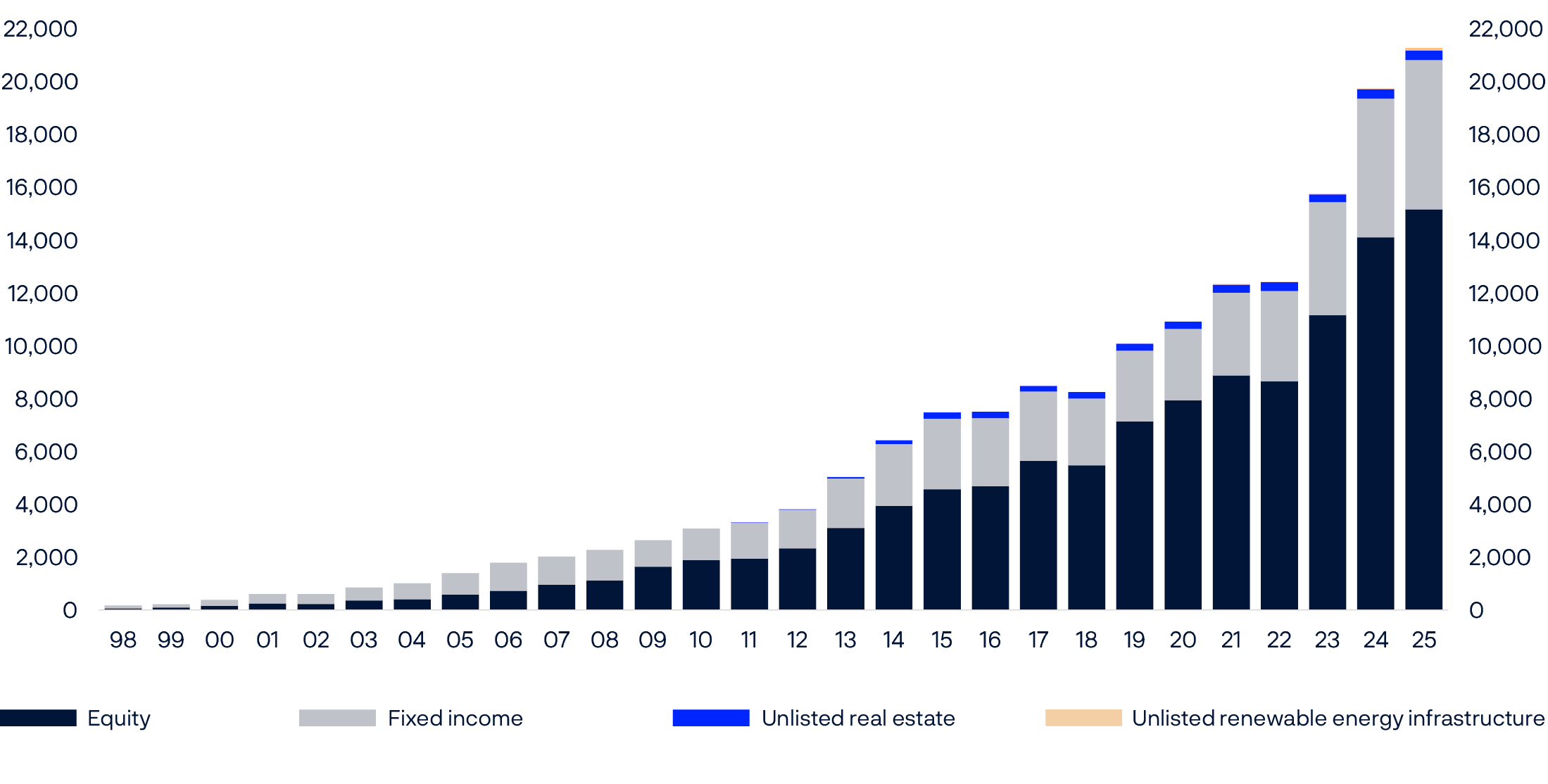
At the end of 2025, the value of the Government Pension Fund Global was 21,268 billion kroner and the fund’s investments comprised 71.3 percent equities, 26.5 percent fixed income, 1.7 percent unlisted real estate and 0.4 percent unlisted renewable energy infrastructure.
The return measured in terms of the fund’s currency basket was 15.1 percent last year before management costs. The return on equities was no less than 19.3 percent. Solid corporate earnings in investee companies and optimism regarding artificial intelligence led to strong equity markets. Fixed-income instruments returned 5.4 percent in 2025, while investments in unlisted real estate returned 4.4 percent. The fund’s investments in unlisted renewable energy infrastructure returned 18.1 percent last year.
The Executive Board considers the overall return on the fund over time to have been solid. In the period between 1998 and 2025, the average annual return was 6.6 percent. The annual net real return, after deductions for inflation and management costs, was 4.3 percent in the same period.
Over the past five years, the Government Pension Fund Global has generated an accumulated return of 8.3 percent measured in the fund's currency basket before management costs, or approximately 7,000 billion kroner in accounting terms. The largest contribution comes from the fund’s equity investments. With such a large fund and an equity share of around 70 percent, we have to be prepared for the possibility of a significant decline in the fund’s value.
The Ministry of Finance determines the overall investment strategy for the fund. Norges Bank manages the fund with a view to achieving the highest possible long-term return, within the constraints laid down in the mandate from the Ministry of Finance. The Executive Board determines a strategic plan for the fulfilment of the investment mandate.
Since 2013, Norges Bank has grouped its investment strategies into three main strategies: market exposure, security selection and fund allocation. In the strategic plan for the period 2026 to 2028, which the Executive Board adopted towards the end of last year, these strategies have largely been continued. The investment strategies are complementary and aim to take advantage of the fund’s distinctive characteristics. We do not expect all investment strategies to generate excess return at all times. The strategies have different time horizons and results will vary with different market conditions. The objective is for them to collectively generate excess return over time.
Under the strategy for market exposure, the fund is invested broadly and cost-effectively in the equities and bonds included in the benchmark index. The security selection strategy involves analysing companies and assessing whether the fund should invest more or less relative to the benchmark index. Norges Bank uses both internal and external managers for security selection. The fund allocation strategy comprises various strategies designed to improve the fund’s return and risk characteristics over time. The fund’s investments in real estate and unlisted renewable energy infrastructure form part of this strategy.
In 2025, the fund’s return before management costs was 0.28 percentage point lower than the return on the benchmark index. Market exposure contributed positively, while security selection and fund allocation contributed negatively to the fund’s relative return. The Executive Board notes that the fund’s total return over the last three years has been lower than that of the benchmark index due to the negative contribution from fund allocation.
The Executive Board emphasises that the fund’s performance must be assessed as a whole and over time. In the period between 1998 and 2025, the annual return before management costs was 0.24 percentage point higher than the return on the benchmark index from the Ministry of Finance. Norges Bank has measured the contributions to excess return from the three main strategies since 2013. Both since 2013 and over the last five years, the annual return before management costs has been 0.19 percentage point higher than the benchmark index. The Executive Board is satisfied with the fund’s performance over time.
The contributions from market exposure and security selection have been positive. With the exception of 2018, the market exposure strategy has contributed positively to the fund’s relative return each year since 2013. The results from security selection have fluctuated somewhat more but have contributed positively in eight of 13 years.
Fund allocation, and real estate investments in particular, have contributed negatively to the fund’s excess return. Since 2017, decisions on whether and how the fund should invest in real estate have been delegated to Norges Bank within the limits for deviation from the fund’s benchmark index.
The Executive Board is not satisfied with the results achieved in real estate investments over time. Real estate returns have been weak, both relative to the equities and bonds sold to fund them and compared with returns in the broader real estate market as measured by a global index. Norges Bank Investment Management made several organisational changes related to real estate management at the beginning of 2025 and began work on adjusting the real estate strategy at the same time.
The Executive Board has now adopted a new strategy for real estate. Norges Bank invests in real estate to achieve the objective of the highest possible return over time. Achieving this goal may also improve the long-term trade-off between return and risk in the fund. To date, the strategy has focused on investing in traditional sectors such as office and retail in predetermined countries and cities. Moving forward, Norges Bank will adopt a broader approach to real estate investments and diversify into more sectors and geographies. Norges Bank will invest more in unlisted real estate through external managers, funds and other indirect investment structures. This will especially apply to investments in new real estate sectors. The Executive Board has further specified that a framework shall be established for the funding of unlisted investments, which includes considerations of the underlying risk of the investment and adjusts for leverage.
Since 2019, the Ministry of Finance has allowed Norges Bank to invest up to 2 percent of the fund in unlisted renewable energy infrastructure. The strategy has been to gradually approach investment opportunities and develop expertise. Norges Bank made few investments during the initial years, but has increased investments based on, among other things, assessments of improved return expectations. Several new investments through 2025, including the fund’s first investment in electricity grids and its first investment in an energy transition fund, contributed to an increase in the share of the fund invested in unlisted renewable energy infrastructure from 0.1 percent to 0.4 percent. The investments are made with a long time horizon, which indicates that results should be assessed over time.
The objective of the highest possible return in the Government Pension Fund Global is to be achieved with an acceptable level of risk. The fund’s risk is measured, analysed and followed up using a broad set of targets and various analytical methods. The management mandate stipulates that Norges Bank shall manage the fund with the aim of ensuring that the expected relative volatility (tracking error) does not exceed 1.25 percentage points. At the end of 2025, the expected relative volatility was 0.37 percentage point, compared with 0.44 percentage point at the end of the previous year.
Measured over the entire period from 1998 to 2025, the realised tracking error has been 0.62 percentage point.
The management of the fund is to be cost-effective. Low costs are not an end in themselves, but cost-effective management contributes to achieving the highest possible return after costs. In the period from 2013 to 2025, annual management costs have been 0.05 percent of assets under management. The Executive Board is satisfied that management costs over time have been low compared to other funds.
Through the fund, we hold a small stake in the world’s largest companies. Responsible investment aims to promote long-term value creation in companies and minimise impact on the environment and society. In this manner, it supports the financial objectives of the fund.
Situations involving war and conflict entail increased risk, and Norges Bank, as manager, must conduct enhanced due diligence. An example of this is the situation in the West Bank and Gaza. Throughout 2025, the Executive Board has further strengthened its monitoring of situations of heightened risk, such as in countries affected by war and conflict. In November 2025, the Ministry of Finance appointed a committee to review the fund’s ethical framework and introduced temporary guidelines that will remain in effect until a new ethical framework has been established. Norges Bank continues to manage the fund in a responsible manner, within the applicable framework.
Norges Bank’s Executive Board
We will be a leader
We live in turbulent and unpredictable times. Often, it is only years later that we truly understand what has transpired and its consequences. In retrospect, events and decisions appear clearer, but in the midst of them, certainty is elusive.
![[Alt text was not generated.]](/contentassets/59e6804fa62d4e959d2e9d82dcea3ab9/en-gb-639076117309337499/imageledergruppen_13_feb_2026.jpg)
From left: Malin Norberg, Chief Investment Officer Market Strategies – Marthe Skaar, Chief Communications and External Relations Officer – Daniel Balthasar, Co-Chief Investment Officer Active Strategies – Pedro Furtado Reis, Co-Chief Investment Officer Active Strategies – Trond Grande, Chief of Staff/Deputy CEO – Carine Smith Ihenacho, Chief Governance and Compliance Officer – Nicolai Tangen, CEO – Birgitte Bryne, Chief Technology and Operating Officer – Ada Magnæs Aass, Chief Human Resources Officer.
I go on an annual cabin trip with friends, where we attempt to forecast what will happen in the coming year. When we meet the following year, we play back a recording of our predictions. It rarely goes particularly well. Last year, 80 percent of what we predicted turned out to be wrong.
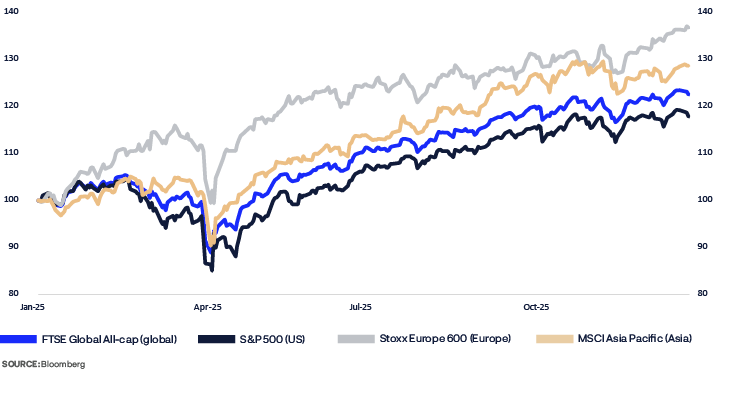
Worse still, if we had correctly predicted everything that happened in 2025, with its constant turmoil and surprises, we would all have believed that the international markets would fall significantly. Instead, they rose steadily throughout 2025, interrupted only by a few brief dips.
Last year was another good year for the Government Pension Fund Global. The fund’s return ended at 15.1 percent, primarily due to a strong upturn in international equity markets. For equity investments, the US technology companies again contributed the most, but financials also had a good year. Despite increases in US tariffs, the total return on fixed income investments was positive.
We can also say that developments in renewable energy infrastructure investments have been positive. After several years of focusing on developing a strong, professional investment department, several major investments were made in 2025, including in Germany’s largest electricity grid.
Over time, we have seen that our real estate investments have not generated the desired returns. In 2025, we therefore felt compelled to change our strategy for these investments and made some organisational changes. I firmly believe that these measures will reverse the negative trend we have seen in recent years.
It is difficult to predict future events with certainty; however, we must nonetheless prepare ourselves as best we can. In 2025, we laid the foundation for the years ahead with a new strategy for the period through 2028.
Our ambition is clear, and it is stated on the first page of the strategic document: Norges Bank Investment Management shall be the best and most respected large investment fund in the world.
How are we going to achieve this? Primarily by continuing the good work all our employees do to leverage the fund’s advantages – its size and long-term horizon – while continuing to be among the leaders in finance in the use of technology, particularly artificial intelligence.
Oslo, 27 February 2026 Nicolai Tangen
CEO of Norges Bank Investment Management
Strong return on the fund’s investments
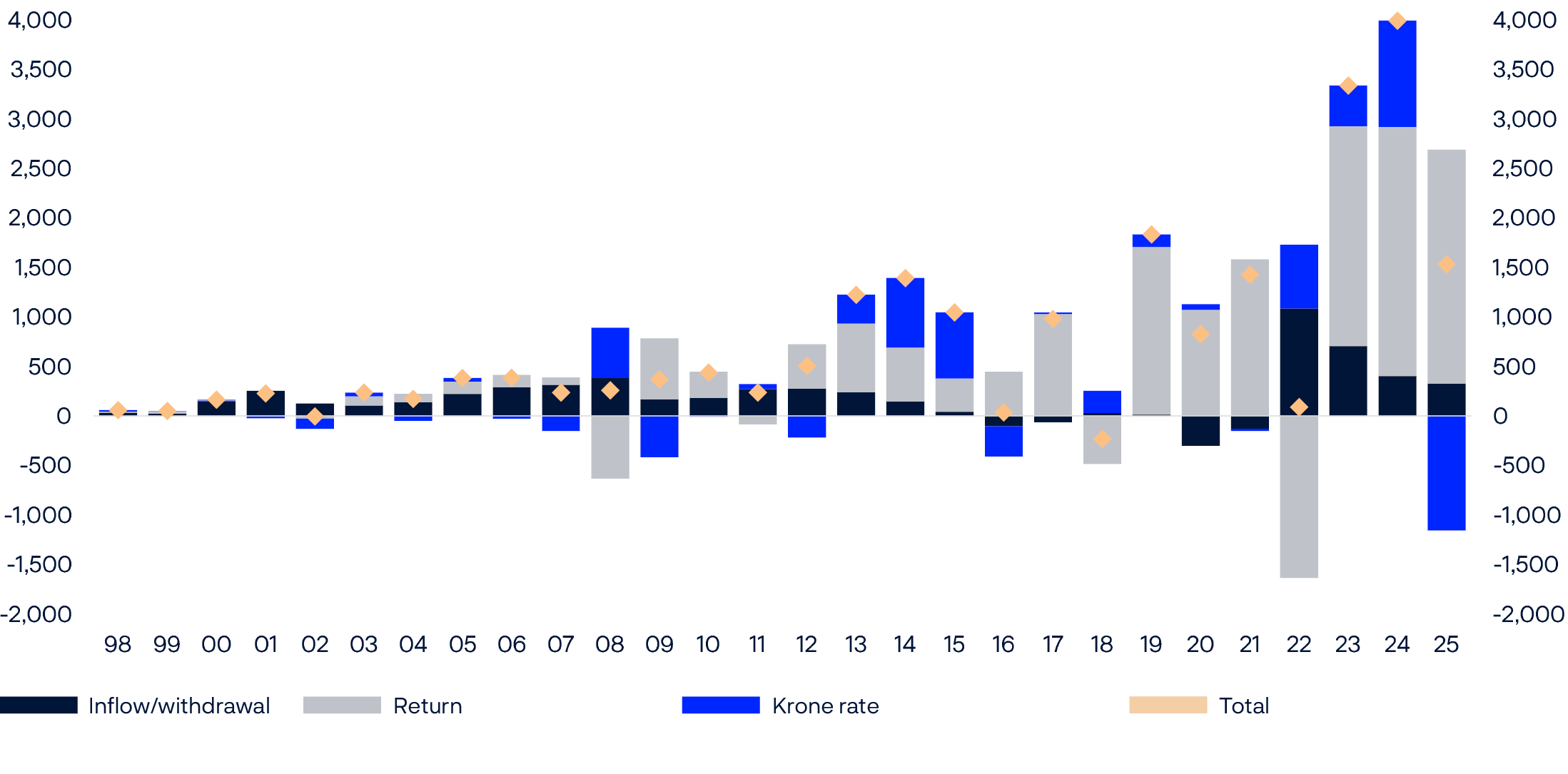
The Government Pension Fund Global returned 15.1 percent, or 2,362 billion kroner, in 2025 in accounting terms. This is the fund’s second-highest return in krone terms.

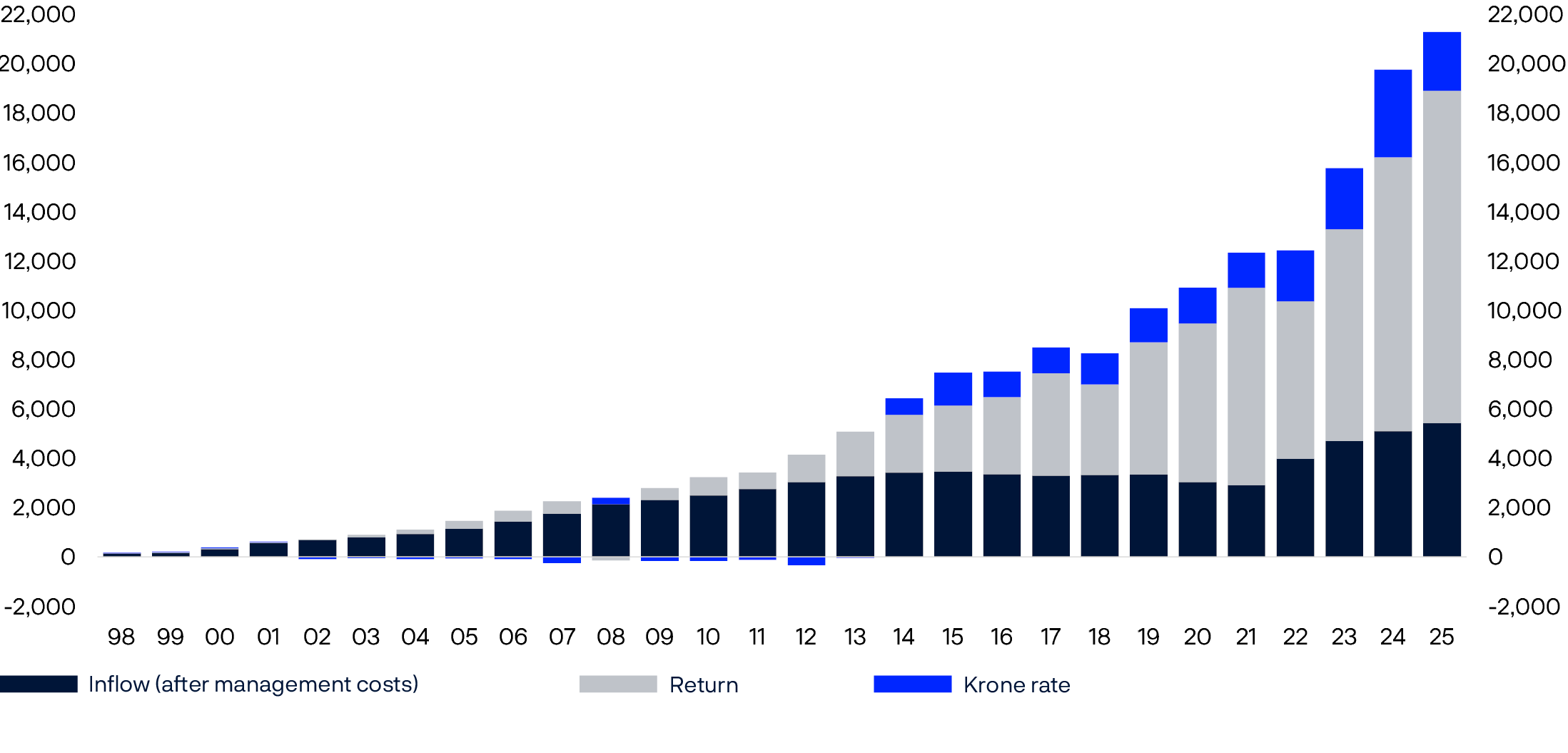
The fund’s value increased by 1,526 billion kroner during the year. Returns and new capital inflows contributed to the growth, while a stronger krone against the currencies the fund is invested in contributed to reducing the value measured in kroner.
The fund’s investments spanned 68 countries and 41 currencies at the end of 2025. Returns are generally measured in international currency – a weighted composition of the currencies in the benchmark index for equities and bonds. This composition is referred to as the fund’s currency basket. At the end of 2025, the currency basket consisted of 34 currencies. Unless otherwise stated, the results in this report is measured in the fund’s currency basket.
TABLE 1 Key figures in billions of kroner.
|
2025 |
2024 |
2023 |
2022 |
2021 |
|
|---|---|---|---|---|---|
|
Market value |
|||||
|
Equity investments |
15,173 |
14,113 |
11,174 |
8,677 |
8,884 |
|
Fixed-income investments |
5,649 |
5,253 |
4,272 |
3,412 |
3,135 |
|
Unlisted real estate investments |
372 |
364 |
301 |
330 |
312 |
|
Unlisted infrastructure investments1 |
91 |
25 |
18 |
15 |
14 |
|
Market value of investment portfolio2 |
21,286 |
19,755 |
15,765 |
12,434 |
12,345 |
|
Deferred tax |
-11 |
-13 |
-8 |
-4 |
-5 |
|
Accrued, not paid, management fees3 |
-8 |
0 |
0 |
0 |
1 |
|
Fund value2 |
21,268 |
19,742 |
15,757 |
12,429 |
12,340 |
|
Inflow of capital |
327 |
409 |
711 |
1,090 |
80 |
|
Withdrawal of capital |
0 |
0 |
0 |
0 |
-199 |
|
Paid management fees4 |
0 |
-7 |
-7 |
-5 |
-10 |
|
Return on fund5 |
2,362 |
2,511 |
2,214 |
-1,637 |
1,580 |
|
Changes due to fluctuations in krone6 |
-1,155 |
1,072 |
409 |
642 |
-25 |
|
Changes in accrued, not paid, management costs |
-7 |
0 |
0 |
0 |
6 |
|
Total change in fund value |
1,526 |
3,985 |
3,327 |
89 |
1,432 |
|
Changes in value since first capital inflow in 1996 |
|||||
|
Total inflow of capital |
6,191 |
5,864 |
5,455 |
4,744 |
3,654 |
|
Total withdrawal of capital3 |
-687 |
-687 |
-687 |
-687 |
-687 |
|
Return on equity investments5 |
11,889 |
9,786 |
7,326 |
5,284 |
6,490 |
|
Return on fixed-income investments5 |
1,494 |
1,252 |
1,192 |
970 |
1,401 |
|
Return on unlisted real estate investments5 |
76 |
67 |
71 |
119 |
120 |
|
Return on unlisted infrastructure investments1, 5 |
10 |
2 |
2 |
2 |
1 |
|
Management fees4 |
-85 |
-77 |
-70 |
-63 |
-58 |
|
Accumulated fluctuations in krone |
2,391 |
3,547 |
2,475 |
2,065 |
1,423 |
|
Accumulated deferred tax6 |
-12 |
-12 |
-8 |
-4 |
-5 |
|
Fund value |
21,268 |
19,742 |
15,757 |
12,429 |
12,340 |
|
Return on fund |
13,457 |
11,095 |
8,584 |
6,370 |
8,007 |
|
Return after management costs |
13,372 |
11,017 |
8,514 |
6,307 |
7,949 |
1 First unlisted infrastructure investment was made in second quarter of 2021.
2 The market value of the investment portfolio is presented before management fee payable/receivable and deferred tax.
3 Total inflow and withdrawal of capital shown in this table is not adjusted for accrued, not paid, management fees.
4 Management fees are described in note 12 in the financial statements.
5 Fund return of 2,362 billion kroner includes the accounting effect of changes in recognised deferred tax. The return on the investment portfolios excludes deferred tax and amounted to 2,361 billion kroner.
6 Does not include the effect of exchange rate fluctuations on deferred tax.
TABLE 2 The fund's ten largest holdings in percent as at 31 December 2025,
by country.
|
Country |
Total |
Equity |
Fixed income |
Unlisted real estate |
Unlisted infrastructure |
|---|---|---|---|---|---|
|
US |
52.9 |
38.8 |
13.4 |
0.74 |
0.00 |
|
Japan |
6.0 |
4.5 |
1.4 |
0.04 |
|
|
UK |
5.5 |
3.5 |
1.6 |
0.41 |
0.03 |
|
Germany |
4.5 |
2.2 |
2.1 |
0.09 |
0.08 |
|
France |
3.4 |
2.0 |
1.1 |
0.30 |
|
|
Canada |
3.3 |
1.8 |
1.6 |
|
|
|
Switzerland |
2.6 |
2.1 |
0.4 |
0.05 |
|
|
China |
2.5 |
2.5 |
|
|
|
|
Netherlands |
2.0 |
1.3 |
0.7 |
0.02 |
0.06 |
|
Taiwan |
1.9 |
1.9 |
|
|
TABLE 3 Return figures in percent.
|
2025 |
2024 |
2023 |
2022 |
2021 |
|
|---|---|---|---|---|---|
|
Returns measured in the fund's currency basket |
|||||
|
Equity investments |
19.29 |
18.19 |
21.25 |
-15.36 |
20.76 |
|
Fixed-income investments |
5.42 |
1.28 |
6.13 |
-12.11 |
-1.93 |
|
Unlisted real estate investments |
4.36 |
-0.57 |
-12.37 |
0.07 |
13.64 |
|
Unlisted infrastructure investments |
18.07 |
-9.81 |
3.68 |
5.12 |
4.15 |
|
Return on fund |
15.11 |
13.09 |
16.14 |
-14.11 |
14.51 |
|
Relative return on fund (percentage points) |
-0.28 |
-0.45 |
-0.18 |
0.87 |
0.75 |
|
Management costs |
0.04 |
0.04 |
0.05 |
0.04 |
0.04 |
|
Return on fund after management costs |
15.07 |
13.04 |
16.09 |
-14.15 |
14.47 |
|
Returns in kroner |
|||||
|
Equity investments |
9.85 |
28.10 |
26.26 |
-9.27 |
20.67 |
|
Fixed-income investments |
-2.92 |
9.77 |
10.51 |
-5.78 |
-2.01 |
|
Unlisted real estate investments |
-3.90 |
7.77 |
-8.75 |
7.27 |
13.55 |
|
Unlisted infrastructure investments |
8.73 |
-2.25 |
7.96 |
12.69 |
7.24 |
|
Return on fund |
6.00 |
22.57 |
20.93 |
-7.93 |
14.42 |
CHART 1 The fund’s investments as at 31 December 2025. Equities, unlisted real estate and infrastructure distributed by country and bonds by currency. In percent.
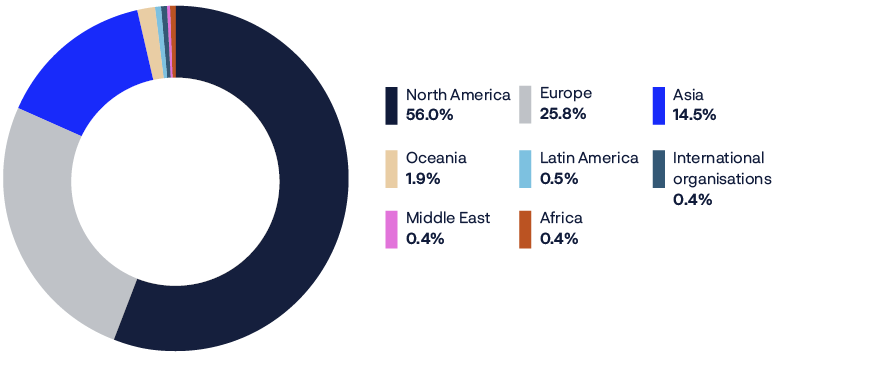
TABLE 4 Return on the fund in percent as at 31 December 2025, measured in various currencies.
|
Since 01.01.1998 Annualised figures |
2025 |
2024 |
2023 |
2022 |
2021 |
|
|---|---|---|---|---|---|---|
|
US dollar |
6.72 |
19.36 |
9.60 |
17.30 |
-17.58 |
11.09 |
|
Euro1 |
6.46 |
5.23 |
16.92 |
13.33 |
-12.18 |
19.53 |
|
British pound |
7.52 |
11.13 |
11.56 |
10.68 |
-7.19 |
12.12 |
|
Norwegian krone |
7.95 |
6.00 |
22.57 |
20.93 |
-7.93 |
14.42 |
|
Currency basket |
6.64 |
15.11 |
13.09 |
16.14 |
-14.11 |
14.51 |
1 Euro was introduced as currency on 01.01.1999. WM/Reuters' euro rate is used as estimate for 31.12.1997.
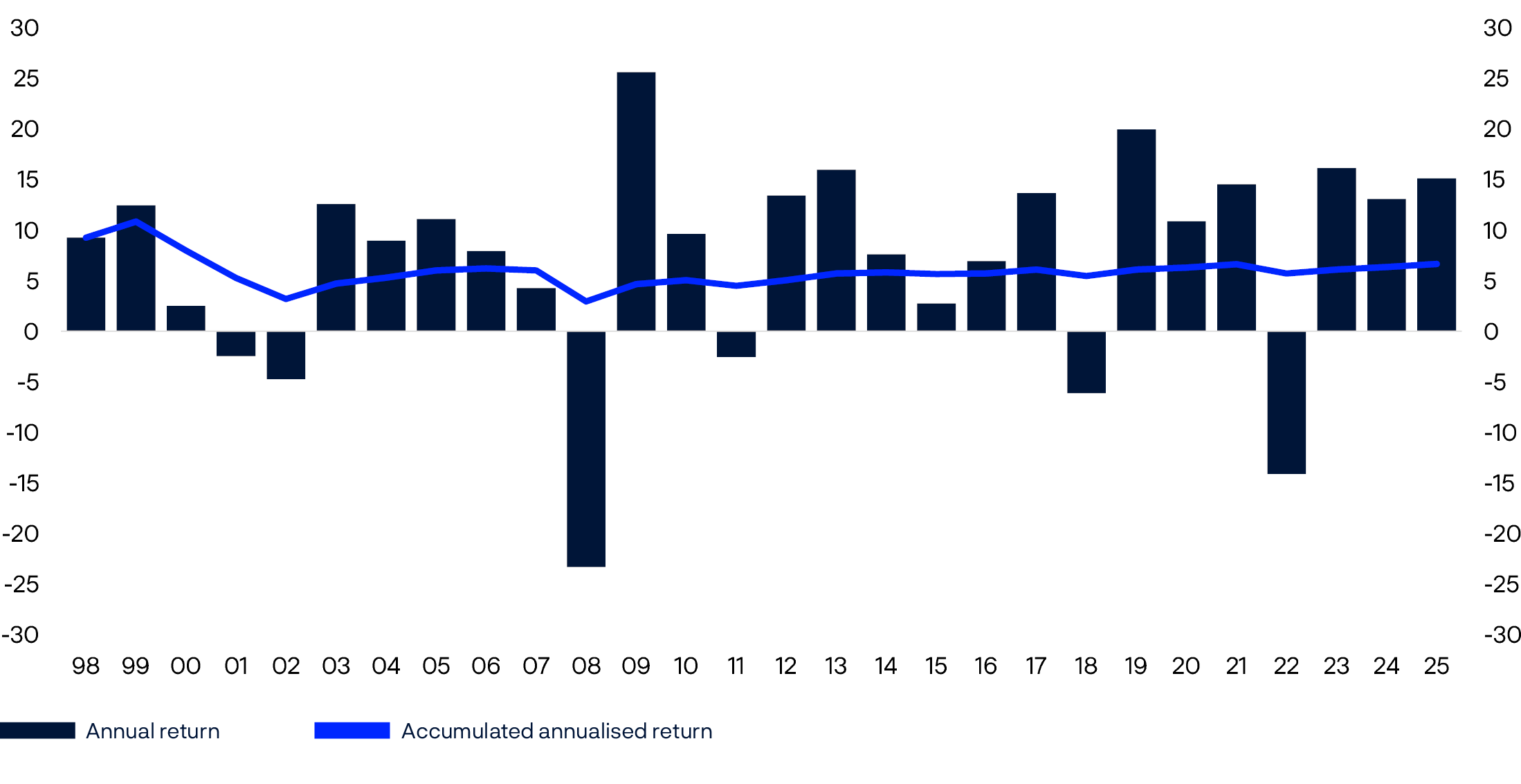
TABLE 5 Historical key figures as at 31 December 2025. Annualised data, measured in the fund's currency basket.
|
Since 01.01.1998 |
Last 15 years |
Last 10 years |
Last |
Last 12 months |
|
|---|---|---|---|---|---|
|
Fund return (percent) |
6.64 |
8.05 |
8.47 |
8.26 |
15.11 |
|
Annual price inflation (percent) |
2.13 |
2.38 |
2.78 |
4.06 |
2.41 |
|
Annual management costs (percent) |
0.07 |
0.05 |
0.05 |
0.04 |
0.04 |
|
Net real return on fund (percent) |
4.34 |
5.49 |
5.49 |
3.99 |
12.36 |
|
The fund's actual standard deviation (percent) |
8.32 |
8.77 |
9.55 |
9.50 |
6.21 |
|
Relative return on fund (percentage points)1 |
0.24 |
0.17 |
0.19 |
0.19 |
-0.28 |
|
The fund's tracking error (percentage points)1 |
0.62 |
0.39 |
0.40 |
0.45 |
0.33 |
|
The fund's information ratio (IR)1.2 |
0.39 |
0.41 |
0.42 |
0.33 |
-0.78 |
1 Based on aggregated equity and fixed-income investments until end of 2016.
2 The fund's information ratio (IR) is the ratio of the fund's average monthly relative return to the fund's tracking error. The IR indicates how much relative return has been achieved per unit of relative risk.
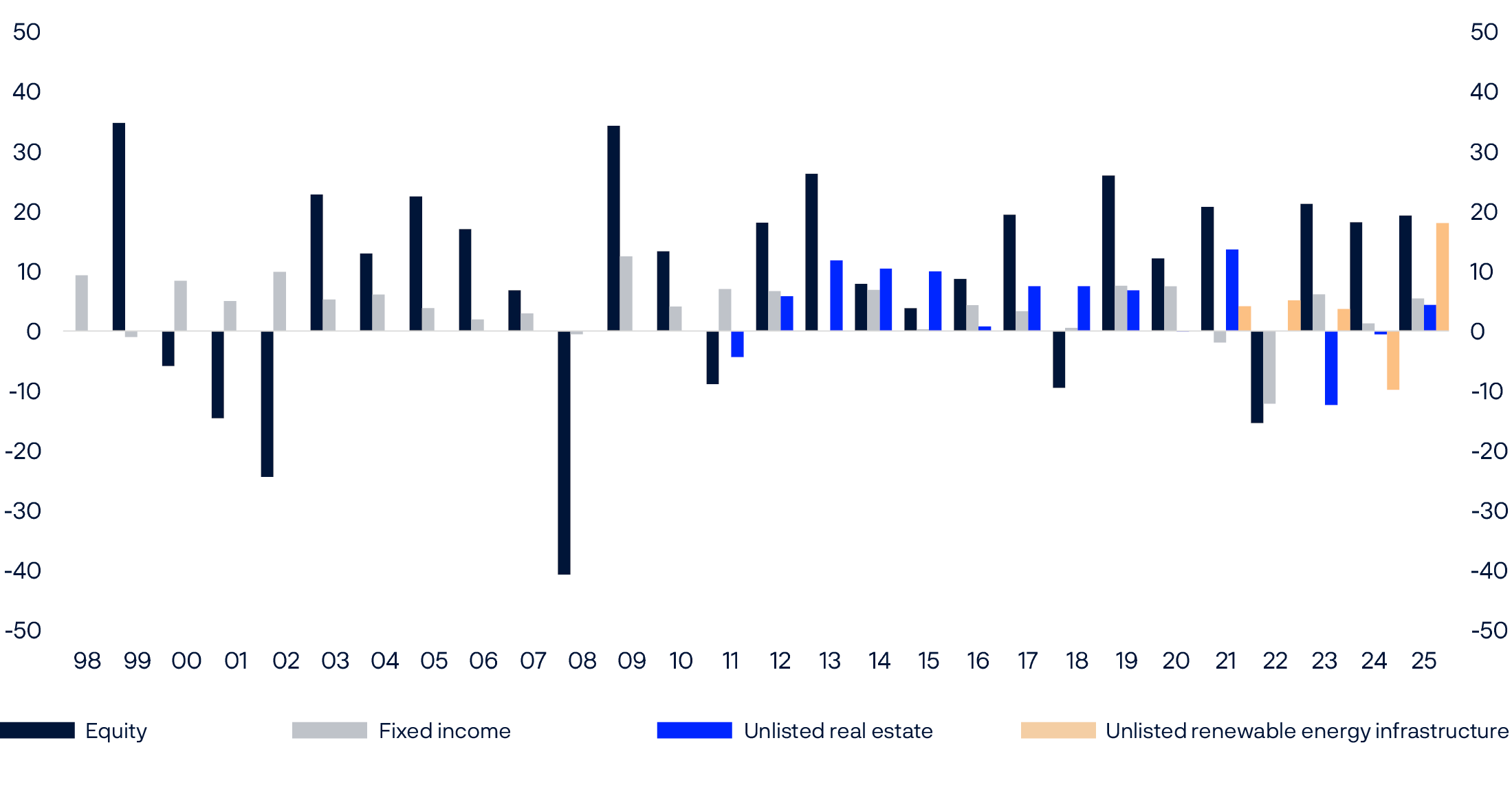
CHART 4 The fund’s market value in billions of kroner, by asset class.
2. Investments

Strong year for equity investments
The fund’s equity investments returned 19.3 percent in 2025. Solid corporate earnings, optimism regarding artificial intelligence and central bank interest rate cuts lifted the equity markets, supported by strong US economic growth. Geopolitical uncertainty and new trade policies caused occasional turmoil; however, the markets quickly recovered and hit new highs.

Our Oslo office.
US technology stocks contributed most to the positive return, driven mainly by the largest technology companies.
Financials perform best
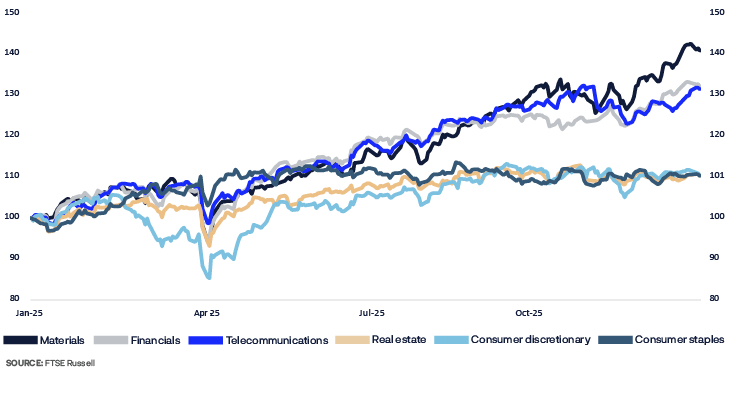
Financials were the best performers in 2025 with a return of 32.4 percent. The valuation of European banks rose as investors became more confident that earnings would remain stable over time. Less regulation and continued high activity in the capital markets also contributed positively to the returns for larger US banks.
Basic materials had the second-highest return at 29.9 percent. Prices for several commodities rose during the year, particularly gold and copper. Increased uncertainty in the global economy and lower interest rates contributed to higher gold prices, while shutdowns at several copper mines pushed copper prices higher.
Telecommunications companies provided the third-highest return at 26.7 percent. The return was largely driven by the South Korean company Samsung Electronics, which operates in several industries. Increased demand for the company’s memory chips, partly driven by the growth of artificial intelligence, contributed to the upturn.
Real estate companies provided the lowest return at 1.6 percent. Developments in the US labour market worried investors. Values fell in parts of the real estate market that are particularly dependent on household consumption, such as residential and self-storage.
Individual investments
At the end of 2025, the fund was invested in 7,201 companies, compared to 8,659 companies in 2024. The decrease was mainly due to changes in the benchmark index for equities.
The investments in the technology companies NVIDIA Corp, Alphabet Inc and Broadcom Inc contributed most to the fund’s return in 2025. The worst-performing investments were in the healthcare companies Novo Nordisk A/S, UnitedHealth Group Inc and the industrial company Fiserv Inc.
The fund participated in a total of 100 initial public offerings. The largest of these were Contemporary Amperex Technology Co, Venture Global Inc and Figma Inc. The offerings in which the fund invested the most were in Medline Inc, Verisure PLC and Alliance Laundry Holdings Inc.
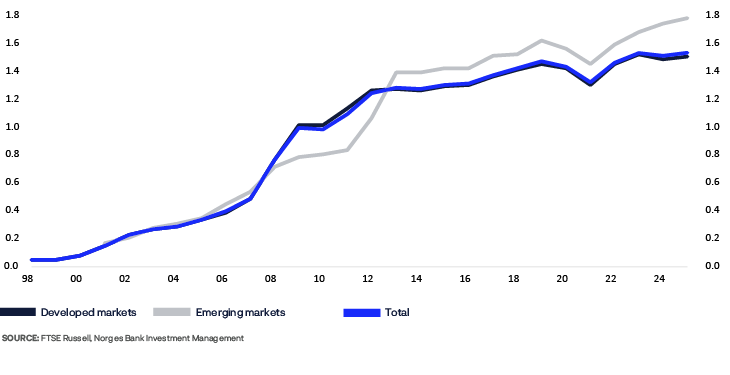
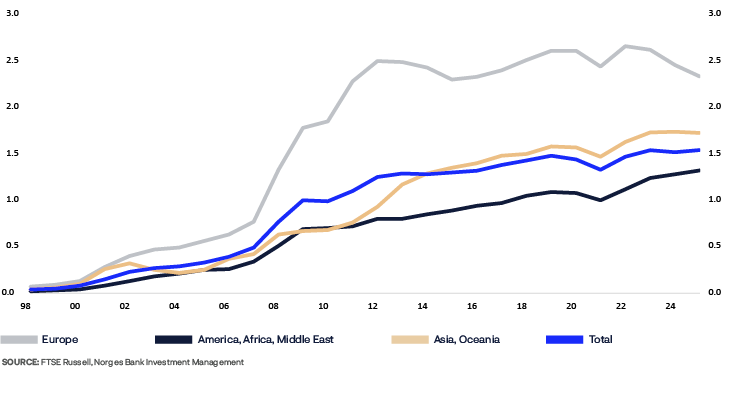
At the end of the year, the fund had holdings of more than 2 percent in 1,000 companies, and more than 5 percent in 68 companies. Its average holding in the world’s listed companies was 1.5 percent.
Excluding listed real estate companies, the fund’s largest single-company percentage holding was in Croda International PLC. The fund’s 9.2 percent stake was valued at 4.7 billion kroner. With the exception of listed real estate companies, the fund may hold no more than 10 percent of the voting shares in a company.
A complete overview of the fund’s equity investments is available
on www.nbim.no.
External managers
Norges Bank Investment Management uses external managers to handle parts of the fund’s equity investments. We use external equity managers in markets and segments where in-depth knowledge of companies, local business conditions and market developments is crucial to making good investment decisions.
At the end of 2025, 1,062 billion kroner, or 5.0 percent of the fund’s assets, was allocated to external managers, up from 994 billion kroner at the start of the year. We awarded 14 new mandates and terminated 17 existing mandates during the year. A total of 111 mandates were managed externally by 103 organisations.
We use external managers for several investment strategies. In emerging markets, we use local equity managers with country-specific mandates. In developed markets in Asia, we use local managers, primarily focused on small-capitalisation companies, while in Europe we use managers with regional mandates. We also employ sector-specific mandates across markets where specialised expertise is particularly valuable. Some managers with European and sector-based mandates are permitted to sell more equities than in the benchmark index they are measured against (long-short mandates). Such positions are nevertheless limited to equities included in the fund's portfolio.
External managers have performed well over time. Since we started investing with external managers in 1998, they have outperformed the market in 25 out of 28 years, after costs. The average annual excess return after costs has been 1.7 percent, increasing the fund’s income by a total of 93 billion kroner after costs.
More information on the use of external managers is available
on www.nbim.no.
TABLE 6 Return on the fund's largest equity investments in 2025 by country.
In percent.
|
Country |
Return in international currency |
Return in local currency |
Share of equity investments1 |
|---|---|---|---|
|
US |
11.9 |
16.0 |
54.7 |
|
Japan |
20.4 |
24.5 |
6.4 |
|
UK |
27.6 |
23.2 |
4.9 |
|
China |
28.5 |
27.6 |
3.6 |
|
Germany |
24.1 |
13.5 |
3.1 |
|
Switzerland |
31.6 |
19.3 |
3.0 |
|
France |
22.5 |
12.0 |
2.8 |
|
Taiwan |
37.3 |
36.5 |
2.7 |
|
Canada |
33.2 |
31.6 |
2.5 |
|
India |
-1.4 |
7.3 |
2.1 |
1 Does not sum up to 100 percent because cash and derivatives are not included.
TABLE 7 Return on the fund's equity investments in 2025. Measured in international currency and sorted by sector. In percent.
|
Sector |
Return |
Share of equity investments1 |
|---|---|---|
|
Technology |
24.1 |
28.5 |
|
Financials |
32.4 |
16.9 |
|
Consumer discretionary |
7.8 |
13.2 |
|
Industrials |
18.0 |
12.7 |
|
Health care |
10.4 |
9.3 |
|
Real estate |
1.6 |
4.2 |
|
Consumer staples |
3.9 |
3.8 |
|
Basic materials |
29.9 |
3.4 |
|
Telecommunications |
26.7 |
2.9 |
|
Energy |
19.2 |
2.8 |
|
Utilities |
21.2 |
2.4 |
1 Does not sum up to 100 percent because cash and derivatives are not included.
Positive return on fixed income
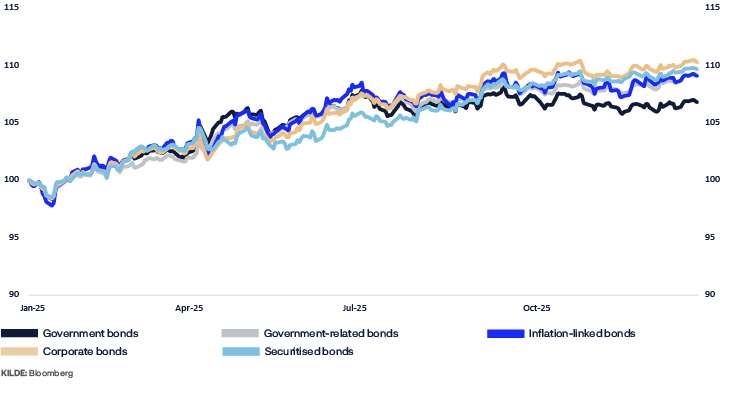
The fund’s fixed income investments returned 5.4 percent in 2025. The fixed income markets were characterised by significant fluctuations throughout the year, particularly in the first half. US tariffs contributed to increased market uncertainty.

Our Oslo office.
The US Federal Reserve held its policy rate steady throughout the first half of 2025. During the second half, the policy rate was lowered three times, by a total of 0.75 percentage point. The European Central Bank continued the interest rate cuts that began in June 2024, lowering its policy rate by a total of 1.0 percentage point in the first half of the year. The policy rate was held steady for the rest of the year.
Positive returns in the eurozone
Government bonds returned 4.1 percent in 2025 and made up 56.4 percent of fixed income investments.
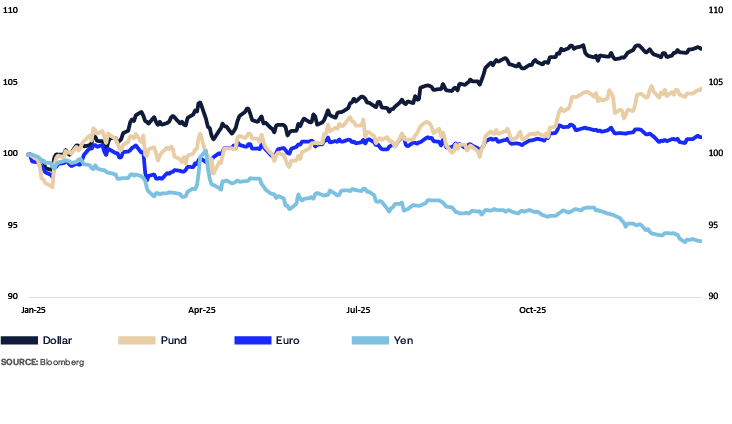
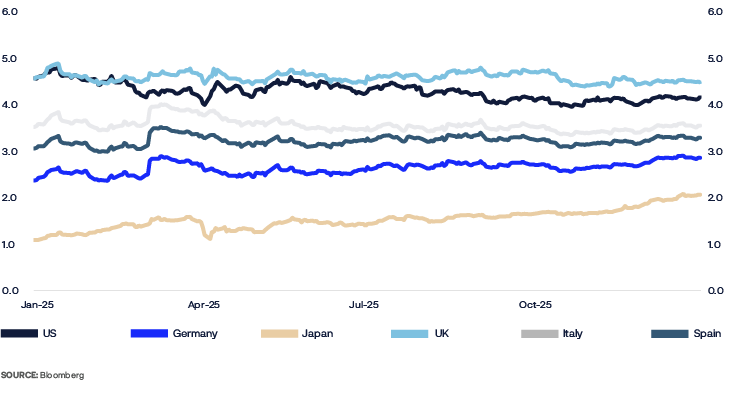
US Treasuries returned 2.9 percent and accounted for 32.5 percent of fixed income investments. The long-term US yields fluctuated significantly throughout the year and ended slightly lower than at the turn of the year. At the same time, a weaker US dollar lowered returns.
Euro-denominated government bonds returned 8.7 percent and accounted for 10.5 percent of fixed income investments. Despite policy rate cuts, long yields rose throughout the year, steepening the yield curve. The return was mainly driven by a stronger euro.
Japanese government bonds returned -8.8 percent and accounted for 4.6 percent of fixed income investments. The Bank of Japan continued to tighten monetary policy, raising its policy rate twice during the year, to 0.75 percent. Inflation remained well above the central bank’s target of 2 percent, and the markets priced in further interest rate hikes going forward.
TABLE 8 Return on the fund's largest bond holdings by currency in 2025. In percent.
|
Currency |
Return in international currency |
Return in local currency |
Share of fixed-income investments |
|---|---|---|---|
|
US dollar |
3.3 |
7.1 |
53.0 |
|
Euro |
10.4 |
1.0 |
26.9 |
|
British pounds |
8.6 |
4.8 |
4.9 |
|
Japanese yen |
-8.5 |
-5.4 |
4.8 |
|
Canadian dollar |
3.9 |
2.7 |
4.5 |
|
Australian dollar |
7.7 |
3.7 |
2.5 |
|
Singapore dollar |
5.6 |
3.2 |
1.7 |
|
Swiss franc |
10.2 |
-0.1 |
1.0 |
|
Swedish kroner |
18.6 |
2.6 |
0.7 |
|
Danish kroner |
8.4 |
-0.8 |
0.5 |
Corporate bonds returned 6.6 percent and accounted for 25.0 percent of fixed income investments. Lower credit premiums, which are the compensation investors demand for holding corporate bonds rather than less risky alternatives, contributed positively to the return.
A complete overview of the fund’s fixed income investments is available on www.nbim.no.
TABLE 9 Return on the fund's fixed-income investments in 2025. Measured in international currency and sorted by sector. In percent.
|
Sector |
Return |
Share of |
|---|---|---|
|
Government bonds2 |
4.1 |
56.4 |
|
Government-related bonds2 |
7.7 |
9.1 |
|
Inflation-linked bonds2 |
4.9 |
6.1 |
|
Corporate bonds |
6.6 |
25.0 |
|
Securitised bonds |
11.7 |
5.8 |
1 Does not sum up to 100 percent because cash and derivatives are not included.
2 Governments may issue different types of bonds, and the fund’s investments in these bonds are grouped accordingly. Bonds issued by a country’s government in the country’s own currency are categorised as government bonds. Bonds issued by a country’s government in another country’s currency are government-related bonds. Inflation-linked bonds issued by governments are grouped with inflation-linked bonds.

Our New York office.
Positive return on real estate investments
The fund’s investments in real estate returned a total of 0.2 percent and accounted for 3.1 percent of the fund at the end of 2025. Unlisted real estate investments returned 4.4 percent, and listed real estate investments -4.0 percent.

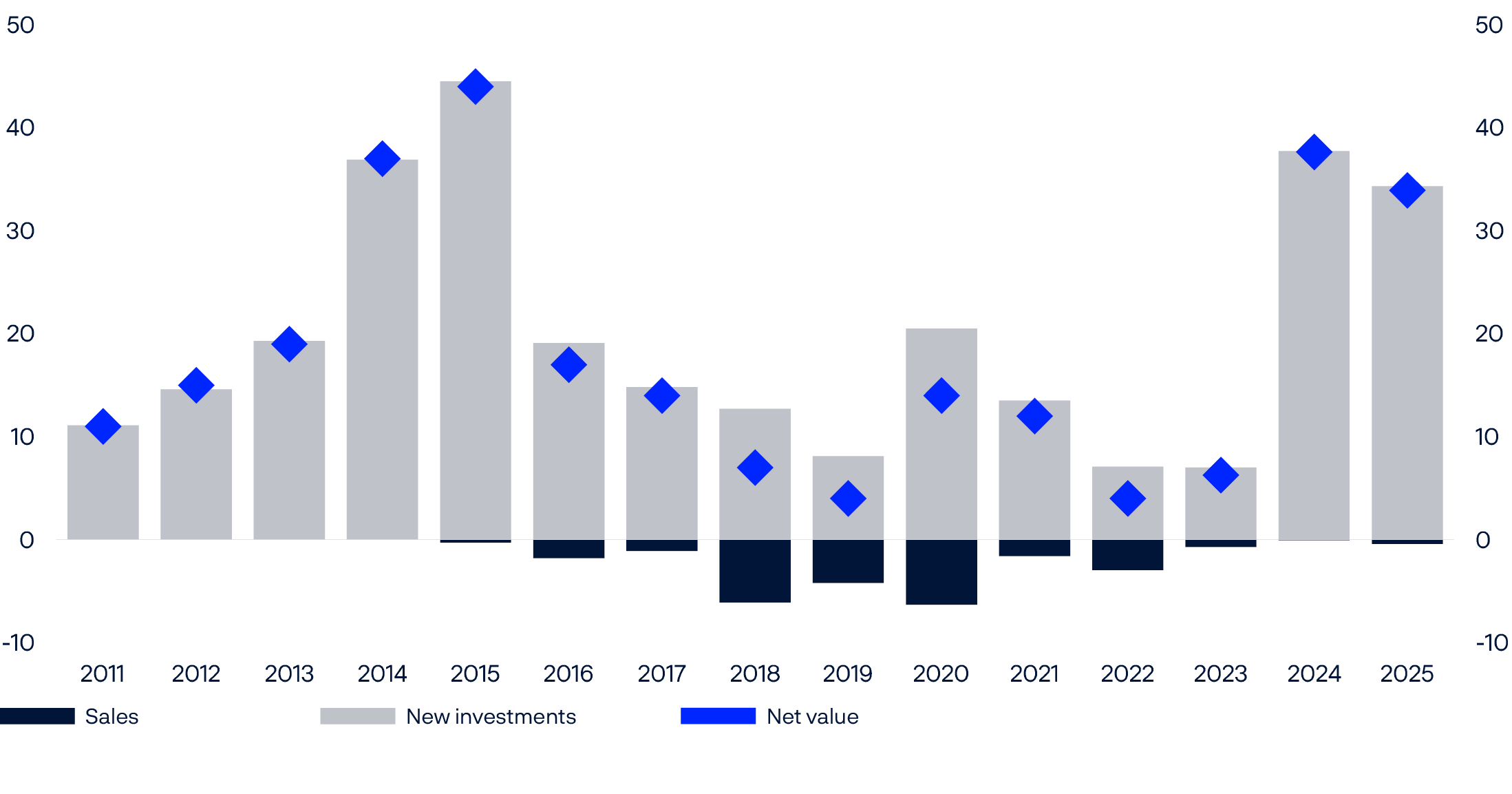
In 2025, we invested in a logistics portfolio in the US, comprising 48 buildings, in a new joint venture with Goodman Group.
The fund’s real estate strategy covers both unlisted and listed real estate investments. Altogether, these investments amounted to 668 billion kroner at the end of the year.
In 2025, we established a new strategy for real estate investments, which will take effect from 2026. The strategy involves a gradual transition from geographical concentration to broader sector diversification across different types of real estate. We will delegate more of the operational management of the properties, and an increasing share of investments will be made through indirect structures, such as funds that invest in real estate. Real estate management was reorganised during the year to support the implementation of the new strategy.
We will continue to gain exposure to the real estate market through both listed and unlisted real estate investments. Our long investment horizon makes us well-suited to handle higher short-term fluctuations in the listed real estate portfolio.
TABLE 10 Value of real estate investments in millions of kroner
as at 31 December 2025.
|
Value1 |
|
|---|---|
|
Unlisted real estate investments |
372,377 |
|
Listed real estate investments |
295,755 |
|
Aggregated real estate investments |
668,132 |
1 Including bank deposits and other receivables
Unlisted real estate
The fund’s investments in unlisted real estate had a market value of 372 billion kroner at the end of 2025, equivalent to 1.7 percent of the fund and 55.7 percent of our total real estate investments.
The fund’s unlisted real estate investments are primarily in office, retail and logistics properties. Office properties account for about half of the portfolio.
Liquidity in the real estate market improved in 2025 compared with previous years. Transaction volumes continued to pick up in most markets. Real estate prices stabilised in traditional sectors such as office and retail, while investors increasingly invested in newer sectors with higher growth, such as data centres.

In 2025, we signed an agreement to acquire a 95 percent interest in an office property located at 1177 Avenue of the America’s in New York City.
Activity was high in 2025, with investments across various sectors. Several of the transactions initiated at the end of 2024 were completed in 2025.
The management mandate from the Ministry of Finance to Norges Bank sets an upper limit for unlisted real estate investments of 7 percent of the fund’s value.
TABLE 11 Return on the fund's unlisted real estate investments in percentage points.
|
Siden 01.04.2011 |
2025 |
2024 |
2023 |
2022 |
2021 |
|
|---|---|---|---|---|---|---|
|
Rental income |
3.8 |
4.0 |
3.9 |
3.4 |
3.1 |
3.4 |
|
Change in value |
0.6 |
-1.1 |
-4.8 |
-16.2 |
-3.0 |
9.8 |
|
Transaction costs |
-0.7 |
-0.2 |
-0.1 |
-0.1 |
-0.1 |
-0.1 |
|
Currency effect |
3.8 |
1.7 |
1.1 |
0.1 |
0.2 |
|
|
Total (percent) |
4.0 |
4.4 |
-0.6 |
-12.4 |
0.1 |
13.6 |
TABLE 12 The fund's largest unlisted real estate investments as at 31 December 2025
|
Retail, office and other by city1 |
Percent |
|---|---|
|
London |
17.0 |
|
Paris |
15.1 |
|
New York |
7.4 |
|
Boston |
7.3 |
|
Berlin |
3.8 |
|
San Francisco |
3.1 |
|
Washington, D.C. |
3.0 |
|
Zurich |
2.9 |
|
Tokyo |
2.0 |
|
Sheffield |
1.9 |
|
Cambridge |
1.4 |
|
Logistics by country |
Percent |
|
US |
22.8 |
|
UK |
4.3 |
|
France |
1.4 |
|
Germany |
1.4 |
|
Netherlands |
1.1 |
|
Spain |
1.1 |
|
Italy |
1.0 |
|
Czech Republic |
0.7 |
|
Other countries |
1.1 |
1 Excluding investments in logistics
TABLE 13 Return on the fund's unlisted real estate investment by market as at 31 December 2025. In percent.
|
Market |
Return |
Share of portfolio |
|---|---|---|
|
Europe |
5.2 |
54.3 |
|
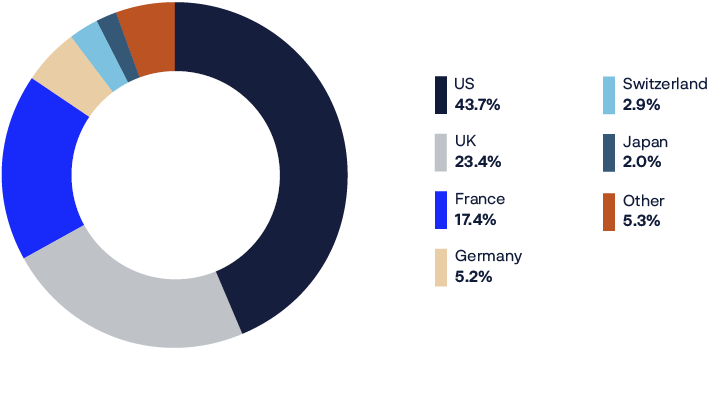
North America |
-0.5 |
43.7 |
|
Japan |
5.3 |
2.0 |
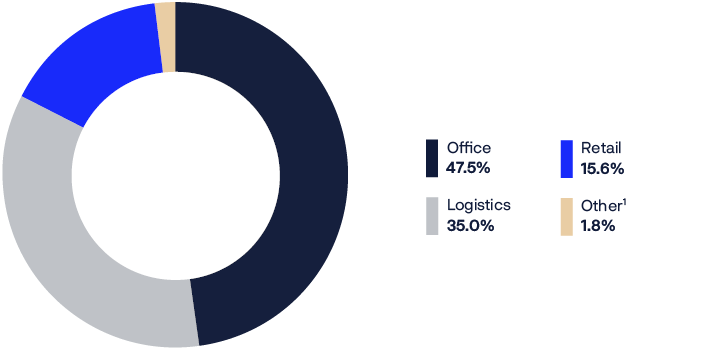
1 Other sectors, bank deposits and other claims.
Listed real estate
Investments in listed real estate made up 1.4 percent of the fund and 44.3 percent of our total real estate investments at the end of 2025, spread across 44 companies.
The largest percentage stakes were 25.2 percent of the listed real estate company Shaftesbury Capital PLC and 14.0 percent of Vonovia SE. The single largest investment was in Welltower Inc at 54.9 billion kroner.
A complete overview of the fund’s real estate investments is available on www.nbim.no.
TABLE 14 Owenship shares in percent for the 10 largest listed investments in real estate management as at 31. desember 2025.
|
Company |
Country |
Ownership share1 |
|---|---|---|
|
Shaftesbury Capital PLC |
UK |
25.2 |
|
Vonovia SE |
Germany |
14.0 |
|
Alexandria Real Estate Equities Inc |
US |
9.5 |
|
Rayonier Inc |
US |
9.4 |
|
Great Portland Estates PLC |
UK |
9.3 |
|
Gecina SA |
France |
9.3 |
|
Equity Residential |
US |
9.2 |
|
Regency Centers Corp |
US |
9.1 |
|
Vornado Realty Trust |
US |
9.1 |
|
Grainger PLC |
UK |
9.0 |
1 The ownership shares also include holdings that are a part of the equity management.
TABLE 15 The fund's largest listed investments in real estate management.
In millions of kroner as at 31 December 2025.
|
Company |
Country |
Holding1 |
|---|---|---|
|
Welltower Inc |
US |
54,872 |
|
Vonovia SE |
Germany |
34,556 |
|
Digital Realty Trust Inc |
US |
34,326 |
|
Equity Residential |
US |
22,158 |
|
Invitation Homes Inc |
US |
14,479 |
|
AvalonBay Communities Inc |
US |
14,014 |
|
Extra Space Storage Inc |
US |
12,245 |
|
Regency Centers Corp |
US |
11,914 |
|
Public Storage |
US |
11,476 |
|
Segro PLC |
UK |
11,003 |
1 The holdings also include holdings that are part of the equity management.
Unlisted renewable energy infrastructure
Investments in unlisted renewable energy infrastructure returned 18.1 percent and accounted for 0.4 percent of the fund at the end of the year.

The return comprises the net income from these assets and the change in their value during the period. Expected future power prices, production volumes and capital costs impact valuations. The value of the assets also falls over time as their expected remaining life decreases.
TABLE 16 Investments in unlisted renewable energy infrastructure in millions of kroner as at 31 December 2025.
|
Value1 |
|
|---|---|
|
Market value (millions of kroner)1 |
91,335 |
|
Return (percent) |
18.1 |
1 Including bank deposits and other receivables.
TABLE 17 Investments in unlisted renewable energy infrastructure in percent as at 31 December 2025.
|
Value1 |
|
|---|---|
|
Wind |
59.9 |
|
Grid |
29.3 |
|
Solar |
10.0 |
|
Other |
0.8 |
In the initial years, we made few investments. We have since increased our investment activity, partly based on assessments of improved return expectations. During the year, asset valuations rose, and new investments were made at attractive prices. Currency effects and net income also contributed positively to the results.
In 2025, we made significant investments to expand and diversify our portfolio in offshore wind and electricity transmission. We acquired ownership interest in two offshore wind projects under construction from RWE – Thor in Denmark and Nordseecluster in Germany. We also invested in TenneT Germany, which operates Germany’s largest electricity grid. This was our first investment in electricity grids. In addition, we committed capital to the Brookfield Global Transition Fund II. This was our first investment in an energy transition fund and gave us exposure beyond our direct investments in Europe. Through these transactions, we have in 2025 tripled the capital we have committed to investments in unlisted renewable energy infrastructure.
The management mandate from the Ministry of Finance sets an upper limit for investments in unlisted renewable energy infrastructure of 2 percent of the fund’s value.
A complete overview of the fund’s investments in unlisted renewable energy infrastructure is available on www.nbim.no.
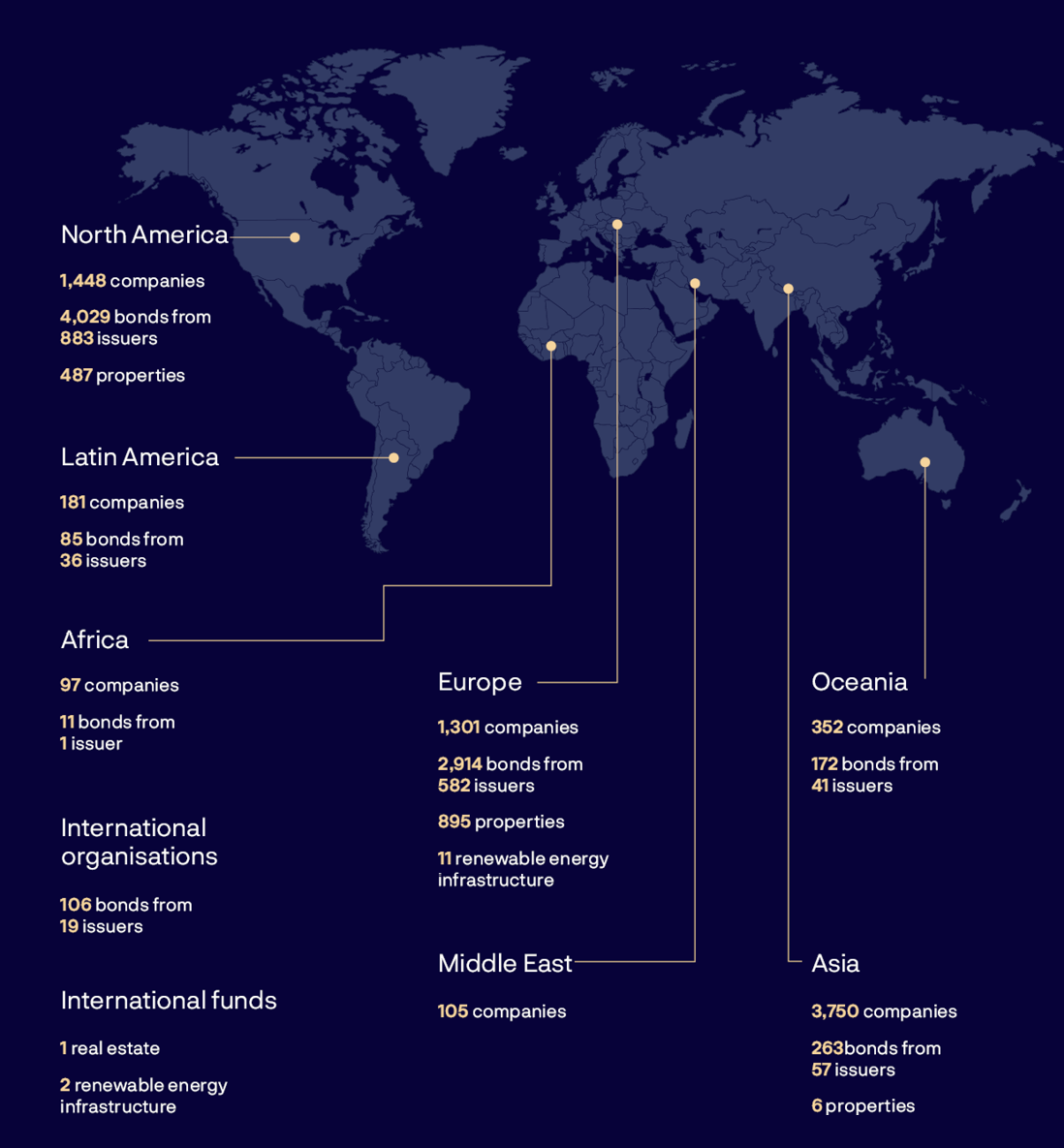
Global investments
Number of investment by asset class
Investment risk
A large, global fund with an equity share of 70 percent will normally experience significant fluctuations in return and market value. This is a risk we must be prepared for in the management of the fund.
Risk management and volatility
The risk in the fund is largely driven by how much of it is invested in equities and how global equity markets develop. Movements in interest rates, credit risk premiums and exchange rates will also affect risk, as will changes in the value of investments in real estate and unlisted renewable energy infrastructure. As an investor, we must continuously monitor and manage these risks. This requires sound risk management, a comprehensive understanding of the markets and robust systems and analyses.
Measuring and managing the fund’s risk exposure is a challenge. To obtain a full picture, we therefore use a variety of risk analyses and calculations. We monitor various aspects including concentration risk, expected fluctuations in markets and fund value, exposure to different risk factors and liquidity risk. We also perform stress tests and hypothetical scenario analyses on the portfolio. Some investment strategies can expose the fund to an increased risk of rare but large and unpredictable losses, and so we closely monitor exposure to strategies of this type.
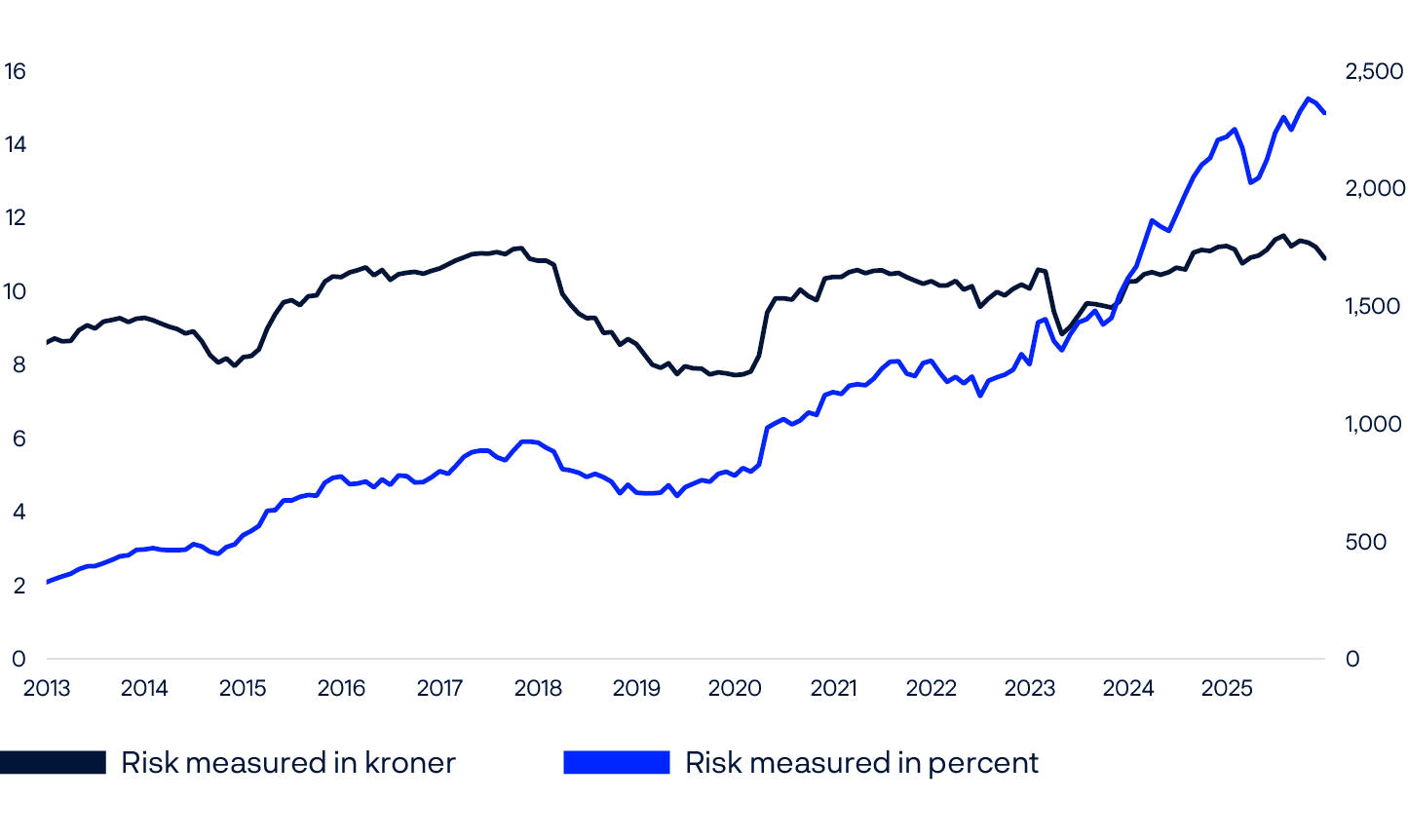
Expected absolute volatility is a measure of how much the return on the fund’s investments can normally be expected to fluctuate in the course of a year. The calculation is based on historical price changes over the last three years. At the end of 2025, the fund’s expected absolute volatility was 10.9 percent, or approximately 2,300 billion kroner. This means that the fund’s value can be expected to fluctuate by more than 2,300 billion kroner in one out of every three years.
Scenario analyses
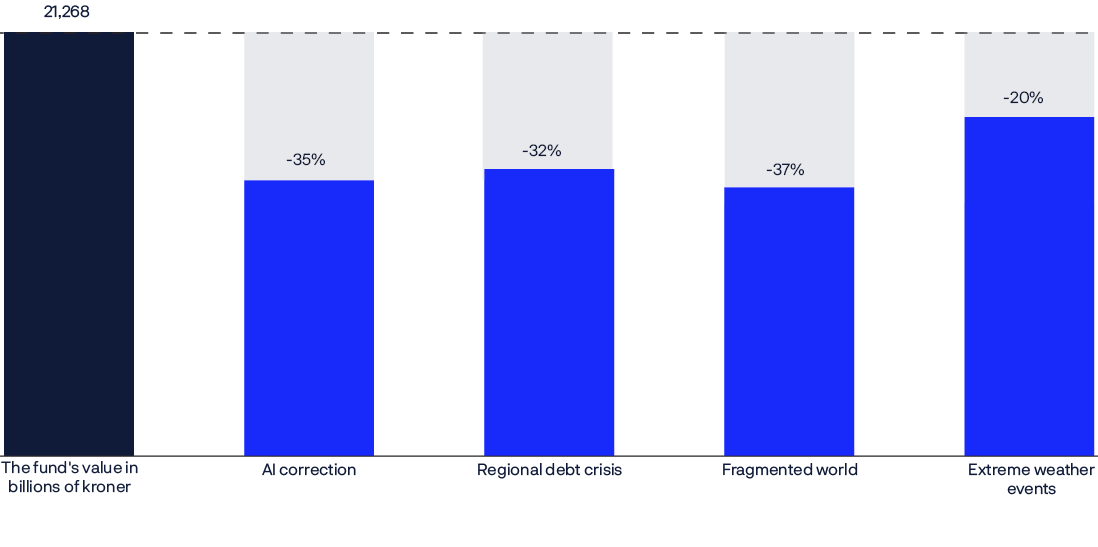
Every year, we publish hypothetical scenario analyses that show how different developments could affect the value of the fund. The scenarios are adjusted from year to year in line with market developments and events that impact the global economy. This year, we analyse how a combination of high valuations of AI-related companies, high debt levels and increased geopolitical tensions could lead to significant reductions in value over time. We also include a climate-related scenario that highlights how global shocks to food supply can impact financial markets, and how environmental events are becoming increasingly economically significant.

This year’s scenarios build on the analyses from 2024. The AI scenario is a continuation of last year’s analysis. In this scenario, we place particular emphasis on increased investments and a high concentration of AI-related stocks in the market. In the fragmented-world scenario, the global economy fragments into several blocs. This has major consequences for economic growth and risk premiums. In the regional debt crisis scenario, we model a loss of investor confidence, where government bonds are no longer perceived as the safest investments. In the climate scenario, extreme weather events trigger crop failures across several major food-producing regions simultaneously. This leads to inflation and lower growth.
AI correction: Investments related to artificial intelligence have increased significantly over the past year. Market concentration has increased, and a limited number of AI-related companies account for a large share of investment. If these investments do not yield the expected productivity gains, this could trigger a sharp correction in the stock market and weaker growth expectations.
Fragmented world: The world fragments into multiple economic blocs. A more challenging geopolitical climate leads to extensive tariff barriers and widespread countermeasures. At the same time, regulations and restrictions on foreign investments increase. Increased uncertainty and decreased economic cooperation result in slower global growth, higher risk premiums and increased inflation.
Regional debt crisis: Investors’ confidence that government bonds will remain the safest investment wanes. This leads to changes in the demand for government bonds. The value of both equities and bonds falls in the affected region as capital is moved to other regions.
Extreme weather events: Extreme weather events cause crop failures in two major food-producing regions simultaneously. This triggers global food supply shocks and sharp price increases. Disruptions in supply chains, exacerbated by extreme weather, contribute to pushing food prices even higher. The crisis spreads throughout the global economy as markets anticipate higher inflation and slower growth.
We have analysed how these scenarios might affect the fund’s value, calculating potential losses in the short to medium term. Losses in equity markets are significant across all scenarios, while the effect on the fixed-income market varies. The fragmented-world scenario produces the heaviest losses, with a 37 percent decline in the fund’s value.
A full report on stress testing is available on www.nbim.no.
The fund’s relative return
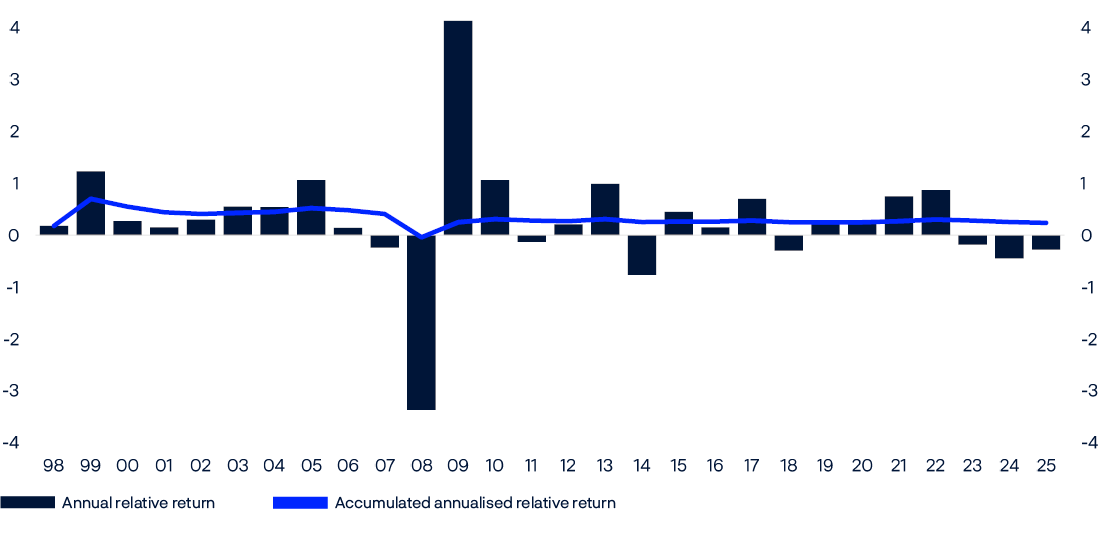
We aim to leverage the fund’s long-term investment horizon and considerable size to generate a high return with acceptable risk. In 2025, the fund’s return was -0.28 percentage point lower than the return on the benchmark index.
The return on the fund’s investments is measured against the benchmark index set by the Ministry of Finance, which is made up of global equity and bond indices. The equity portion of the benchmark index is based on the FTSE Global All Cap Index and comprised 7,397 listed companies at the end of 2025. The bond portion of the benchmark index is based on indices from Bloomberg and comprised 19,193 bonds from 2,543 issuers.
At the end of the year, the fund was invested in 7,201 listed companies and 7,600 bonds from 1,618 issuers. The fund also had 1,389 investments in unlisted real estate and 13 investments in unlisted renewable energy infrastructure. To achieve the objective of the highest possible return after costs, we delegate responsibility for individual investments to our portfolio managers via individual investment mandates. The mandates are awarded within the fund’s three main strategies: market exposure, security selection and fund allocation. This approach gives us in-depth knowledge of selected market segments and companies, and makes us a better responsible investor. At the end of the year, we had 281 individual equity and bond mandates, of which 111 were assigned to external equity managers. The mandate structure provides effective management and control over risk, return, costs and incentives for each investment mandate.

Our Oslo office.
The fund’s investments in real estate and unlisted renewable energy infrastructure are not included in the benchmark index set by the Ministry. These investments are funded by selling equities and bonds from the benchmark index. Which equities and bonds are sold depends on the country and currency in which the investment is made. When we measure the relative return on equity and bond management, we use the benchmark index adjusted for the equities and bonds we have sold to fund investments in real estate and unlisted renewable energy infrastructure. The return on real estate and infrastructure investments is measured against the equities and bonds sold to fund them.
In 2025, the fund’s return was -0.28 percentage point lower than the return on the fund’s benchmark index. However, the fund has outperformed the benchmark index by 0.24 percentage point annually since 1998, 0.19 percentage point over the past decade, and 0.19 percentage point over the past five years.
TABLE 18 Relative return in 2025. .
|
Percentage points |
|
|---|---|
|
Fund |
-0.28 |
|
Equity investments |
-0.47 |
|
Fixed-income investments |
0.45 |
CHART 20 Annual relative return and accumulated annualised relative return in percentage points. Calculations based on aggregated equity and fixed-income investments until end of 2016.
Equity management
Equity management is measured against the equity portion of the benchmark index, adjusted for sales of equities to fund investments in real estate and renewable energy infrastructure. The return on equity management was 0.09 percentage point higher than the adjusted benchmark index for equities in 2025, contributing 0.07 percentage point to the fund’s total relative return. Investments in the technology and finance sectors made the most positive contribution to the results. Both sectors were characterised by significant fluctuations throughout the year. Investments in health and materials made the largest negative contribution, particularly due to certain investments in the US. Among the countries in which the fund invested, equities in South Korea, the UK and Taiwan contributed most positively, while investments in Germany and the US contributed most negatively.
Since 1999, the annual relative return on equity management has been 0.44 percentage point higher than the benchmark index. Over the last decade, it has been 0.31 percentage point higher, and over the last five years, 0.33 percentage point higher.
Fixed income management
Fixed-income management is measured against the bond portion of the benchmark index, adjusted for sales of bonds to fund investments in real estate and renewable energy infrastructure. The return on fixed income management was 0.54 percentage point higher than this adjusted benchmark index in 2025, contributing 0.16 percentage point to the fund’s relative return. The management of government bonds contributed positively, partly due to different positioning along the yield curve and a higher running yield in the portfolio than in the benchmark index. The fund also made investments in government bonds in emerging markets, which contributed positively to the relative return. Investments in corporate bonds contributed marginally to the results.
Since 1998, the annual relative return on fixed income management has been 0.25 percentage point higher than the benchmark index. Over the last decade, it has been 0.45 percentage point higher, and over the last five years, 0.60 percentage point higher.
Real estate
The fund’s real estate strategy covers both unlisted and listed real estate investments. The relative return from real estate management is measured as the difference between the return on real estate investments and the returns on the bonds and equities sold to fund them. Real estate management contributed -0.46 percentage point to the fund’s relative return in 2025. Listed real estate investments made a negative contribution of -0.31 percentage point. The portfolio underperformed the broad listed real estate market, with the largest negative contributions coming from investments in listed residential property in Europe and the US, and in US data centres. Unlisted investments made a negative contribution of -0.15 percentage point. Unlisted real estate investments returned 4.4 percent, with US office buildings performing poorly, while European investments returned 5.2 percent.
We report unlisted real estate returns quarterly and annually, but it is important to assess the real estate strategy over a longer period. From the fund’s first unlisted real estate investment in 2011 through to the end of 2016, the annual return on unlisted real estate investments was 5.98 percent. During this period, real estate investments were funded through bond sales. Bond investments yielded an annual return of 4.37 percent during the same period. From 2017 to 2025, the annual return on unlisted real estate investments was 2.75 percent. During this period, investments in unlisted real estate were funded through the sale of both equities and bonds. These investments had an annual return of 4.89 percent during the same period.
More information about the relative return of the real estate management is available on the fund’s website.
Unlisted renewable energy infrastructure
The fund’s strategy is to build a diversified portfolio within renewable energy infrastructure across multiple technologies and geographical areas. We invest directly in wind and solar power, and will increase our investments in distribution and storage as opportunities arise. We will gradually increase our investments through indirect structures, such as funds that invest in renewable energy projects. The relative return on investments in renewable energy infrastructure is measured as the difference between the return on these investments and the return on the bonds and equities sold to fund them. In 2025, investments in renewable energy infrastructure returned 18.1 percent. Offshore wind projects under construction contributed most positively. Since its inception in 2021, the strategy has produced an annual return of 4.2 percent.
TABLE 19 Relative return on the fund's asset management in percentage points.
|
Year |
Fund1 |
Equity management2 |
Fixed-income |
Real estate |
Infrastructure |
|---|---|---|---|---|---|
|
2025 |
-0.28 |
0.09 |
0.54 |
-12.26 |
8.93 |
|
2024 |
-0.45 |
-0.20 |
0.18 |
-6.72 |
-7.35 |
|
2023 |
-0.18 |
0.38 |
0.51 |
-10.51 |
-5.67 |
|
2022 |
0.87 |
0.52 |
1.68 |
0.22 |
25.09 |
|
20213 |
0.75 |
0.78 |
-0.04 |
7.36 |
8.04 |
|
2020 |
0.27 |
0.98 |
0.76 |
-13.81 |
|
|
2019 |
0.23 |
0.51 |
0.11 |
-3.89 |
|
|
2018 |
-0.30 |
-0.69 |
-0.01 |
5.49 |
|
|
2017 |
0.70 |
0.79 |
0.39 |
0.70 |
|
|
2016 |
0.15 |
0.15 |
0.16 |
||
|
2015 |
0.45 |
0.83 |
-0.24 |
||
|
2014 |
-0.77 |
-0.82 |
-0.70 |
||
|
2013 |
0.99 |
1.28 |
0.25 |
||
|
2012 |
0.21 |
0.52 |
-0.29 |
||
|
2011 |
-0.13 |
-0.48 |
0.52 |
||
|
2010 |
1.06 |
0.73 |
1.53 |
||
|
2009 |
4.13 |
1.86 |
7.36 |
||
|
2008 |
-3.37 |
-1.15 |
-6.60 |
||
|
2007 |
-0.24 |
1.15 |
-1.29 |
||
|
2006 |
0.14 |
-0.09 |
0.25 |
||
|
2005 |
1.06 |
2.16 |
0.36 |
||
|
2004 |
0.54 |
0.79 |
0.37 |
||
|
2003 |
0.55 |
0.51 |
0.48 |
||
|
2002 |
0.30 |
0.07 |
0.49 |
||
|
2001 |
0.15 |
0.06 |
0.08 |
||
|
2000 |
0.27 |
0.49 |
0.07 |
||
|
1999 |
1.23 |
3.49 |
0.01 |
||
|
1998 |
0.18 |
0.21 |
1 Includes real estate management from 2017. The fund's relative return prior to 2017 is calculated on equity and fixed-income management only.
2 Measured against actual funding from 2017. The relative return on equity and fixed-income management before 2017 is measured against the respective Ministry of Finance asset class indices.
3 The relative return on the fund and fixed-income management for 2021 have been adjusted by 0.01 percentage point as a result of an update of the return on the benchmark index.
Investment strategies
We employ a range of investment strategies in our management of the fund. These are grouped into three main strategies: market exposure, security selection and fund allocation. The strategies cut across equities, fixed income, real estate and infrastructure management.
The market exposure strategy consists of positioning and securities lending. Overall, these strategies contributed 0.22 percentage point to the fund’s relative return in 2025. Positioning is about implementing market exposures in ways that increase investment returns and reduce transaction costs. This is done partly by exploiting relative valuations across instruments and issuers, and the pricing effects of company and market events. This includes positioning based on interest rate levels, inflation, exchange rates and interest rate differentials between countries. Equity positioning contributed 0.08 percentage point. Investments in US and Chinese equities made the largest contribution. Fixed-income positioning contributed 0.10 percentage point, with positive contributions across all regions, led by Europe. Securities lending contributed 0.04 percentage point to the fund’s relative return, most of which came from lending out equities.
The strategy for security selection is based on a thorough analysis of the fund’s largest investments. The objective is to improve returns and enhance our role as a responsible and active owner. The strategy contributed -0.01 percentage point to the fund’s relative return in 2025. Internal stock selection contributed -0.03 percentage point. North American equities made the largest negative contribution to the results, particularly due to investments in health and telecommunications. Investments in financials made the most positive contribution. External stock selection contributed 0.02 percentage point. Investments in China boosted the results, while investments in the Middle East and emerging markets in Europe had a negative impact. When it comes to fixed-income management, security selection focuses on corporate bonds. The strategy marginally improved the fund’s relative return in 2025.
The fund allocation strategy comprises various strategies that aim to improve the trade-off between return and risk in the fund over time. The strategy contributed negatively by -0.49 percentage point to the fund’s relative return in 2025.
Investments in real estate and renewable energy infrastructure are reported under fund allocation. Real estate investments contributed -0.46 percentage point to the fund’s relative return, while investments in renewable energy infrastructure contributed 0.04 percentage point.
Throughout 2025, the fund was underweight in equities and overweight in bonds relative to the reference index, especially in emerging markets. We also had a lower weighting for the largest US technology companies in the fund allocation strategy. Overall, such fund allocation decisions contributed -0.07 percentage point to the fund’s relative return in 2025.
TABLE 20 Contributions to the fund's relative return from investment strategies in 2025. In percentage points.
|
Equity management |
Fixed-income management |
Real assets management |
Allocation |
Total |
|
|---|---|---|---|---|---|
|
Market exposure |
0.12 |
0.10 |
0.00 |
0.22 |
|
|
Asset positioning |
0.08 |
0.10 |
0.00 |
0.18 |
|
|
Securities lending |
0.03 |
0.00 |
0.04 |
||
|
Security selection |
-0.02 |
0.00 |
-0.01 |
||
|
Internal security selection |
-0.03 |
0.00 |
-0.03 |
||
|
External security selection |
0.02 |
0.02 |
|||
|
Fund allocation |
-0.04 |
0.05 |
-0.42 |
-0.08 |
-0.49 |
|
Real estate |
-0.46 |
-0.46 |
|||
|
Unlisted real estate |
-0.15 |
-0.15 |
|||
|
Listed real estate |
-0.31 |
-0.31 |
|||
|
Renewable energy infrastructure |
0.04 |
0.04 |
|||
|
Allocation |
-0.04 |
0.05 |
0.00 |
-0.08 |
-0.07 |
|
Totalt |
0.07 |
0.16 |
-0.42 |
-0.08 |
-0.28 |
TABLE 21 Contributions to the fund's relative return from investment strategies annualised for 2013-2025. In percentage points.
|
Equity management |
Fixed-income management |
Real assets management |
Allocation |
Total |
|
|---|---|---|---|---|---|
|
Market exposure1 |
0.10 |
0.07 |
0.00 |
0.18 |
|
|
Asset positioning |
0.06 |
0.07 |
0.00 |
0.13 |
|
|
Securities lending |
0.04 |
0.01 |
0.05 |
||
|
Security selection |
0.13 |
0.01 |
0.14 |
||
|
Internal security selection |
0.04 |
0.01 |
0.06 |
||
|
External security selection |
0.09 |
0.09 |
|||
|
Fund allocation |
-0.01 |
0.00 |
-0.10 |
-0.01 |
-0.12 |
|
Real estate |
-0.10 |
-0.10 |
|||
|
Unlisted real estate |
-0.02 |
-0.02 |
|||
|
Listed real estate |
-0.08 |
-0.08 |
|||
|
Renewable energy infrastructure |
0.00 |
0.00 |
|||
|
Allocation2,3 |
-0.01 |
0.00 |
0.00 |
-0.01 |
-0.03 |
|
Total |
0.22 |
0.08 |
-0.10 |
-0.01 |
0.19 |
1 Market exposure includes -0.01 percentage point from the systematic factors strategy which was ended in the second quarter of 2020.
2 Regulations for Environmental related mandates for equities and fixed income were changed by the Ministry of Finance during 2022. The historic performance impact from Environmental related mandates until 2022 is included under Allocations.
3 Specific allocation to Systematic factors was ended in 2022. The historic performance impact from Systematic factors is included under Allocations.
Risk relative to the benchmark index
The fund is invested differently to its benchmark index along various dimensions, including asset classes, currencies, sectors, countries, regions, individual stocks and individual bond issuers.
Real estate investments constituted one of the fund’s largest relative exposures. The fund had 372 billion kroner invested in unlisted real estate and 296 billion kroner in listed real estate. At the end of 2025, the equity portfolio had a higher weighting in volatile companies and companies with lower current dividends than the benchmark index. The fixed income portfolio had greater exposure to emerging-market and government-related bonds than the benchmark index. The fund also had an underweight in equities versus bonds.
The Ministry of Finance and the Executive Board of Norges Bank have set limits on how much the fund’s investments can deviate from the benchmark index.
One of the limits concerns expected relative volatility, or tracking error, which puts a ceiling on how much the return on the fund’s investments can be expected to deviate from the return on the benchmark index. All of the fund’s investments are included in the calculation of expected relative volatility in accordance with the mandate and are measured against the benchmark index, which consists of global equity and bond indices. The fund is to aim for expected relative volatility of no more than 1.25 percentage points. At the end of 2025, the fund’s expected relative volatility was 0.37 percentage point, down from 0.44 percentage point the previous year. The decline is mainly due to reduced expected relative volatility in equity investments.
Real estate investments made the largest contribution to expected relative volatility in 2025. These investments are expected to have a different return profile than equities and bonds, both in the short and long term. This has an impact on the calculation of the fund’s expected relative volatility. As daily pricing is not available for our unlisted real estate investments, we use a model from MSCI to calculate the relative risk for these investments.
The Executive Board of Norges Bank has also set a limit for the expected shortfall between the return on the fund and return on the benchmark index in extreme situations. This limit, known as extreme deviation risk, is set at 3.75 percentage points. At the end of the year, it was 1.01 percentage points, down from 1.18 percentage points the previous year.
More information on risk and exposure for the fund is available on the fund’s website.
TABLE 22 Key figures for the fund's risk and exposure.
|
Limits set by the Ministry of Finance |
31.12.2025 |
|
|---|---|---|
|
Allocation |
Equity portfolio 60–80 percent of fund's market value1 |
71.2 |
|
Unlisted real estate no more than 7 percent of the fund's market value |
1.8 |
|
|
Fixed-income portfolio 20–40 percent of fund's market value1 |
26.6 |
|
|
Unlisted renewable energy infrastructure no more than 2 percent of the fund's market value |
0.4 |
|
|
Market risk |
1.25 percentage points expected relative volatility for the fund's investments |
0.4 |
|
Credit risk |
Maximum 5 percent of fixed-income investments may be rated below BBB- |
1.0 |
|
Emerging markets |
Maximum 5 percent of fixed-income investments may be in emerging markets |
2.5 |
|
Ownership |
Maximum 10 percent of voting shares in a listed company in the equity portfolio2 |
9.7 |
1 Derivatives are represented with their underlying economic exposure.
2 Investments in listed and unlisted real estate companies are exempt from this restriction.
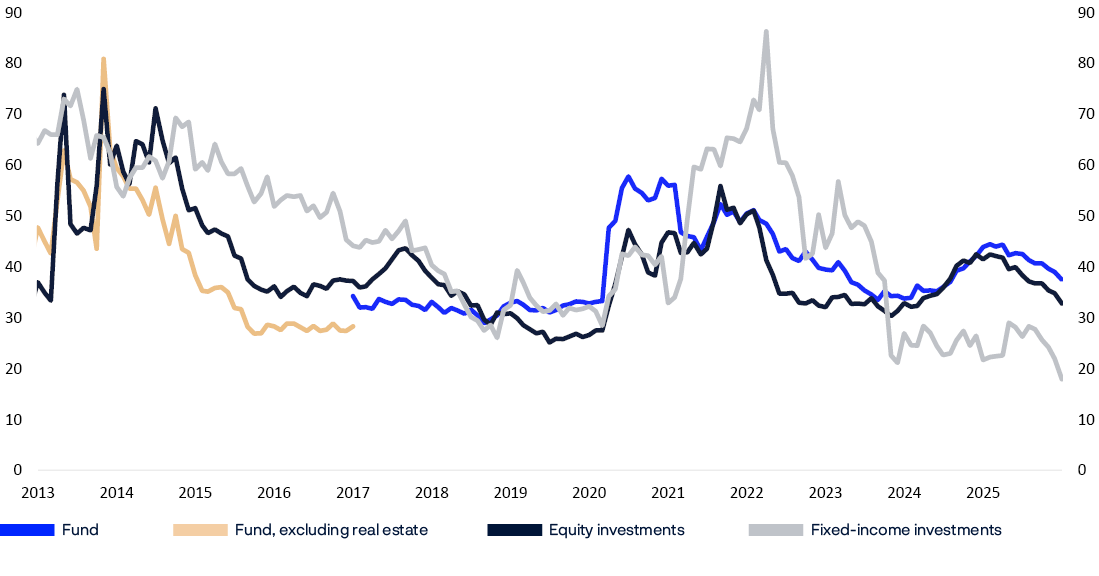
TABLE 23 Expected relative volatility of investment strategies as at 31 December 2025. Each strategy measured stand-alone with the other strategies positioned in line with the benchmarks. All numbers measured at fund level in basis points.
|
Equity management |
Fixed-income management |
Real assets management |
Allocation |
Total |
|
|---|---|---|---|---|---|
|
Market exposure |
4 |
2 |
- |
4 |
|
|
Asset positioning |
4 |
2 |
- |
4 |
|
|
Security selection |
16 |
1 |
16 |
||
|
Internal security selection |
10 |
1 |
10 |
||
|
External security selection |
10 |
10 |
|||
|
Fund allocation |
8 |
3 |
32 |
18 |
39 |
|
Real estate |
31 |
31 |
|||
|
Unlisted real estate |
19 |
19 |
|||
|
Listed real estate |
18 |
18 |
|||
|
Renewable energy infrastructure |
4 |
4 |
|||
|
Allocation |
8 |
3 |
18 |
21 |
|
|
Total |
16 |
4 |
32 |
18 |
37 |

Responsible investment report
Responsible investment of the Government Pension Fund is presented in a separate report, which is available on the fund’s website www.nbim.no.

3. Organisation

Our New York office.
Management organisation
Our employees are the heart of the organisation
Our employees are our most important resource. We shall retain, develop and attract the top talent. We aim to ensure that everyone can work efficiently and innovatively and has the skills to take on new challenges.

Our Singapore office.
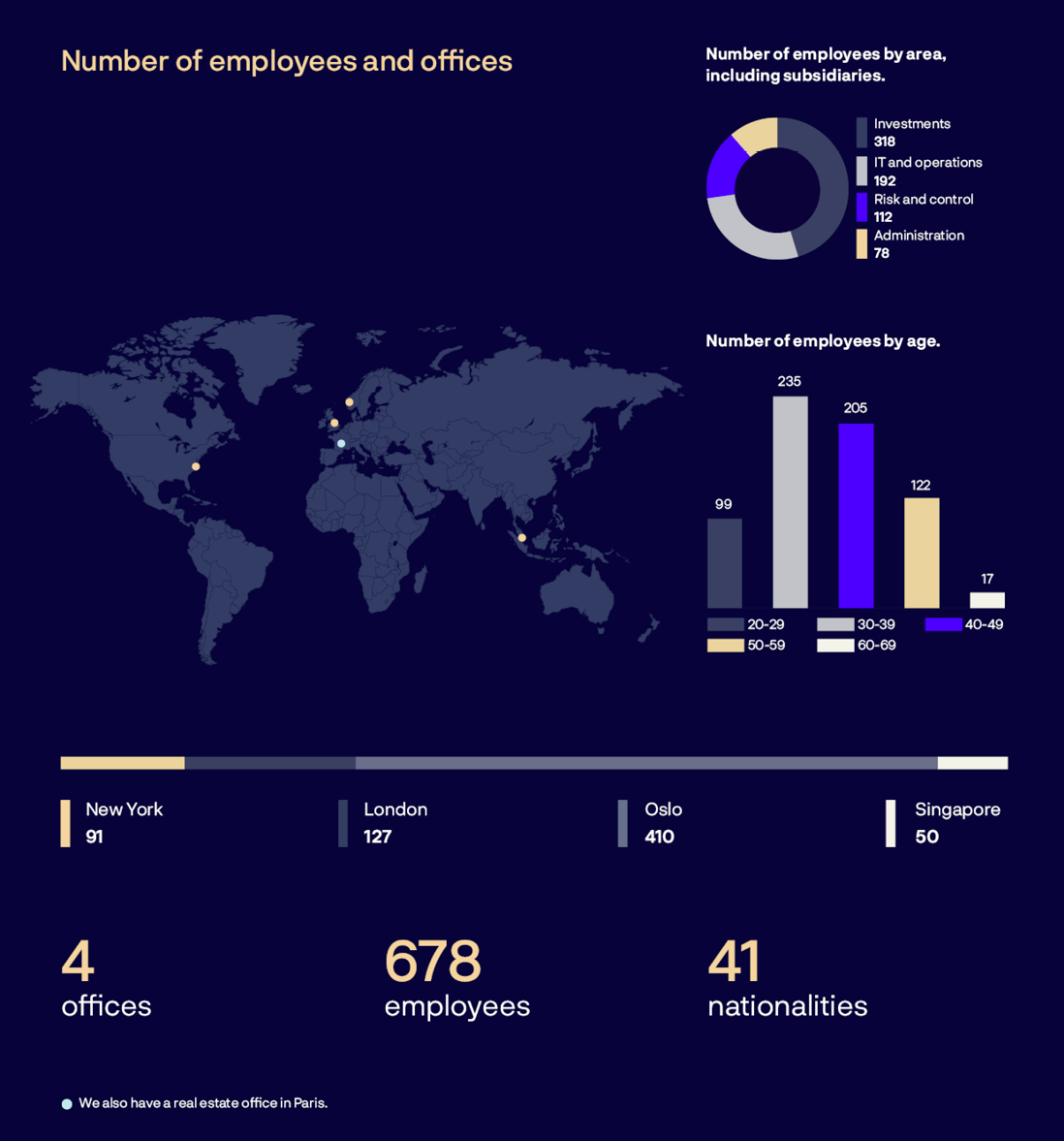
We are a global investment organisation. At the end of 2025, we had 678 employees working in our offices in Oslo, London, New York and Singapore. We also have a real estate office in Paris. Close collaboration across these offices is essential for achieving the fund’s objective of the highest possible return.
In spring 2025, we started a process to close our real estate office in Tokyo. As part of a strategic review, expanding our Japan real estate portfolio is no longer a priority. Investments in Japan remain unchanged. It was also decided to gather our Europe real estate team in one location, in London. As a result, we initiated a process to close our dedicated real estate office in Paris.
2025 marked the end of the 2023–2025 strategic period. The strategy was based on the fund’s distinctive characteristics as a large, long-term investor, with the objective of achieving the highest possible return in a responsible manner. It had five main areas: investments, technology, operational robustness, people and communication. Throughout the period, we have strengthened our contrarian investment culture, made greater use of new technologies and integrated artificial intelligence as a key tool to improve decision-making, strengthen risk management and increase efficiency. At the same time, we have made the organisation more robust and invested purposefully in our employees’ skills and development. Additionally, we have enhanced transparency in our investments and further developed our communication with stakeholders. More information about what we have achieved during the strategic period is available on the fund’s website.
Learning and development opportunities
We believe in lifelong learning and give our employees the opportunity to build relevant skills throughout their careers. We work systematically on developing leaders and other staff by offering a variety of learning and development opportunities. We have a continuous development process where employees and their leaders set clear targets and expectations together.
Artificial intelligence (AI) is changing the way we work – both individually and collectively. To enhance our productivity and decision-making ability, we launched Tech Year 2025 – a comprehensive initiative to develop technological skills throughout the organisation, with a particular focus on AI. The approach combined mandatory training, hackathons, workshops and technology days at all offices. We also launched a network of 71 AI ambassadors to provide guidance and support across the organisation. The AI initiative evolved throughout the year from experimentation and skills development to identifying and further developing solutions that provide the greatest value to the organisation. All employees now actively use AI tools in their daily work. In an internal survey, employees report an average productivity increase of 20 percent when using AI tools.
For the third year in a row, we held an Investment Academy to boost investment skills, value chain understanding and collaboration across the organisation. The programme is led by our own experts, and the feedback has been very positive.
Through our learning platform, we offer digital courses customised to the organisation. In 2025, employees completed over 3,500 such courses. Employees also have access to 10,000 online courses from leading universities and organisations.
Feedback is a key component of our organisational culture and is important for professional development. In 2025, we broadened our training on giving and receiving feedback with exercises based on specific work situations. Each year, leaders and employees conduct 360-degree evaluations in which everyone receives constructive feedback from their colleagues. In 2025, we moved from anonymous to open feedback. This led to a 64 percent increase in the number of requests for feedback.

Graduates of 2025.
We continue to prioritise our mentoring scheme, which provides employees with guidance from experienced colleagues or external professionals. The purpose is to promote new perspectives across the organisation and support personal development.
Our leaders are crucial in building a strong learning culture. They set the direction, guide employees and facilitate high performance and innovation. We set clear expectations for them and arrange regular forums, including annual leadership gatherings. New managers complete an induction programme, and all leaders receive training in topics such as psychological safety, feedback, stress management and mental resilience.
Information and recruitment
We are keen to give young people a better understanding of the world of finance. In 2025, we gave 47 guest lectures at Norwegian and international universities and colleges. The aim was to give students an insight into investment management in practice and increase knowledge about the fund.
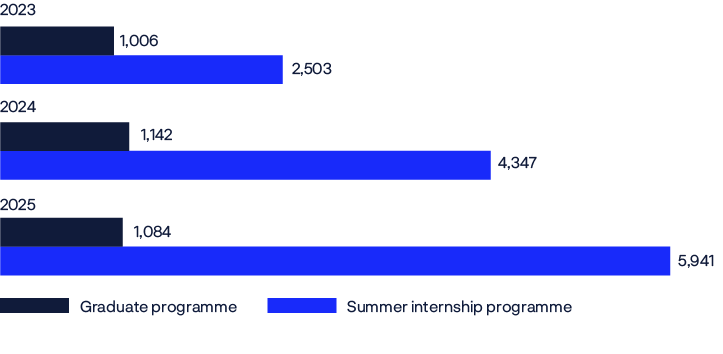
We work systematically to recruit the best candidates both in Norway and internationally, and seek talent with varied skills and backgrounds. In 2025, we saw a significant increase in the number of applicants compared with the previous year, including continued high applicant numbers for the graduate and summer internship programmes.
Diversity, equality and working environment
We aim to be an inclusive organisation with a diversity of mindsets, ethnicities, age groups, academic backgrounds and life experience. This brings a broader perspective, increases creativity and enables us to make better decisions.
We have extended our range of social activities to encourage a greater sense of community. We marked various international awareness days and events during the year, including Pride and International Women’s Day. To ensure a safe and inclusive working environment, we have a network of mental health first aiders at all our offices.
We are working actively to increase the share of women in the organisation as a whole and in senior management positions. In 2025, we continued to support the Women’s Investment Club at universities and colleges in Norway and internationally. The aim is to inspire and motivate more people to pursue careers in finance.
Norges Bank is also one of the initiators of the Women in Finance Charter, and in 2025, we hosted the Charter’s fourth status report. Our target is at least 40 percent women in Norges Bank as a whole, in senior management positions, and in specialist positions. Our commitments under the Charter’s four principles are published on the fund’s website www.nbim.no. Although we have a healthy gender balance in some areas, we still have some way to go to increase the proportion of women in senior management positions and senior specialist positions.
TABLE 24 Gender balance by management level as at 31 December 2025. In percent.
|
Grade |
Women |
Men |
|---|---|---|
|
Management level 1 (Chief) |
56 |
44 |
|
Management level 2 (Global Head) |
12 |
88 |
|
Management level 3 (Head) |
30 |
70 |
|
Specialised positions |
22 |
78 |
CHART 23 Share of employees, managers and new hires who are women, in percent.
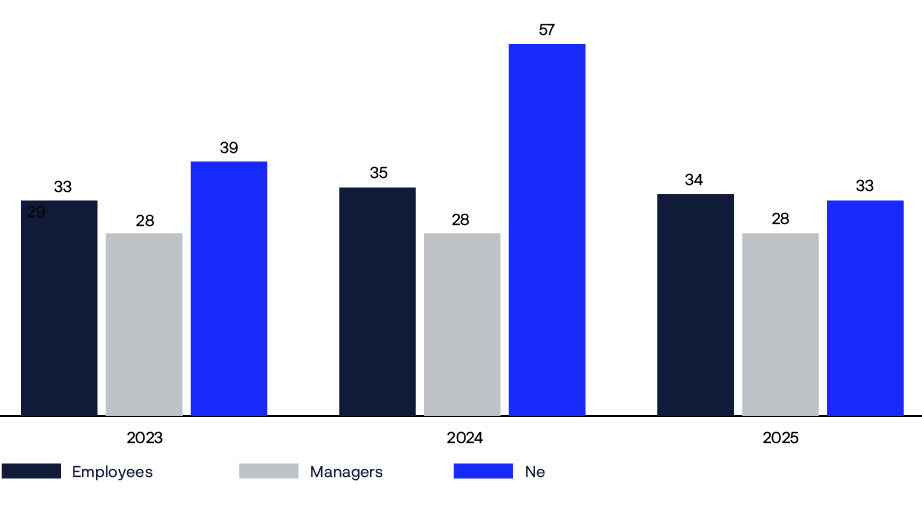
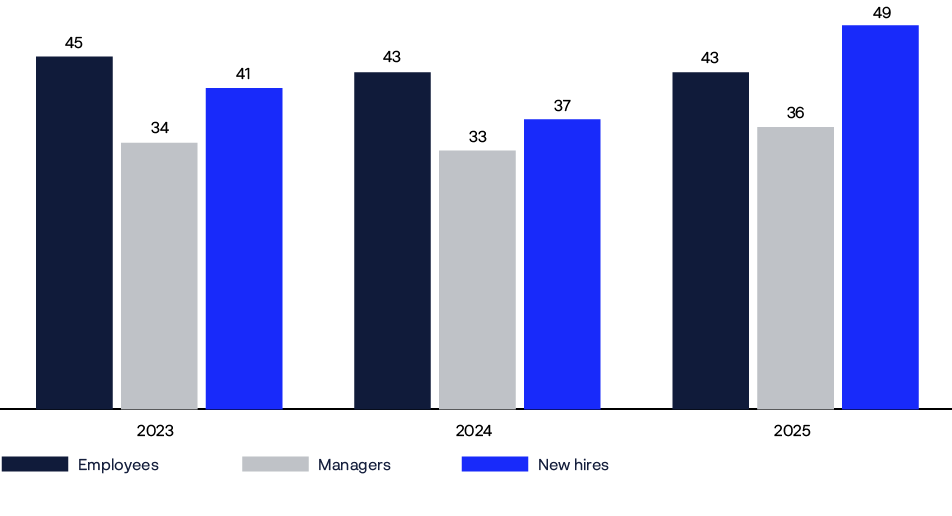
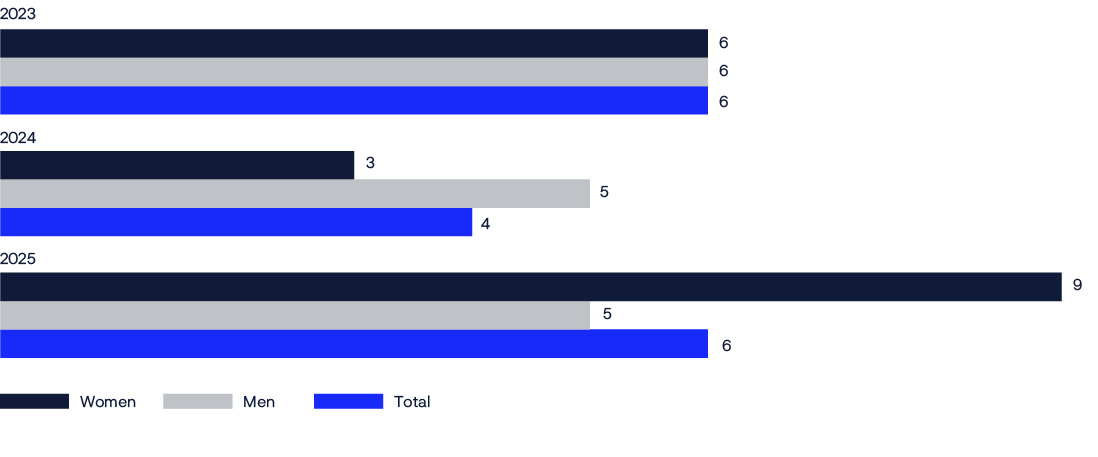
To ensure that we are consistent and fair in our approach to employees’ progression, promotion and remuneration, different areas of the organisation have their own career ladders. Each ladder can have up to five different grades with consistent job titles. Each grade reflects the expectations associated with the role that are to be met regardless of which area the employee works in.
The 2025 people survey revealed high levels of engagement in the workforce, and during the year, we changed suppliers to enhance follow-up. Reputation and job content are cited as the most important drivers of engagement and motivation. Job content includes tasks that are engaging, offer professional challenges and allow for independence.
TABLE 25 Gender balance by grade and office as at 31 December 2025. In percent.
|
Grade |
Oslo |
London |
New York |
Singapore |
||||
|---|---|---|---|---|---|---|---|---|
|
Share of employees |
Share of employees |
Share of employees |
Share of employees |
|||||
|
Men |
Women |
Men |
Women |
Men |
Women |
Men |
Women |
|
|
Global Head |
84 |
16 |
100 |
0 |
100 |
0 |
100 |
0 |
|
Head |
67 |
33 |
67 |
33 |
80 |
20 |
100 |
0 |
|
Level 5 |
93 |
7 |
100 |
0 |
75 |
25 |
33 |
67 |
|
Level 4 |
78 |
22 |
69 |
31 |
82 |
18 |
85 |
15 |
|
Level 3 |
58 |
42 |
59 |
41 |
68 |
32 |
74 |
26 |
|
Level 2 |
68 |
32 |
40 |
60 |
46 |
54 |
60 |
40 |
|
Level 1 |
38 |
62 |
25 |
75 |
100 |
0 |
0 |
0 |
Remuneration system
Norges Bank’s Executive Board sets limits for our remuneration system and monitors its implementation. Pay levels are to be competitive but generally not market-leading. Salaries are set individually and reflect the position’s responsibilities and the employee’s skills, experience and achievements. Total remuneration paid includes fixed salary and any performance-based pay, overtime pay and travel time pay.
In keeping with the management mandate from the Ministry of Finance, the remuneration system complies with the requirements of the regulations issued under the Securities Funds Act with necessary adjustments. The Executive Board’s Remuneration Committee is to contribute to thorough and independent consideration of matters concerning Norges Bank’s remuneration arrangements. Norges Bank’s Internal Audit unit also issues an independent statement on compliance with rules and guidelines on remuneration. The review in 2025 confirmed that the remuneration system was operated in line with applicable rules in 2024.
Members of the leader group receive only a fixed salary. The CEO’s salary and pay bands for other members of the leader group are set by the Executive Board.
TABLE 26 Fixed salary and other key information for senior management in 2025.
|
Position |
Name |
Gender |
Investment area |
Age |
Tenure in Norges Bank Investment Management |
Annual fixed salary in kroner |
|---|---|---|---|---|---|---|
|
Chief Human Resources Officer |
Aass, Ada Magnæs |
Woman |
46 years |
11 years |
2,700,000 |
|
|
Chief Investment Officer Equities |
Balthasar, Daniel1 |
Man |
Yes |
49 years |
19 years |
13,436,000 |
|
Chief Technology and Operating Officer |
Bryne, Birgitte |
Woman |
53 years |
10 years |
4,380,000 |
|
|
Chief Investment Officer Equities |
Furtado Reis, Pedro1 |
Man |
Yes |
50 years |
14 years |
13,436,000 |
|
Deputy Chief Executive Officer/Chief of Staff |
Grande, Trond |
Man |
55 years |
18 years |
5,540,000 |
|
|
Chief Risk Officer |
Huse, Dag2 |
Man |
59 years |
22 years |
4,554,000 |
|
|
Chief Governance and Compliance Officer |
Ihenacho, Carine Smith1 |
Woman |
63 years |
8 years |
6,711,000 |
|
|
Chief Investment Officer Market Strategies |
Norberg, Malin |
Woman |
Yes |
41 years |
16 years |
4,695,000 |
|
Chief Communications and External Relations Officer |
Skaar, Marthe |
Woman |
42 years |
12 years |
2,500,000 |
|
|
Chief Executive Officer |
Tangen, Nicolai |
Man |
59 years |
5 years |
7,606,000 |
1 Receives a salary in pounds sterling. The amount shown includes the currency effect when translating into kroner
2 Transferred to another position within Norges Bank Investment Management on 19.11.2025. Remuneration is shown up until this date.
TABLE 27 Remuneration of senior management in 2025. In kroner.
|
Position |
Name |
Paid salary5 |
Performance-based pay |
Value of other benefits4 |
Pension benefit earned |
Employee loan |
|---|---|---|---|---|---|---|
|
Chief Human Resources Officer |
Aass, Ada Magnæs |
2,640,191 |
16,990 |
401,075 |
||
|
Co-Chief Investment Officer Equities |
Balthasar, Daniel1,2 |
13,436,951 |
1,687,616 |
180,468 |
1,343,695 |
|
|
Chief Technology and Operating Officer |
Bryne, Birgitte |
4,387,232 |
24,306 |
493,160 |
||
|
Co-Chief Investment Officer Equities |
Furtado Reis, Pedro1,2 |
13,436,951 |
1,631,938 |
182,820 |
1,343,695 |
|
|
Deputy Chief Executive Officer/Chief of Staff |
Grande, Trond |
5,555,193 |
17,764 |
406,217 |
||
|
Chief Risk Officer |
Huse, Dag3 |
4,512,129 |
11,667 |
571,678 |
||
|
Chief Governance and Compliance Officer |
Ihenacho, Carine Smith1 |
6,721,292 |
182,049 |
672,129 |
||
|
Co-Chief Investment Officer Asset Strategies |
Norberg, Malin2 |
5,288,432 |
636,462 |
1,886,757 |
334,068 |
1,065,913 |
|
Chief Communications and External Relations Officer |
Skaar, Marthe |
2,377,035 |
18,187 |
342,338 |
||
|
Chief Executive Officer |
Tangen, Nicolai |
7,172,790 |
156,558 |
364,579 |
1 Receives a salary in pounds sterling. The amount shown includes the currency effect when translating into kroner
2 Members of the Norges Bank Investment Management leader group only receive a fixed salary. Members of the leader group that previously were entitled to performance-based pay are no longer a part of this arrangement, but over the coming years will receive accrued performanve-based pay that has been held back. The amounts reported in the table are performance-based pay disbursed during the financial year, but accrued and expensed in earlier periods.
3 Transferred to another position within Norges Bank Investment Management on 19.11.2025. Remuneration is shown up until this date.
4 Consist mainly of personnel insurance and electronic communication tools.
5 Paid salary includes holiday pay from performance-based salary.
A total of 1,299 million kroner was paid in fixed salaries to 786 employees in 2025: 66 million kroner to senior management, 541 million to employees entitled to performance-based pay and 692 million kroner to other employees.
Fixed salary at subsidiaries
A total of 53 million kroner was paid in fixed salaries to 28 employees of subsidiaries linked to the management of the real estate portfolio during the year: 44 million kroner to employees entitled to performance-based pay and 9 million kroner to other employees.
Performance-based pay
In addition to their fixed salary, those who work directly on investment decisions may qualify for performance-based pay. This is calculated on the basis of the performance of the fund, group and individual measured against agreed qualitative and quantitative targets. Results are measured over a period of at least two years.
The limit for performance-based pay is generally a maximum of 100 percent of fixed salary. For a limited number of employees at the overseas offices, however, the limit may be 200 percent of fixed salary. Employees eligible for performance-based pay accrued an average of 54 percent of the overall limit for 2025 based on multi-year performance. A total of 362 million kroner was paid in performance-based pay to 229 employees during the year.
As a general rule, accrued performance-based pay is paid over several years, where up to half is paid the year after it is accrued. The remainder is held back and paid over the following three years. The amount held back is adjusted according to the return on the fund.
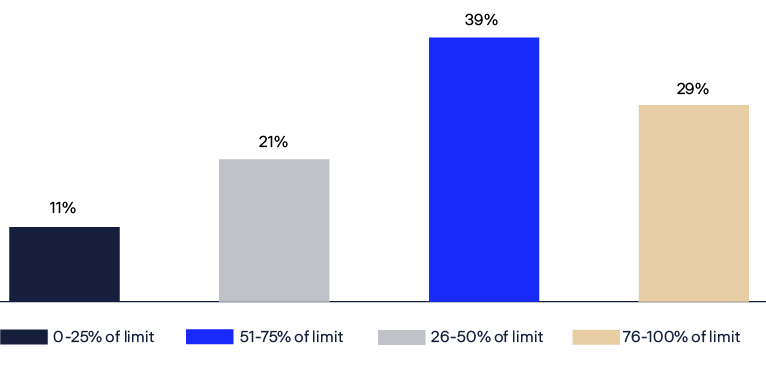
Performance-based pay at subsidiaries
A total of 15 million kroner was paid in performance-based pay to 20 employees at subsidiaries linked to the management of the real estate portfolio.
Equal pay
To ensure fair pay practices, we regularly analyse pay trends among our employees. Any significant discrepancies at the level of the individual or group are investigated further to ensure that gender-neutral criteria have been applied.
The analysis shows no significant pay differences between women and men in comparable positions and roles. The pay differences increased marginally from 2024, primarily due to changes in the composition at different career levels. Pay gaps between women and men at the level of the organisation are a result of men being over-represented in positions working on investment decisions. Positions with investment responsibilities are generally better paid in the market than positions at the same grade in other areas. A larger share of men than women at senior grades also contributes to differences at the level of the organisation.
TABLE 28 Unajusted pay gap between women and men in percent.1
|
Fixed salary |
Expected remuneration paid |
|||
|---|---|---|---|---|
|
Median |
Average |
Median |
Average |
|
|
Oslo office |
86.50 |
86.50 |
88.10 |
78.90 |
|
Total |
80.60 |
77.70 |
78.40 |
68.40 |
1 Unajusted pay gap between women and men reflects the disparity in earnings without adjusting for factors such as working hours, occupation, age, experience, education level, or other variables that could impact total pay gaps.

Our New York office.
For data protection reasons, there must be at least five members of each gender at each grade for pay data to be published.
TABLE 29 Fixed salary by grade at the Oslo office as at 31 December 2025.
|
Grade |
Number of employees |
Median fixed salary in kroner |
Women's as a percentage of men's |
Mean fixed salary in kroner |
Women's as a percentage of men's |
|||
|---|---|---|---|---|---|---|---|---|
|
Men |
Women |
Men |
Women |
Men |
Women |
|||
|
Head |
33 |
16 |
1,845,000 |
1,690,000 |
92 |
1,916,000 |
1,734,000 |
91 |
|
Level 4 |
73 |
21 |
1,500,000 |
1,440,000 |
96 |
1,567,000 |
1,431,000 |
91 |
|
Level 3 |
77 |
56 |
1,170,000 |
1,150,000 |
98 |
1,176,000 |
1,187,000 |
101 |
|
Level 2 |
50 |
24 |
923,000 |
878,000 |
95 |
933,000 |
883,000 |
95 |
|
Level 1 |
8 |
13 |
720,000 |
720,000 |
100 |
719,000 |
713,000 |
99 |
TABLE 30 Total remuneration paid by grade at the Oslo office as at 31 December 2025.
|
Grade |
Number of employees |
Median total remuneration paid in kroner |
Women's as a percentage of men's |
Mean total remuneration paid in kroner |
Women's as a percentage of men's |
|||
|---|---|---|---|---|---|---|---|---|
|
Men |
Women |
Men |
Women |
Men |
Women |
|||
|
Head |
33 |
16 |
1,945,000 |
1,718,000 |
88 |
2,110,000 |
1,806,000 |
86 |
|
Level 4 |
73 |
21 |
1,760,000 |
1,467,000 |
83 |
1,905,000 |
1,527,000 |
80 |
|
Level 3 |
77 |
56 |
1,250,000 |
1,248,000 |
100 |
1,311,000 |
1,294,000 |
99 |
|
Leve 2 |
50 |
24 |
954,000 |
897,000 |
94 |
998,000 |
911,000 |
91 |
|
Level 1 |
8 |
13 |
737,000 |
720,000 |
98 |
736,000 |
722,000 |
98 |
Operational risk
Norges Bank’s Executive Board sets limits for operational risk management and internal controls at Norges Bank Investment Management. We work systematically to identify operational risk and improve our processes.

Our Oslo office.
The Executive Board has decided that there must be less than a 20 percent probability that operational risk factors result in gains and losses totalling 1 billion kroner or more over a 12-month period. This is referred to as the Executive Board’s operational risk tolerance. Our estimated operational risk exposure was within this limit throughout 2025.
Unwanted incidents in 2025
A total of 178 unwanted incidents were recorded in 2025, up from 175 the previous year. Most of these events had no financial consequences. Altogether, unwanted incidents had an estimated financial impact of 142 million kroner. Nine of the incidents were considered significant.
The significant incidents accounted for approximately 110 million kroner of the total financial impact. Five of the incidents involved failures in IT systems and systems availability. Two incidents were linked to external parties – one to cloud infrastructure and the other to a breach of mandate by an external manager. One incident concerned a failure in an internal portfolio management process, and one resulted from human error during a network change.
Compliance with guidelines
The Ministry of Finance has issued a mandate for the management of the Government Pension Fund Global. No material breaches of the mandate were registered in 2025. Norges Bank Investment Management did not receive any notifications from local supervisory authorities of any significant breaches of market rules or general legislation.
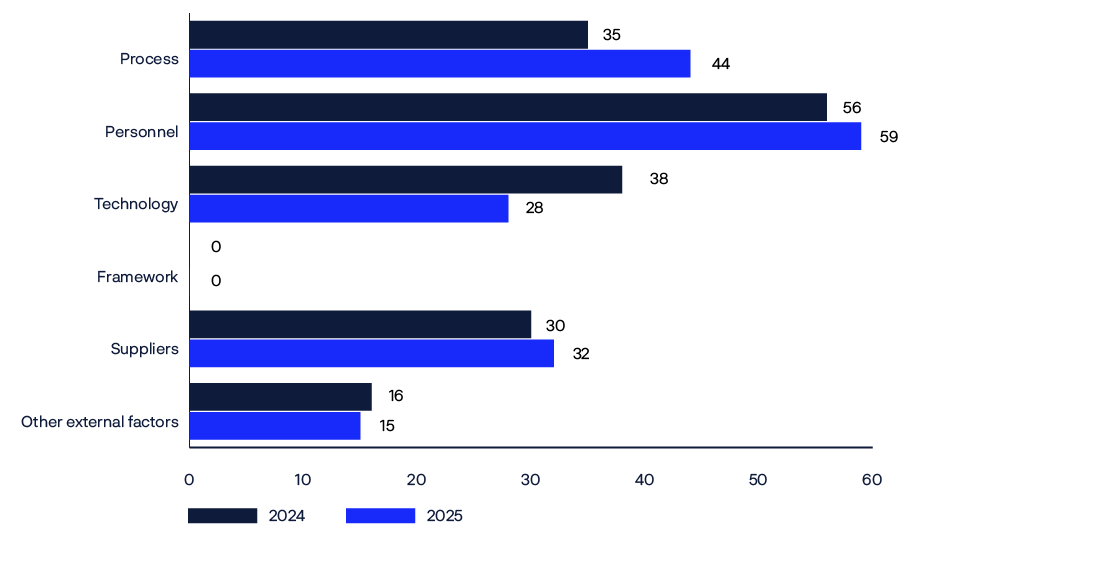
Cyber risk
Attempted cyber attacks pose a significant risk to Norges Bank Investment Management. The security policy landscape is changing rapidly, and the malicious use of AI is making cyber attacks both more effective and easier to scale.
In 2025, we saw how AI is amplifying established attack methods. This includes more convincing social manipulation across languages, faster identification of vulnerabilities and increased use of attacks targeting supply and value chains. At the same time, some criminal groups are increasingly operating on behalf of state actors, making it more difficult to distinguish between financially and politically motivated attacks.
Several processes and controls are in place to reduce cyber risk. No significant incidents related to information security were identified in 2025.

Our New York office.
Low costs
We maintain a high level of cost awareness in our management of the fund and work continually to automate processes and streamline operations to realise economies of scale.

Our Singapore office.
High returns, responsible investment and transparency are important priorities for the fund. We leverage the fund’s characteristics as a large and long-term investor to achieve the highest possible returns in a responsible manner. At the same time, we want to ensure cost-effectiveness without compromising the opportunity to create added value in the management of the fund. We must also ensure sound control, good risk management and operational robustness in a time of geopolitical uncertainty and a more complex risk landscape.
Internal management costs as a share of assets under management have been stable or somewhat declining in recent years. We work systematically to automate processes and streamline operations to realise economies of scale. In recent years we have carried out a range of initiatives to support this work. The management of the fund should be cost-effective, but low costs are not a goal in itself. The fund’s objective as set out in the management mandate from the Ministry of Finance is to generate the highest possible return, net of costs, measured in the investment portfolio’s currency basket, within the applicable investment management framework.
The fund’s management costs measured as a share of assets under management are low compared to other funds. Management costs at Norges Bank amounted to 0.038 percent of assets under management in 2025. Annual analyses prepared by CEM Benchmarking Inc. for the Ministry of Finance show that the fund has had lower costs than all other funds in the peer group over time. Management costs have been between 11 and 19 basis points lower than the peer group since 2012. The comparison takes into account differences in fund size and the allocation to different asset classes. The CEM report is considered the best source of comparable information on cost levels in asset management.
Management costs
Management costs comprise all costs relating to the management of the fund. These are mainly incurred at Norges Bank, but also at subsidiaries established to manage the fund’s investments in unlisted real estate and unlisted renewable energy infrastructure. See note 12, as well as table 6.4 and table 7.4 in the financial statements for additional information related to costs at Norges Bank and subsidiaries.
Total management costs at Norges Bank were 7.5 billion kroner in 2025, up from 7.4 billion kroner in 2024. The increase was due to higher salary and personnel costs and increased base fees to external managers. This was partly offset by lower performance-based fees to external managers and currency effects. The increase in salary and personnel costs was mainly due to an accounting transition effect related to a change in practice for payment of performance pay, resulting in a change in periodisation. As a result, personnel costs increased by 235 million kroner in 2025. The change does not impact accrued performance pay and has limited impact on amounts paid. Excluding this transition effect, total management costs would have been somewhat lower than in 2024. Base fees to external managers increased due to higher average assets under external management in 2025. Performance-based fees to external managers were lower, due to lower excess returns for some external managers.
Each year, the Ministry of Finance sets an upper limit for the reimbursement of management costs. Norges Bank is only reimbursed for costs incurred up to this limit. Management costs at subsidiaries are measured against the upper limit but are not reimbursed, as they are expensed directly in the portfolio result. Norges Bank is also reimbursed for performance-based fees to external managers. These fees are not included in the limit. Total management costs incurred at Norges Bank and subsidiaries, excluding performance-based fees to external managers, were limited to 8.1 billion kroner for 2025. Management costs measured against this upper limit amounted to 6.6 billion kroner. These comprised management costs at Norges Bank, excluding performance-based fees to external managers, of 6.4 billion kroner and management costs at subsidiaries of 0.2 billion kroner. This corresponds to 0.033 percent of assets under management, down from 0.034 percent in 2024.
Fixed and variable fees to external managers accounted for 39 percent of management costs in 2025. We use external equity managers in markets and segments where we believe they will enhance returns. Our strategy is to use external managers primarily for equity investments in emerging markets. The use of external managers has played an important role in achieving the fund’s objectives. From inception in 1999 until the end of 2025, the cumulative excess return after costs from external equity mandates was approximately 93 billion kroner.
A share of the fees to external managers varies with the excess return achieved relative to a benchmark index. Agreements with external managers regarding performance-based fees are structured so that the majority of the excess return is retained by the fund, and the agreements include caps on the fees that can be paid. Performance-based fees to external managers will increase when excess returns increase.
The fund’s investments in equities and bonds must be registered with local securities depositories around the world. We use a global custodian institution to assist us with this process. Custody costs as a share of assets under management have fallen in recent years and accounted for 6 percent of management costs in 2025.
The fund’s reporting currency is the Norwegian krone. Exchange rate fluctuations can have a significant accounting impact even if actual costs in foreign currency remain unchanged. Over 75 percent of costs are invoiced and paid in foreign currency. For example, a 25 percent change in the value of the krone against all other currencies would in isolation change management costs by around 1,800 million kroner. The weakening of the krone in recent years has therefore contributed to higher costs measured in kroner.
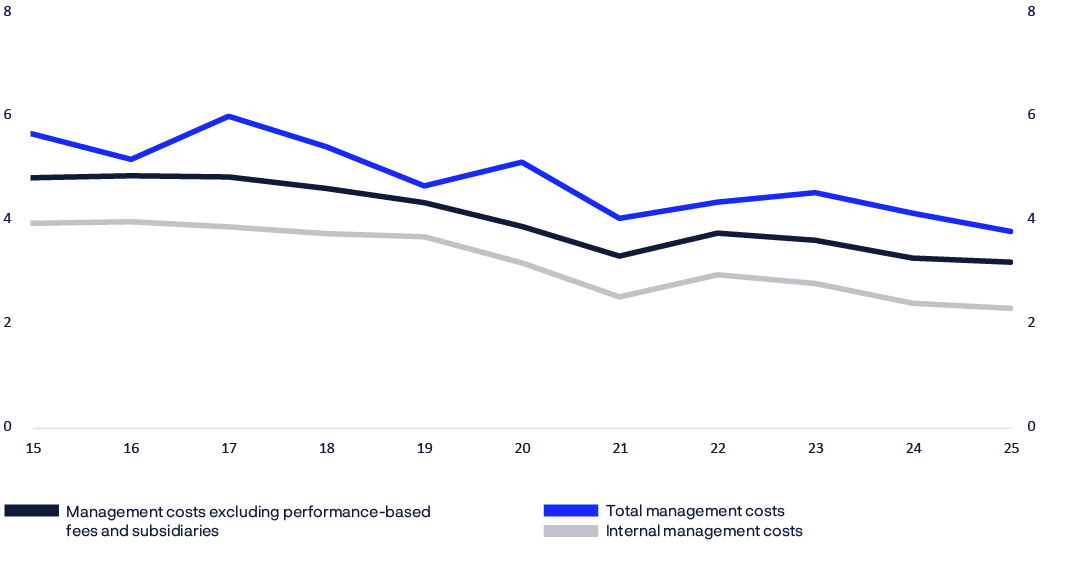
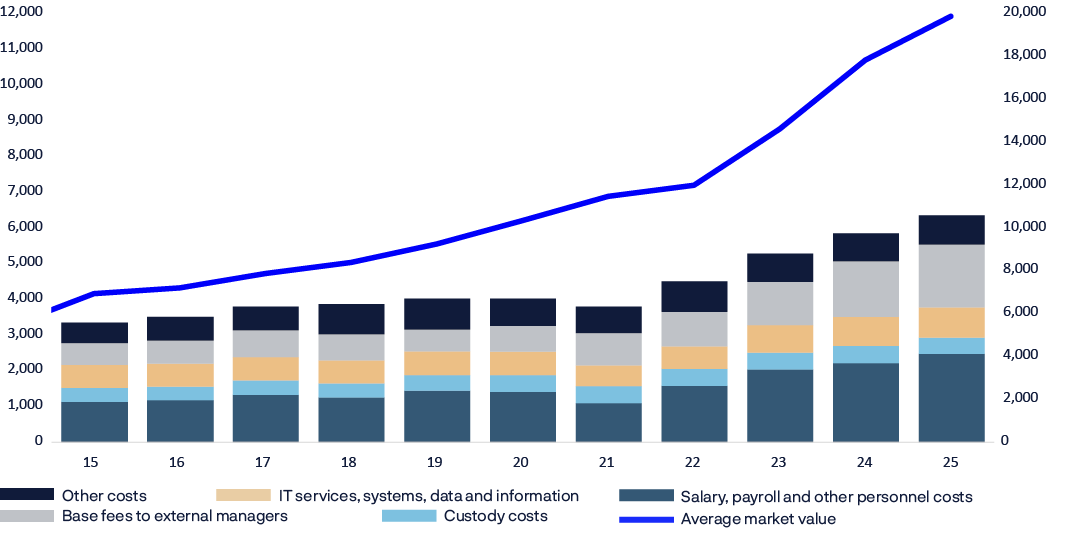
1 Excluding performance-based fees and subsidiaries.
Management costs broken down by investment strategy
We pursue different investment strategies in our management of the fund. These strategies complement and influence one another, and there are cost synergies between them. Costs are allocated to the different strategies either based on actual costs or using allocation keys such as number of employees or transaction volumes.
TABLE 31 Management costs in basis points per investment strategy in 2025. Costs as reimbursed by the Ministry of Finance.
|
2025 |
Contribution to the fund's management costs |
Management costs based on |
|---|---|---|
|
Market exposure |
1.3 |
1.8 |
|
Securities selection |
2.2 |
9.6 |
|
Internal security selection |
0.6 |
3.5 |
|
External security selection1 |
1.6 |
29.4 |
|
Fund allocation |
0.3 |
|
|
of which unlisted real estate |
0.2 |
8.3 |
|
Total |
3.8 |
1 Includes all externally managed capital.
TABLE 32 Management cost per investment strategy 2013-2025. Costs as reimbursed by the Ministry of Finance. Basis points.
|
2013–2025 |
Contribution to the fund's |
Management costs based on |
|---|---|---|
|
Market exposure |
2.0 |
2.6 |
|
Security selection |
2.5 |
13.7 |
|
Internal security selection |
0.7 |
5.0 |
|
External security selection1 |
1.8 |
40.9 |
|
Fund allocation |
0.3 |
|
|
Unlisted real estate2 |
0.3 |
16.5 |
|
Total |
5.0 |
1 Includes all externally managed capital.
2 Unlisted real estate is part of the Fund allocation strategy from 2017, but is presented on a separate line for 2013-2025.
Transaction costs
Transaction costs are defined as all costs associated with transactions that directly impact the portfolio result. Both direct and indirect transaction costs are incurred. For equities and bonds, direct transaction costs normally consist of commission fees and transaction taxes, including stamp duty. For unlisted real estate and unlisted renewable energy infrastructure, they include one-off costs for the purchase and sale of investments, including stamp duty, registration fees, due diligence costs and insurance.
We work continuously to keep direct transaction costs low. We do this by analysing our trades and taking transaction costs into account in our investment strategies, thereby reducing the number of transactions. There may therefore be lower activity in markets with high commissions or taxes, than in markets with lower fixed transaction costs. We also choose counterparties that can execute our investment decisions cost-effectively. Transaction costs amounted to 7.7 billion kroner in 2025, compared to 6.1 billion kroner in 2024. Of this, 6.7 billion kroner was related to equity investments, 0.7 billion kroner to investments in unlisted real estate and 0.3 billion kroner to investments in unlisted renewable energy infrastructure.
In addition to direct costs, indirect costs are incurred when we invest. These arise as a result of price fluctuations from the time the trade is initiated in the market until it is implemented. Indirect costs are included in the portfolio result and are estimated at 14.5 billion kroner for internal equity investments in 2025, compared to 16.0 billion kroner in 2024. Despite higher activity in 2025, indirect transaction costs were reduced due to broad cost-reduction measures and some improvement in market conditions.
4. Financial statements

Our London office.
Income statement
|
Amounts in NOK million |
Note |
2025 |
2024 |
|---|---|---|---|
|
Profit/loss on the portfolio before foreign exchange gain/loss |
|||
|
Income/expense from: |
|||
|
- Equities |
4 |
2 115 405 |
2 454 653 |
|
- Bonds |
4 |
243 405 |
70 889 |
|
- Unlisted real estate |
6 |
9 063 |
-3 789 |
|
- Unlisted infrastructure |
7 |
7 313 |
-627 |
|
- Financial derivatives |
4 |
1 350 |
11 262 |
|
- Secured lending |
13 |
20 801 |
21 622 |
|
- Secured borrowing |
13 |
-22 889 |
-24 810 |
|
Tax expense |
10 |
-11 157 |
-17 211 |
|
Interest income/expense |
-1 042 |
-939 |
|
|
Other income/expense |
-117 |
4 |
|
|
Profit/loss on the portfolio before foreign exchange gain/loss |
2 362 132 |
2 511 054 |
|
|
Foreign exchange gain/loss |
11 |
-1 155 299 |
1 072 207 |
|
Profit/loss on the portfolio |
1 206 833 |
3 583 261 |
|
|
Management fee |
12 |
-7 537 |
-7 390 |
|
Profit/loss and total comprehensive income |
1 199 296 |
3 575 870 |
Balance sheet
|
Amounts in NOK million |
Note |
31.12.2025 |
31.12.2024 |
|---|---|---|---|
|
Assets |
|||
|
Deposits in banks |
19 394 |
25 550 |
|
|
Secured lending |
13,14 |
1 374 213 |
1 020 455 |
|
Cash collateral posted |
14 |
20 426 |
11 340 |
|
Unsettled trades |
38 765 |
72 619 |
|
|
Equities |
5 |
14 217 305 |
13 290 055 |
|
Equities lent |
5,13 |
1 011 469 |
862 197 |
|
Bonds |
5 |
4 987 629 |
4 481 076 |
|
Bonds lent |
5,13 |
811 514 |
1 088 846 |
|
Financial derivatives |
5,14 |
27 597 |
32 904 |
|
Unlisted real estate |
6 |
371 524 |
355 769 |
|
Unlisted infrastructure |
7 |
60 228 |
25 236 |
|
Withholding tax receivable |
10 |
11 594 |
17 938 |
|
Other assets |
17 |
2 165 |
1 690 |
|
Total assets |
22 953 824 |
21 285 673 |
|
|
Liabilities and owner's capital |
|||
|
Secured borrowing |
13,14 |
1 370 328 |
1 319 892 |
|
Cash collateral received |
14 |
129 608 |
103 193 |
|
Unsettled trades |
141 044 |
76 260 |
|
|
Financial derivatives |
5,14 |
26 483 |
31 229 |
|
Deferred tax |
10 |
10 744 |
13 170 |
|
Other liabilities |
17 |
194 |
147 |
|
Management fee payable |
7 537 |
190 |
|
|
Total liabilities |
1 685 938 |
1 544 083 |
|
|
Owner's capital |
21 267 886 |
19 741 590 |
|
|
Total liabilities and owner's capital |
22 953 824 |
21 285 673 |
Statement of cash flows
Accounting policy
The statement of cash flows is prepared in accordance with the direct method. Major classes of gross cash receipts and payments are presented separately, with the exception of specific transactions that are presented on a net basis, primarily relating to the purchase and sale of financial instruments. Cash flows related to the fund’s investment activities are presented as operating activities, since they represent the income-generating activities of the fund. Inflows and withdrawals between the GPFG and the Norwegian government are financing activities. These transfers have been settled in the period. Accrued inflows/withdrawals are shown in the Statement of changes in owner’s capital.
|
Amounts in NOK million, receipt (+) / payment (-) |
Note |
2025 |
2024 |
|---|---|---|---|
|
Operating activities |
|||
|
Receipts of dividend from equities |
274 816 |
267 025 |
|
|
Receipts of interest from bonds |
160 695 |
131 621 |
|
|
Receipts of interest and dividend from unlisted real estate |
6 |
9 070 |
8 175 |
|
Receipts of interest and dividend from unlisted infrastructure |
7 |
747 |
440 |
|
Net receipts of interest and fee from secured lending and borrowing |
-2 655 |
-3 359 |
|
|
Receipts of dividend, interest and fee from holdings of equities, bonds, unlisted real estate and unlisted infrastructure |
442 673 |
403 902 |
|
|
Net cash flow from purchase and sale of equities |
18 918 |
-230 218 |
|
|
Net cash flow from purchase and sale of bonds |
-552 445 |
-650 861 |
|
|
Net cash flow to/from investments in unlisted real estate |
6 |
-38 899 |
-40 244 |
|
Net cash flow to/from investments in unlisted infrastructure |
7 |
-27 955 |
-7 614 |
|
Net cash flow financial derivatives |
-9 528 |
20 874 |
|
|
Net cash flow cash collateral related to derivative transactions |
19 778 |
73 732 |
|
|
Net cash flow secured lending and borrowing |
-173 972 |
65 565 |
|
|
Net payment of taxes |
10 |
-5 574 |
-20 710 |
|
Net cash flow related to interest on deposits in banks and bank overdraft |
74 |
214 |
|
|
Net cash flow related to other income/expense, other assets and other liabilities |
-183 |
920 |
|
|
Management fee paid to Norges Bank1 |
-190 |
-7 032 |
|
|
Net cash inflow/outflow from operating activities |
-327 303 |
-391 472 |
|
|
Financing activities |
|||
|
Inflow from the Norwegian government |
326 697 |
411 365 |
|
|
Withdrawal by the Norwegian government |
- |
- |
|
|
Net cash inflow/outflow from financing activities |
326 697 |
411 365 |
|
|
Net change deposits in banks |
|||
|
Deposits in banks at 1 January |
25 550 |
8 584 |
|
|
Net increase/decrease of cash in the period |
-606 |
19 892 |
|
|
Net foreign exchange gain/loss on cash |
-5 549 |
-2 927 |
|
|
Deposits in banks at end of period |
19 394 |
25 550 |
1 Management fee in the statement of cash flows consists of transfers to/from the krone account in connection with the settlement of management costs incurred in Norges Bank.
Statement of changes in owner's capital
Accounting policy
Owner’s capital for the GPFG comprises contributed capital in the form of accumulated net inflows from the Norwegian government and retained earnings in the form of total comprehensive income. Owner’s capital corresponds to the Ministry of Finance’s krone account in Norges Bank.
|
Amounts in NOK million |
Inflows |
Retained earnings |
Total |
|---|---|---|---|
|
1 January 2024 |
4 768 370 |
10 988 349 |
15 756 719 |
|
Profit/loss and total comprehensive income |
- |
3 575 870 |
3 575 870 |
|
Inflow during the period |
409 000 |
- |
409 000 |
|
Withdrawal during the period |
- |
- |
- |
|
31 December 2024 |
5 177 370 |
14 564 220 |
19 741 590 |
|
1 January 2025 |
5 177 370 |
14 564 220 |
19 741 590 |
|
Profit/loss and total comprehensive income |
1 199 296 |
1 199 296 |
|
|
Inflow during the period |
327 000 |
- |
327 000 |
|
Withdrawal during the period |
- |
- |
- |
|
31 December 2025 |
5 504 370 |
15 763 516 |
21 267 886 |
Note 1 General information
Introduction
Norges Bank is Norway’s central bank. Norges Bank is a separate legal entity and is owned by the state. Norges Bank manages the Government Pension Fund Global (GPFG) on behalf of the Ministry of Finance, in accordance with section 3, second paragraph of the Government Pension Fund Act and the management mandate for the GPFG, issued by the Ministry of Finance.
The GPFG shall support government saving to finance future expenditure and underpin long-term considerations relating to the use of Norway’s petroleum revenues. The Storting (Norwegian Parliament) has established the legal framework in the Government Pension Fund Act, and the Ministry of Finance has formal responsibility for the fund’s management. The Executive Board of Norges Bank has delegated day-to-day management of the GPFG to Norges Bank Investment Management (NBIM).
The Ministry of Finance has placed funds for investment in the GPFG in the form of a Norwegian krone deposit with Norges Bank (the krone account). Norges Bank manages the krone account in its own name by investing the funds in an investment portfolio consisting of equities, bonds, real estate and renewable energy infrastructure. The GPFG is invested in its entirety outside of Norway.
Transfers are made to and from the krone account in accordance with the management mandate. When the Norwegian State’s petroleum revenue exceeds the use of petroleum revenue in the fiscal budget, deposits will be made into the krone account. In the opposite situation, withdrawals will be made. Transfers to and from the krone account lead to a corresponding change in owner’s capital.
For further information on the management mandate for the GPFG, Norges Bank’s governance structure and risk management, see note 9 Investment risk.
Approval of the financial statements
The annual financial reporting for the GPFG is an excerpt from Norges Bank’s financial reporting and is included in Norges Bank’s annual financial statements as note 20. The annual financial statements of Norges Bank for 2025 were approved by the Executive Board on 5 February 2026 and approved by the Supervisory Council on 26 February 2026.
Note 2 Accounting policies
This note describes accounting policies, significant estimates and accounting judgements that are relevant to the financial statements as a whole. Additional accounting policies, significant estimates and accounting judgements are described in the respective statements and notes.
Significant estimates and accounting judgements
The preparation of the financial statements involves the use of uncertain estimates and assumptions relating to future events that affect the reported amounts for assets, liabilities, income and expenses. Estimates are based on historical experience and reflect management’s expectations about future events. Actual outcomes may deviate from estimates. The preparation of the financial statements also involves the use of judgement when applying accounting policies, which may have a significant impact on the financial statements.
In cases where there are particularly uncertain estimates or accounting judgements, this is described in the respective notes.
Basis of preparation
In accordance with the Regulation on the financial reporting of Norges Bank (the Regulation) as laid down by the Ministry of Finance, the financial reporting for the GPFG is prepared in accordance with IFRS Accounting Standards as adopted by the EU, based on the going concern assumption. The annual financial statements are prepared with a closing date of 31 December, and are presented in Norwegian kroner (NOK), rounded to the nearest million. Rounding differences may occur.
Changes in accounting policies, including new and amended standards and interpretations in the period
Accounting policies are applied consistently with those of the previous financial year. There are no new or amended IFRS standards and interpretations that have become effective for the financial year starting 1 January 2025, that have had a material impact on the financial statements.
New and amended standards and interpretations effective from 2026 or later
IFRS 18 Presentation and Disclosure in Financial Statements
In 2024, the IASB issued a new accounting standard, IFRS 18 Presentation and Disclosure in Financial Statements. IFRS 18 will replace IAS 1 Presentation of Financial Statements. The new standard applies to annual reporting periods beginning on or after 1 January 2027. The new standard introduces several new requirements for the presentation of the financial statements and note disclosures. The most relevant for the GPFG are:
- A requirement to classify all income and expenses into five categories in the income statement: operating, investing, financing, income taxes, and discontinued operations.
- A requirement to present a defined operating profit subtotal.
- A requirement to disclose items defined as Management-defined Performance Measures (MPMs) in a single note in the financial statements.
Norges Bank has started the assessment of the new requirements in IFRS 18. Recognition and measurement will remain unchanged and the implementation of IFRS 18 will therefore not have an impact on Profit/loss and total comprehensive income and Owner’s capital.
The preliminary assessment is that the GPFG is considered to be an entity that invests in assets as a main business activity under IFRS 18. Accordingly, income and expense items related to the investment portfolio will primarily be classified in the operating category in the income statement.
IFRS 18 will be implemented from the effective date, with retrospective application as required.
Other
Other issued IFRS standards, changes in existing standards and interpretations with effective dates from 2026 or later, are expected to be immaterial or not applicable for the financial reporting for the GPFG at the time of implementation.
Accounting policies for the financial statements as a whole
Financial assets and liabilities
Recognition and derecognition
Financial assets and liabilities are recognised in the balance sheet upon becoming a party to the instrument’s contractual provisions.
Financial assets are derecognised when the contractual rights to the cash flows expire, or when the financial assets and substantially all the risks and rewards of ownership are transferred. See note 13 Secured lending and borrowing for details of transferred assets that are not derecognised.
Financial liabilities are derecognised when the obligation is extinguished, i.e. when the obligation specified in the contract is discharged, cancelled or expires.
Purchase or sale of a financial asset where the contractual terms require settlement in accordance with normal market conditions, is recognised on the trade date.
Classification and measurement
Financial assets are classified based on the business model used for managing the assets and their contractual cash flow characteristics.
The investment portfolio of the GPFG is managed in accordance with the management mandate issued by the Ministry of Finance, the investment mandate issued by the Executive Board of Norges Bank and investment strategies issued by the management of Norges Bank Investment Management. These mandates and strategies, including the risk management strategies, entail that financial assets are managed and evaluated on a fair value basis. The GPFG’s financial assets are therefore measured at fair value through profit or loss, except for Management fee receivable which is not part of the investment portfolio. Management fee receivable is measured at amortised cost.
Financial liabilities, except for Management fee payable and Deferred tax, are integrated in the investment portfolio which is managed and evaluated on a fair value basis. These are therefore designated at fair value through profit or loss. Management fee payable is measured at amortised cost. See note 10 Tax for information on recognition and measurement of deferred tax.
Financial derivatives are measured at fair value through profit or loss.
Subsidiaries
The GPFG is an investment entity in accordance with IFRS 10 Consolidated financial statements. IFRS 10 defines an investment entity and introduces a mandatory exemption from consolidation for investment entities.
Accounting judgement
The GPFG is an investment entity based on the following:
a) The GPFG receives funds from the Norwegian government, a related party and its sole owner, and delivers professional investment services in the form of management of the fund, to the Norwegian government,
b) The GPFG commits to the Norwegian government that it will invest solely for capital appreciation and investment income,
c) The GPFG measures and evaluates returns for all investments exclusively on a fair value basis.
The GPFG does not have an explicit strategy that defines a specified timeframe for the realisation of each individual investment, but the investments are assessed continuously, and purchase and sale assessments are made. Following an overall assessment, it has been concluded that the GPFG meets the criteria in the definition of an investment entity.
Investments in real estate and renewable energy infrastructure are made through subsidiaries of Norges Bank, which are exclusively established as part of the management of the fund. Subsidiaries are controlled by the GPFG and are included in the financial reporting for the GPFG in accordance with section 3-4 of the Regulation. For further information, see note 16 Interests in other entities.
Subsidiaries measured at fair value through profit or loss
Subsidiaries that invest in real estate or renewable energy infrastructure through ownership interests in other entities, are investment entities. These subsidiaries are measured at fair value through profit or loss in accordance with the principles for financial assets. Subsidiaries that invest in real estate and renewable energy infrastructure are presented in the balance sheet as Unlisted real estate and Unlisted infrastructure, respectively. See note 6 Unlisted real estate and note 7 Unlisted renewable energy infrastructure for supplementary policies.
Consolidated subsidiaries
Subsidiaries that perform investment-related services, and which are not investment entities themselves, are consolidated. Consolidated subsidiaries do not own investments in real estate or infrastructure for renewable energy, either directly or indirectly.
Note 3 Returns
Table 3.1 shows return for the fund and for each asset class.
Table 3.1 Returns
|
2025 |
2024 |
|
|---|---|---|
|
Returns measured in the fund's currency basket (percent) |
||
|
Return on equity investments |
19.29 |
18.19 |
|
Return on fixed-income investments |
5.42 |
1.28 |
|
Return on unlisted real estate investments |
4.36 |
-0.57 |
|
Return on unlisted infrastructure investments |
18.07 |
-9.81 |
|
Return on fund |
15.11 |
13.09 |
|
Relative return on fund (percentage points) |
-0.28 |
-0.45 |
|
Returns measured in Norwegian kroner (percent) |
||
|
Return on equity investments |
9.85 |
28.10 |
|
Return on fixed-income investments |
-2.92 |
9.77 |
|
Return on unlisted real estate investments |
-3.90 |
7.77 |
|
Return on unlisted infrastructure investments |
8.73 |
-2.25 |
|
Return on fund |
6.00 |
22.57 |
A time-weighted rate of return methodology is applied. The fair value of holdings is determined at the time of cash flows into and out of the asset classes and the fund as a whole. Geometric linking of periodic returns is used for longer return periods.
Returns are calculated net of transaction costs, non-reclaimable withholding taxes on dividends and interest, and taxes on realised capital gains.
Returns are measured both in Norwegian kroner and in the fund’s currency basket. The currency basket is weighted according to the currency composition of the benchmark index for equities and bonds. Returns measured in the fund’s currency basket are calculated as the geometric difference between the fund’s returns measured in Norwegian kroner and the return of the currency basket.
The fund’s relative return is calculated as the arithmetic difference between the fund’s return and the return of the fund’s benchmark index. The fund’s benchmark index consists of global equity and bond indices determined by the Ministry of Finance and is calculated by weighting the monthly returns of the benchmark indices for each of the two asset classes, using the weight in the actual benchmark at the beginning of the month for the respective asset class.
Note 4 Income/expense from equities, bonds and financial derivatives
Accounting policy
Investments in equities, bonds and financial derivatives are measured at fair value through profit or loss. See note 2 Accounting policies for further information.
Tables 4.1 to 4.3 specify the change in fair value during the period, where the line Income/expense shows the amount recognised in profit or loss for the relevant income statement line. The following principles for presentation apply to the respective income and expenses presented in the tables:
Dividend income is recognised on the ex-dividend date, which is when the right to receive the dividend is established.
Interest income is recognised when the interest is accrued. Interest expense is recognised as incurred. The measurement of interest income and expense is based on contractual terms.
Realised gain/loss mainly represents amounts realised when assets or liabilities are derecognised. Average acquisition cost is assigned upon derecognition. Realised gain/loss includes transaction costs, which are expensed as incurred. Transaction costs are defined as all costs directly attributable to the completed transaction. For investments in equities and bonds, these normally comprise commission fees and stamp duty.
Unrealised gain/loss represents changes in fair value for the related balance sheet item during the period, that are not attributable to the aforementioned categories.
Table 4.1 Specification Income/expense from equities
|
Amounts in NOK million |
2025 |
2024 |
|---|---|---|
|
Dividends |
276 796 |
270 263 |
|
Realised gain/loss |
783 386 |
617 366 |
|
Unrealised gain/loss |
1 055 223 |
1 567 024 |
|
Income/expense from equities before foreign exchange gain/loss |
2 115 405 |
2 454 653 |
Table 4.2 Specification Income/expense from bonds
|
Amounts in NOK million |
2025 |
2024 |
|---|---|---|
|
Interest |
178 836 |
157 191 |
|
Realised gain/loss |
-20 660 |
-44 964 |
|
Unrealised gain/loss |
85 230 |
-41 338 |
|
Income/expense from bonds before foreign exchange gain/loss |
243 405 |
70 889 |
Table 4.3 Specification Income/expense from financial derivatives
|
Amounts in NOK million |
2025 |
2024 |
|---|---|---|
|
Interest |
866 |
-4 494 |
|
Realised gain/loss |
-4 353 |
11 411 |
|
Unrealised gain/loss |
4 837 |
4 345 |
|
Income/expense from financial derivatives before foreign exchange gain/loss |
1 350 |
11 262 |
Note 5 Holdings of equities, bonds and financial derivatives
Accounting policy
Investments in equities and bonds are measured at fair value through profit or loss.
Earned dividends and interest are presented in the balance sheet on the same line as the underlying financial instruments. Earned dividends are dividends that have been declared but are not paid at the balance sheet date. See note 4 Income/expense from equities, bonds and financial derivatives for further information.
The balance sheet line Equities includes investments in depository certificates (GDR/ADR) and units in listed funds, such as REITs. Transferred equities and bonds are presented separately. For more information, see note 13 Secured lending and borrowing.
Financial derivatives are measured at fair value through profit or loss. Exchange-traded futures and associated variation margin are presented net in the balance sheet, since there is a legally enforceable right to offset and the intention is to settle on a net basis or to realise the asset and settle the liability simultaneously. Norges Bank does not engage in hedge accounting, therefore no financial instruments are designated as hedging instruments.
For further information on fair value measurement, see note 8 Fair value measurement. Changes in fair value are recognised in the income statement and specified in note 4 Income/expense from equities, bonds and financial derivatives.
Table 5.1 specifies the sector composition of investments in equities.
Table 5.1 Equities
|
31.12.2025 |
31.12.2024 |
|
|---|---|---|
|
Amounts in NOK million |
Fair value |
Fair value |
|
Technology |
4 322 534 |
3 821 747 |
|
Financials |
2 560 735 |
2 175 781 |
|
Consumer discretionary |
2 011 834 |
2 018 538 |
|
Industrials |
1 928 892 |
1 790 346 |
|
Health care |
1 423 670 |
1 390 234 |
|
Consumer staples |
586 120 |
652 771 |
|
Real estate |
642 830 |
691 317 |
|
Basic materials |
515 072 |
434 985 |
|
Energy |
429 186 |
444 666 |
|
Telecommunications |
445 093 |
405 090 |
|
Utilities |
362 809 |
326 775 |
|
Total equities |
15 228 774 |
14 152 251 |
|
Of which presented in the balance sheet line Equities |
14 217 305 |
13 290 055 |
|
Of which presented in the balance sheet line Equities lent |
1 011 469 |
862 197 |
At the end of 2025, accrued dividends amounted to NOK 11 115 million (NOK 12 234 million at the end of 2024).
Table 5.2 specifies investments in bonds per category. Notional value represents the amount that shall be returned at maturity, also referred to as the par value of the bond.
Table 5.2 Bonds
|
31.12.2025 |
31.12.2024 |
|||
|---|---|---|---|---|
|
Amounts in NOK million |
Notional value |
Fair value |
Notional value |
Fair value |
|
Government bonds |
||||
|
Government bonds issued in the government's local currency |
3 387 913 |
3 200 365 |
3 388 045 |
3 166 117 |
|
Total government bonds |
3 387 913 |
3 200 365 |
3 388 045 |
3 166 117 |
|
Government-related bonds |
||||
|
Sovereign bonds |
22 311 |
21 965 |
16 640 |
16 151 |
|
Bonds issued by local authorities |
226 545 |
217 504 |
182 060 |
172 785 |
|
Bonds issued by supranational bodies |
88 976 |
88 114 |
100 588 |
100 466 |
|
Bonds issued by federal agencies |
186 547 |
185 509 |
207 826 |
203 263 |
|
Total government-related bonds |
524 378 |
513 092 |
507 114 |
492 665 |
|
Inflation-linked bonds |
||||
|
Inflation-linked bonds issued by government authorities |
363 616 |
342 561 |
325 074 |
303 792 |
|
Total inflation-linked bonds |
363 616 |
342 561 |
325 074 |
303 792 |
|
Corporate bonds |
||||
|
Convertible bonds |
54 |
64 |
58 |
69 |
|
Bonds issued by utilities |
130 176 |
125 514 |
124 293 |
116 511 |
|
Bonds issued by financial institutions |
613 271 |
610 719 |
599 756 |
580 509 |
|
Bonds issued by industrial companies |
698 079 |
676 568 |
643 891 |
605 262 |
|
Total corporate bonds |
1 441 581 |
1 412 864 |
1 367 998 |
1 302 352 |
|
Securitised bonds |
||||
|
Covered bonds |
343 058 |
330 261 |
322 255 |
304 996 |
|
Total securitised bonds |
343 058 |
330 261 |
322 255 |
304 996 |
|
Total bonds |
6 060 546 |
5 799 143 |
5 910 486 |
5 569 922 |
|
Of which presented in the balance sheet line Bonds |
4 987 629 |
4 481 076 |
||
|
Of which presented in the balance sheet line Bonds lent |
811 514 |
1 088 846 |
||
At the end of 2025, earned interest amounted to NOK 56 924 million (NOK 51 128 million at the end of 2024).
Financial derivatives
Financial derivatives are used to adjust the exposure in various portfolios as a cost-efficient alternative to trading in the underlying securities. Foreign exchange derivatives are also used in connection with liquidity management. Equity derivatives with an option component are often a result of corporate actions, and can be converted into equities or sold. The GPFG also uses equity swaps in combination with purchase and sale of equities.
Table 5.3 specifies financial derivatives recognised in the balance sheet. Notional amounts are the basis for calculating any cash flows and gains/losses for derivative contracts. This provides information on the extent to which different types of financial derivatives are used.
Table 5.3 Financial derivatives
|
31.12.2025 |
31.12.2024 |
|||||
|---|---|---|---|---|---|---|
|
Amounts in NOK million |
Notional amount |
Fair value |
Notional amount |
Fair value |
||
|
Liability |
||||||
|
Asset |
Liability |
|||||
|
Foreign exchange derivatives |
913 773 |
3 928 |
5 774 |
1 216 103 |
14 652 |
10 267 |
|
Interest rate derivatives |
5 630 066 |
21 971 |
12 428 |
2 827 002 |
14 028 |
10 961 |
|
Credit derivatives |
209 308 |
1 421 |
8 233 |
173 841 |
4 147 |
9 982 |
|
Equity derivatives1 |
- |
141 |
- |
- |
36 |
- |
|
Exchange-traded futures contracts2 |
167 303 |
137 |
48 |
174 242 |
40 |
20 |
|
Total financial derivatives |
6 920 450 |
27 597 |
26 483 |
4 391 189 |
32 904 |
31 229 |
1 Notional amounts are not considered relevant for equity derivatives and are therefore not included in the table.
2 Exchange-traded futures contracts have daily margin payments and the net amount recognised in the balance sheet is normally zero at the balance sheet date, with the exception of futures contracts in certain markets where there is different timing for setting the market value for recognition in the balance sheet and daily margining.
Foreign exchange derivatives
This consists of foreign exchange forward contracts, which are agreements to buy or sell a specified quantity of foreign currency on an agreed future date.
Interest rate derivatives
This consists of agreements between two parties to exchange interest payment streams based on different interest rate calculation methods. Interest rate derivatives recognised in the balance sheet are mainly interest rate swaps, where one party pays a floating rate of interest and the other pays a fixed rate.
Credit derivatives
This comprises credit default swaps indices (CDS indices) for corporate bonds, where one party (the seller) assumes the credit risk and the other party (the buyer) reduces the credit risk on the underlying index of corporate bonds. Under a CDS index contract, the seller receives a periodic coupon from the buyer as compensation for assuming the credit risk. The buyer only receives payment if the credit protection is triggered by for instance default on the underlying credit in the index (credit event).
Equity derivatives
Equity derivatives are derivatives with exposure to an underlying equity. Equity derivatives recognised in the balance sheet include instruments with an option component, such as rights and warrants. These instruments grant the owner the right to purchase an equity at an agreed price within a certain time frame.
Futures contracts
Futures contracts are listed contracts to buy or sell a specified asset (security, index, interest rate, power or similar assets) at an agreed price at a future point in time.
Equity swaps in combination with purchase or sale of equities
Equity swaps are entered into in combination with purchases or sales of equities, as part of the fund’s secured lending and borrowing activities. See note 13 Secured lending and borrowing for further information. The GPFG does not take market risk in these transactions and therefore has virtually no net exposure. The equity swaps (derivative) are not recognised in the balance sheet. At the end of 2025, equities purchased in combination with offsetting equity swaps amounted to NOK 873 billion (NOK 671 billion at the end of 2024). Equity sales in combination with offsetting equity swaps amounted to NOK 179 billion (NOK 194 billion at the end of 2024). See also table 14.1 in note 14 Collateral and offsetting.
Note 6 Unlisted real estate
Accounting policy
Investments in unlisted real estate are made through subsidiaries of Norges Bank, exclusively established as part of the management of the GPFG. Subsidiaries presented as Unlisted real estate in the balance sheet are measured at fair value through profit or loss. See note 2 Accounting policies for further information.
The fair value of unlisted real estate is equivalent to the sum of the GPFG’s share of assets and liabilities in the underlying real estate subsidiaries, measured at fair value. For further information, see note 8 Fair value measurement.
Changes in fair value are recognised in the income statement and presented as Income/expense from unlisted real estate.
The following principles for presentation apply for the respective income and expense elements presented in table 6.1:
Interest is recognised when it is earned.
Dividends are recognised when the dividend is formally approved by the general meeting or equivalent decision-making body, or is paid out in accordance with the company’s articles of association.
Income/expense and changes in carrying amounts related to investments in unlisted real estate are specified in tables 6.1 and 6.2 below.
Table 6.1 Income/expense from unlisted real estate
|
Amounts in NOK million |
2025 |
2024 |
|---|---|---|
|
Receipts of interest and dividend |
9 070 |
8 175 |
|
Unrealised gain/loss1 |
-7 |
-11 963 |
|
Income/expense from unlisted real estate before foreign exchange gain/loss |
9 063 |
-3 789 |
1 Earned interest and dividends which are not cash-settled are included in Unrealised gain/loss.
Table 6.2 Changes in carrying amounts unlisted real estate
|
Amounts in NOK million |
31.12.2025 |
31.12.2024 |
|---|---|---|
|
Unlisted real estate at 1 January |
355 769 |
300 541 |
|
Net cash flow to/from investments |
38 899 |
40 244 |
|
Unrealised gain/loss |
-7 |
-11 963 |
|
Foreign exchange gain/loss |
-23 137 |
26 947 |
|
Unlisted real estate, closing balance for the period |
371 524 |
355 769 |
Cash flows between the GPFG and subsidiaries presented as Unlisted real estate
The GPFG makes cash contributions to subsidiaries in the form of equity and long-term loan financing, to fund investments in real estate assets, primarily properties. Net income in the underlying real estate companies can be distributed back to the GPFG in the form of interest and dividend as well as repayment of equity and long-term loan financing. There are no significant restrictions on the distribution of interest and dividend from subsidiaries to the GPFG.
Net income distributed back to the GPFG in the form of interest and dividend is presented in the statement of cash flows as Receipts of interest and dividend from unlisted real estate. Cash flows in the form of equity and loan financing, as well as repayment of these, are presented in the statement of cash flows as Net cash flows to/from investments in unlisted real estate.
Net income that is not distributed back to the GPFG is reinvested in the underlying real estate companies, to finance for instance property development and repayment of external debt.
A net cash flow from the GPFG to subsidiaries will result in an increase in the value of Unlisted real estate in the balance sheet, while a net cash flow from subsidiaries to the GPFG will result in a decrease.
Table 6.3 specifies cash flows between the GPFG and subsidiaries presented as Unlisted real estate.
Table 6.3 Cash flow unlisted real estate
|
Amounts in NOK million |
2025 |
2024 |
|---|---|---|
|
Receipts of interest from ongoing operations |
2 988 |
2 889 |
|
Receipts of dividends from ongoing operations |
6 083 |
5 252 |
|
Receipts of interest from sales |
- |
33 |
|
Receipts of interest and dividend from unlisted real estate |
9 070 |
8 175 |
|
Payments for new investments |
-34 337 |
-37 716 |
|
Payments for property development |
-4 597 |
-3 444 |
|
Net payments external debt |
-1 871 |
- |
|
Receipts from ongoing operations |
1 478 |
890 |
|
Receipts from sales |
427 |
26 |
|
Net cash flow to/from investments in unlisted real estate |
-38 899 |
-40 244 |
|
Net cash flow unlisted real estate |
-29 829 |
-32 069 |
|
Of which cash flow from ongoing operations |
10 549 |
9 032 |
|
Of which cash flow to/from other activities |
-40 378 |
-41 101 |
Underlying real estate companies
Real estate subsidiaries have investments in other non-consolidated, unlisted companies. For further information, see note 16 Interests in other entities.
Principles for presentation
The following principles apply for the respective income and expense elements in the subsidiaries presented in table 6.4:
Rental income is recognised on a straight-line basis over the lease term. Net rental income mainly comprises accrued rental income, less costs relating to the operation and maintenance of properties.
Asset management fees are directly related to the underlying properties and are primarily linked to the operation and development of properties and leases. Fixed fees are expensed as incurred. Variable fees to external asset managers are based on achieved performance over time. The provision for variable fees is based on the best estimate of the incurred fees to be paid. The change in best estimate in the period is recognised in profit or loss.
Transaction costs and fees from purchases and sales of properties are incurred as one-off costs and expensed as incurred.
Table 6.4 specifies the GPFG’s share of net income generated in the underlying real estate companies, which is the basis for Income/expense from unlisted real estate presented in table 6.1.
Table 6.4 Income from underlying real estate companies
|
Amounts in NOK million |
2025 |
2024 |
|---|---|---|
|
Net rental income |
17 325 |
14 708 |
|
External asset management - fixed fees |
-1 225 |
-1 023 |
|
External asset management - variable fees |
-9 |
-24 |
|
Internal asset management - fixed fees1 |
-122 |
-114 |
|
Operating costs in wholly-owned subsidiaries2 |
-116 |
-76 |
|
Operating costs in joint ventures |
-265 |
-174 |
|
Interest expense external debt |
-999 |
-806 |
|
Tax expense |
-328 |
-253 |
|
Net income from ongoing operations |
14 261 |
12 237 |
|
Realised gain/loss |
49 |
93 |
|
Unrealised gain/loss3 |
-4 522 |
-15 718 |
|
Realised and unrealised gain/loss |
-4 473 |
-15 625 |
|
Transaction costs and fees from purchases and sales |
-725 |
-400 |
|
Net income underlying real estate companies |
9 063 |
-3 789 |
1 Internal asset management is carried out on 100 percent owned properties by employees in a wholly-owned, consolidated subsidiary.
2 Operating costs in wholly-owned subsidiaries are measured against the upper limit from the Ministry of Finance, see note 12 for more information.
3 Unrealised gain/loss presented in table 6.1 includes net income in the underlying real estate companies which is not distributed back to the GPFG, and will therefore not correspond to Unrealised gains/loss presented in table 6.4.
Table 6.5 specifies the GPFG’s share of assets and liabilities in the underlying real estate companies, which comprises the closing balance for Unlisted real estate presented in table 6.2.
Table 6.5 Assets and liabilities underlying real estate companies
|
Amounts in NOK million |
31.12.2025 |
31.12.2024 |
|---|---|---|
|
Properties |
405 896 |
374 603 |
|
External debt |
-36 045 |
-31 494 |
|
Net other assets and liabilities1 |
1 673 |
12 660 |
|
Total assets and liabilities underlying real estate companies |
371 524 |
355 769 |
1 Net other assets and liabilities comprise cash, tax and operational receivables and liabilities.
Note 7 Unlisted renewable energy infrastructure
Accounting policy
Investments in unlisted renewable energy infrastructure (Unlisted infrastructure) are made through subsidiaries of Norges Bank, exclusively established as part of the management of the GPFG. Subsidiaries presented as Unlisted infrastructure in the balance sheet are measured at fair value through profit or loss. See note 2 Accounting policies for further information.
The fair value of unlisted infrastructure is equivalent to the GPFG’s share of the equity value of the underlying infrastructure subsidiaries, measured at fair value. For further information, see note 8 Fair value measurement.
Changes in fair value are recognised in the income statement and presented as Income/expense from unlisted infrastructure.
The following principles for presentation apply for the respective income and expense elements presented in table 7.1:
Interest is recognised when it is earned.
Dividends are recognised when the dividend is formally approved by the general meeting or equivalent decision-making body, or is paid out in accordance with the company’s articles of association.
Income/expense and changes in carrying amounts related to unlisted infrastructure are specified in table 7.1 and 7.2 below.
Table 7.1 Income/expense from unlisted infrastructure
|
Amounts in NOK million |
2025 |
2024 |
|---|---|---|
|
Receipts of interest and dividend |
747 |
440 |
|
Unrealised gain/loss1 |
6 566 |
-1 067 |
|
Income/expense from unlisted infrastructure before foreign exchange gain/loss |
7 313 |
-627 |
1 Earned interest and dividends which are not cash-settled are included in Unrealised gain/loss.
Table 7.2 Changes in carrying amounts unlisted infrastructure
|
Amounts in NOK million |
31.12.2025 |
31.12.2024 |
|---|---|---|
|
Unlisted infrastructure at 1 January |
25 236 |
17 593 |
|
Net cash flow to/from investments |
27 955 |
7 614 |
|
Unrealised gain/loss |
6 566 |
-1 067 |
|
Foreign exchange gain/loss |
471 |
1 096 |
|
Unlisted infrastructure, closing balance for the period |
60 228 |
25 236 |
Cash flows between the GPFG and subsidiaries presented as Unlisted infrastructure
The GPFG makes cash contributions to subsidiaries in the form of equity and long-term loan financing, to fund investments in renewable energy infrastructure. Net income in the underlying infrastructure companies can be distributed back to the GPFG in the form of interest and dividend as well as repayment of equity and long-term loan financing. There are no significant restrictions on the distribution of interest and dividend from subsidiaries to the GPFG.
Net income which is distributed back to the GPFG in the form of interest and dividend is presented in the statement of cash flows as Receipts of interest and dividend from unlisted infrastructure. Cash flows in the form of equity and loan financing, as well as repayment of these, are presented in the statement of cash flows as Net cash flows to/from investments in unlisted infrastructure.
A net cash flow from the GPFG to subsidiaries will result in an increase in the value of Unlisted infrastructure in the balance sheet, while a net cash flow from subsidiaries to the GPFG will result in a decrease.
Table 7.3 specifies cash flows between the GPFG and subsidiaries presented as Unlisted infrastructure.
Table 7.3 Cash flow unlisted infrastructure
|
Amounts in NOK million |
2025 |
2024 |
|---|---|---|
|
Receipts of interest from ongoing operations |
457 |
407 |
|
Receipts of dividends from ongoing operations |
290 |
33 |
|
Receipts of interest and dividend from unlisted infrastructure |
747 |
440 |
|
Payments for new investments |
-23 792 |
-7 541 |
|
Payments for development of infrastructure assets |
-4 601 |
-681 |
|
Receipts from ongoing operations |
439 |
608 |
|
Net cash flow to/from investments in unlisted infrastructure |
-27 955 |
-7 614 |
|
Net cash flow unlisted infrastructure |
-27 208 |
-7 174 |
|
Of which cash flow from ongoing operations |
1 186 |
1 048 |
|
Of which cash flow to/from other activities |
-28 394 |
-8 222 |
Underlying infrastructure companies
Infrastructure subsidiaries have investments in other non-consolidated, unlisted companies. For further information, see note 16 Interests in other entities.
Principles for presentation
The following principles apply for the respective income and expense elements in the subsidiaries presented in table 7.4:
Income from the sale of renewable energy is recognised at the time of delivery. Net income from the sale of renewable energy mainly comprises accrued income less costs relating to the operation and maintenance of infrastructure assets.
Transaction costs and fees from purchases and sales of infrastructure for renewable energy are incurred as one-off costs and expensed as incurred.
Table 7.4 specifies the GPFG’s share of net income generated in the underlying infrastructure companies, which is the basis for Income/expense from unlisted infrastructure presented in table 7.1.
Table 7.4 Income from underlying infrastructure companies
|
Amounts in NOK million |
2025 |
2024 |
|---|---|---|
|
Net income from sale of renewable energy |
2 582 |
1 661 |
|
External manager fees1 |
-172 |
-148 |
|
Operating costs in wholly-owned subsidiaries2 |
-41 |
-12 |
|
Operating costs in joint ventures |
-377 |
-226 |
|
Interest income/expense |
-198 |
-222 |
|
Tax expense |
-154 |
-84 |
|
Net income from ongoing operations |
1 641 |
970 |
|
Unrealised gain/loss3 |
5 879 |
-1 503 |
|
Transaction costs and fees from purchases |
-207 |
-95 |
|
Net income underlying infrastructure companies |
7 313 |
-627 |
1 External manager fees are related to investments in unlisted funds.
2 Operating costs in wholly-owned subsidiaries are measured against the upper limit from the Ministry of Finance, see note 12 for more information.
3 Unrealised gain/loss presented in table 7.1 includes net income in the underlying infrastructure companies which is not distributed back to the GPFG, and will therefore not correspond to Unrealised gains/loss presented in table 7.4.
Table 7.5 specifies the GPFG’s share of assets and liabilities in the underlying infrastructure companies, which comprises the closing balance for Unlisted infrastructure as presented in table 7.2.
Table 7.5 Assets and liabilities underlying infrastructure companies
|
Amounts in NOK million |
31.12.2025 |
31.12.2024 |
|---|---|---|
|
Infrastructure assets |
65 138 |
32 582 |
|
External debt |
-7 848 |
-9 109 |
|
Net other assets and liabilities1 |
2 938 |
1 763 |
|
Total assets and liabilities underlying infrastructure companies |
60 228 |
25 236 |
1 Net other assets and liabilities comprise cash, tax and operational receivables and liabilities.
Note 8 Fair value measurement
Accounting policy
All assets and liabilities presented as Equities, Bonds, Unlisted real estate, Unlisted infrastructure, Financial derivatives, Secured lending and borrowing, Deposits in banks and Cash collateral posted and received are measured at fair value through profit or loss.
Fair value, as defined by IFRS 13 Fair value measurement, is the price that would be received to sell an asset or paid to transfer a liability in an orderly transaction between market participants at the measurement date.
Introduction
Fair value for the majority of assets and liabilities is based on quoted market prices or observable market inputs. If the market is not active, fair value is established using valuation techniques that maximise the use of relevant observable inputs. Estimating fair value can be complex and requires the use of judgement, particularly when observable inputs are not available. The control environment in Norges Bank Investment Management addresses valuation risk, as described in the Control environment section of this note.
The fair value hierarchy
All assets and liabilities that are part of the investment portfolio are classified in the three categories in the fair value hierarchy presented in table 8.1. The classification is determined by the observability of the market inputs used in the fair value measurement:
- Level 1 comprises assets that are valued based on unadjusted quoted prices in active markets. An active market is defined as a market in which transactions take place with sufficient frequency and volume to provide pricing information on an ongoing basis.
- Assets and liabilities classified as Level 2 are valued using models that utilise market inputs that are either directly or indirectly observable. Inputs are considered observable when they are developed based on publicly available market data reflecting actual events and transactions.
- Assets classified as Level 3 are valued using models with significant use of unobservable inputs. Inputs are considered to be unobservable when market data is not available, and the input is developed using the best available information on the assumptions that market participants would use when pricing the asset.
An overview of models and valuation techniques, with observable and unobservable inputs, categorised by instrument type, is provided in the Valuation techniques section of this note.
Significant estimates
Classification in the fair value hierarchy is based on set criteria, some of which may require the use of judgement.
Level 3 investments consist of instruments measured at fair value that are not traded or quoted in active markets. Fair value is determined using valuation techniques that use models with significant use of unobservable inputs. A considerable degree of judgement is applied in determining the assumptions that market participants would use when pricing the asset or liability, when observable market data is not available.
Table 8.1 Categorisation of the investment portfolio by level in the fair value hierarchy
|
Level 1 |
Level 2 |
Level 3 |
Total |
|||||
|---|---|---|---|---|---|---|---|---|
|
Amounts in NOK million |
31.12.2025 |
31.12.2024 |
31.12.2025 |
31.12.2024 |
31.12.2025 |
31.12.2024 |
31.12.2025 |
31.12.2024 |
|
Equities |
15 192 762 |
14 117 497 |
34 289 |
33 124 |
1 723 |
1 630 |
15 228 774 |
14 152 251 |
|
Government bonds |
2 812 904 |
2 862 994 |
387 462 |
303 122 |
- |
- |
3 200 365 |
3 166 117 |
|
Government-related bonds |
441 716 |
415 878 |
70 274 |
75 397 |
1 101 |
1 389 |
513 092 |
492 665 |
|
Inflation-linked bonds |
282 635 |
245 771 |
59 926 |
58 021 |
- |
- |
342 561 |
303 792 |
|
Corporate bonds |
1 388 752 |
1 277 040 |
24 111 |
25 311 |
1 |
1 |
1 412 864 |
1 302 352 |
|
Securitised bonds |
277 233 |
257 841 |
53 028 |
47 157 |
- |
- |
330 261 |
304 996 |
|
Total bonds |
5 203 240 |
5 059 523 |
594 801 |
509 008 |
1 102 |
1 390 |
5 799 143 |
5 569 922 |
|
Financial derivatives (assets) |
68 |
4 051 |
27 522 |
28 843 |
7 |
10 |
27 597 |
32 904 |
|
Financial derivatives (liabilities) |
-1 187 |
-9 434 |
-25 296 |
-21 795 |
- |
- |
-26 483 |
-31 229 |
|
Total financial derivatives |
-1 119 |
-5 383 |
2 226 |
7 048 |
7 |
10 |
1 114 |
1 675 |
|
Unlisted real estate |
- |
- |
- |
- |
371 524 |
355 769 |
371 524 |
355 769 |
|
Unlisted infrastructure |
- |
- |
- |
- |
60 228 |
25 236 |
60 228 |
25 236 |
|
Other (assets)1 |
- |
- |
1 466 556 |
1 149 591 |
- |
- |
1 466 556 |
1 149 591 |
|
Other (liabilities)2 |
- |
- |
-1 641 173 |
-1 499 493 |
- |
- |
-1 641 173 |
-1 499 493 |
|
Market value investment portfolio3 |
20 394 882 |
19 171 638 |
456 699 |
199 278 |
434 584 |
384 035 |
21 286 167 |
19 754 950 |
|
Total assets (percent) |
88.9 |
90.1 |
9.2 |
8.1 |
1.9 |
1.8 |
100.0 |
100.0 |
|
Total liabilities (percent) |
0.1 |
0.6 |
99.9 |
99.4 |
0.0 |
0.0 |
100.0 |
100.0 |
|
Total (percent) |
95.8 |
97.1 |
2.2 |
1.0 |
2.0 |
1.9 |
100.0 |
100.0 |
1 Other (assets) consists of the balance sheet lines Deposits in banks, Secured lending, Cash collateral posted, Unsettled trades (assets), Withholding tax receivable and Other assets
2 Other (liabilities) consists of the balance sheet lines Secured borrowing, Cash collateral received, Unsettled trades (liabilities) and Other liabilities.
3 Market value investment portfolio is exclusive of Management fee payable and Deferred tax.
The majority of the total portfolio is priced based on observable market prices. At the end of 2025, 98.0 percent of the portfolio was classified as Level 1 or 2, which is a marginal decrease compared to year-end 2024. For further information, see the section Movements between levels in the fair value hierarchy in this note.
Equities
Measured as a share of total value, virtually all equities (99.76 percent) were valued based on official closing prices from stock exchanges and classified as Level 1 at the end of 2025. A small share of equities (0.23 percent) were classified as Level 2 at year-end. These are mainly equities that are valued based on derived prices. The share of equities valued with significant use of unobservable inputs and classified as Level 3 at year-end was 0.01 percent. These are equities that are not listed, or where trading has been suspended and an adjustment has been applied to the last traded price based on company- or country-specific factors.
Bonds
The majority of bonds have observable, executable market quotes in active markets and 89.72 percent of bond holdings were classified as Level 1 at the end of 2025. Bond holdings that do not have a sufficient number of observable quotes or that are priced based on comparable liquid bonds are classified as Level 2. These amounted to 10.26 percent of bond holdings at year-end. An insignificant share of bond holdings (0.02 percent) that did not have observable quotes were classified as Level 3 at year-end, since the valuation was based on significant use of unobservable inputs.
Unlisted real estate and unlisted renewable energy infrastructure
All investments in unlisted real estate and unlisted renewable energy infrastructure are classified as Level 3, since models are used to value the underlying assets and liabilities with extensive use of unobservable market inputs. Properties and direct investments in unlisted infrastructure are measured at the value determined by external valuers. Investments in unlisted infrastructure funds are measured at the fair value provided by the fund manager. Exceptions to this are recent investments where the purchase price, excluding transaction costs, is normally considered to be the best estimate of fair value, or cases where there are indications that the value determined by external valuers or fund managers does not reflect fair value, such that adjustment of valuations is justified.
Financial derivatives
Some equity derivatives (rights and warrants) and credit derivatives (CDS indices) that are actively traded, are classified as Level 1. The majority of derivatives are classified as Level 2, since the valuation of these is based on standard models using observable market inputs. Certain derivatives are valued based on models with significant use of unobservable inputs and are classified as Level 3.
Other assets and liabilities that are part of the investment portfolio are classified as Level 2.
Movements between the levels in the fair value hierarchy
Accounting policy
Transfers between levels in the fair value hierarchy are deemed to have occurred at the beginning of the reporting period.
Reclassifications between Level 1 and Level 2
The share of equities classified as Level 1 was virtually unchanged compared to year-end 2024. There were no significant reclassifications of equities between Level 1 and Level 2.
The share of bonds classified as Level 1 decreased by 1.1 percentage points compared to year-end 2024. There was a net reclassification from Level 1 to Level 2 of NOK 149 billion during the year. This consisted of bonds with a value of NOK 222 billion which were reclassified from Level 1 to Level 2, primarily due to reduced price observability, offset by bonds with a value of NOK 73 billion which were reclassified from Level 2 to Level 1.
Reclassifications between Level 2 and Level 3
The share of equities and bonds classified as Level 3 was virtually unchanged compared to year-end 2024. There were no significant reclassifications between Level 2 and Level 3 during the year.
Table 8.2 Changes in Level 3 holdings
|
Amounts in NOK million |
01.01.2025 |
Purchases |
Sales |
Settlements |
Net gain/loss |
Transferred into Level 3 |
Transferred out of Level 3 |
Foreign exchange gain/loss |
31.12.2025 |
|---|---|---|---|---|---|---|---|---|---|
|
Equities |
1 630 |
43 |
-97 |
12 |
-156 |
182 |
-27 |
136 |
1 723 |
|
Bonds |
1 390 |
- |
- |
-39 |
34 |
- |
-144 |
-139 |
1 102 |
|
Financial derivatives (assets) |
10 |
7 |
- |
- |
- |
- |
- 10 |
- |
7 |
|
Unlisted real estate1 |
355 769 |
38 899 |
- |
- |
- 7 |
- |
- |
- 23 137 |
371 524 |
|
Unlisted infrastructure1 |
25 236 |
27 955 |
- |
- |
6 566 |
- |
- |
471 |
60 228 |
|
Total |
384 035 |
66 904 |
-97 |
-27 |
6 437 |
182 |
-181 |
-22 669 |
434 584 |
|
Amounts in NOK million |
01.01.2024 |
Purchases |
Sales |
Settlements |
Net gain/loss |
Transferred into Level 3 |
Transferred out of Level 3 |
Foreign exchange gain/loss |
31.12.2024 |
|---|---|---|---|---|---|---|---|---|---|
|
Equities |
1 500 |
23 |
-33 |
21 |
-72 |
277 |
-65 |
-21 |
1 630 |
|
Bonds |
916 |
- |
-105 |
-56 |
-46 |
535 |
-9 |
155 |
1 390 |
|
Financial derivatives (assets) |
4 |
6 |
- |
- |
1 |
- |
-1 |
- |
10 |
|
Unlisted real estate1 |
300 541 |
40 244 |
- |
- |
-11 963 |
- |
- |
26 947 |
355 769 |
|
Unlisted infrastructure1 |
17 593 |
7 614 |
- |
- |
-1 067 |
- |
- |
1 096 |
25 236 |
|
Total |
320 554 |
47 887 |
-138 |
-35 |
-13 147 |
812 |
-75 |
28 177 |
384 035 |
1 Purchases represent the net cash flow to investments in unlisted real estate and unlisted infrastructure, as presented in the Statement of cash flows.
The relative share of the portfolio classified as Level 3 was 2.0 percent at the end of 2025, a slight increase from 1.9 percent at year-end 2024. The GPFG’s aggregate holdings in Level 3 amounted to NOK 434 584 million at year-end 2025, an increase of NOK 50 549 million compared to year-end 2024. The increase was mainly due to investments in unlisted real estate and unlisted infrastructure, which are all classified as Level 3.
Russian equities constituted the majority of equity securities classified as Level 3 at year-end 2025. These securities had a value of NOK 1.4 billion at year-end, compared to NOK 1.2 billion at year-end 2024. The increase is due to foreign currency gains.
Valuation techniques
Norges Bank Investment Management has defined hierarchies for which price sources are to be used in the valuation. Holdings that are included in the benchmark indices are normally valued in accordance with prices from the index providers, while the remaining holdings of equities and bonds are valued almost exclusively using prices from other external price providers. For equities and derivatives traded in active markets (Level 1), the close price is used. For bonds traded in active markets, the bid price is generally used. Market activity and volumes are monitored using several price sources that provide access to market prices, quotes and transactions at the measurement date.
The next section sets out the valuation techniques used for instruments classified as Level 2 and Level 3 in the fair value hierarchy. In addition, the most significant observable and unobservable inputs used in the valuation models are described.
Unlisted real estate (Level 3)
The fair value of unlisted real estate is determined as the sum of the underlying assets and liabilities as presented in note 6 Unlisted real estate. Assets and liabilities consist mainly of properties and external debt. Properties are valued at each reporting date by external certified and independent valuation specialists using valuation models. Valuation of properties is inherently dependent on significant forward-looking assumptions. These include key estimates with respect to each individual property type, location, future estimated net cash flows and relevant yields. These assumptions represent primarily unobservable inputs and unlisted real estate is therefore classified as Level 3 in the fair value hierarchy. Assumptions used reflect recent comparable market transactions of properties with a similar location and quality when this is available.
Yields and assumptions regarding expected future cash flows are the most important inputs in the valuation models. Expected future cash flows are affected by changes in assumptions related to, but not limited to:
- Estimated market rental values and market rental value growth
- Changes in actual tenancy situation
- Expected inflation (market, consumer price index, costs, etc.)
- Renewal and tenant default probabilities, void periods, operating costs and capital costs
The asset values are estimated by discounting the expected future cash flows. The discount rates used take into account a range of factors reflecting the specific investment, including asset level characteristics, market outlook, comparable market transactions and the local and global economic environment. For certain investments, the capitalisation method, also known as the traditional method, is used in line with local market convention. The traditional method capitalises the current net income with a capitalisation rate that incorporates the same factors as the above-mentioned discount rate and estimated cash flows.
Table 8.3 provides information on the significant unobservable inputs used in the measurement of fair value for investments in unlisted real estate.
Table 8.3 Unobservable inputs – Unlisted real estate
|
Property type |
Fair value in NOK million |
Valuation methodology |
Average equivalent yield/ discount rate in percent |
Average annual market rent per square meter (in NOK) |
|||
|---|---|---|---|---|---|---|---|
|
31.12.2025 |
31.12.2024 |
31.12.2025 |
31.12.2024 |
31.12.2025 |
31.12.2024 |
||
|
Office |
|||||||
|
UK |
35 852 |
31 660 |
Income capitalisation |
5.1 |
4.8 |
14 057 |
13 132 |
|
Europe |
60 179 |
52 382 |
Discounted cash flow |
5.5 |
5.4 |
8 170 |
7 266 |
|
US |
75 191 |
85 027 |
Discounted cash flow |
8.6 |
8.2 |
8 192 |
8 840 |
|
Retail |
|||||||
|
UK |
32 659 |
19 344 |
Income capitalisation |
5.3 |
5.6 |
19 859 |
18 670 |
|
Europe |
21 285 |
20 976 |
Discounted cash flow |
5.3 |
5.2 |
23 032 |
21 974 |
|
Logistics |
|||||||
|
US |
85 018 |
91 031 |
Discounted cash flow |
7.3 |
7.5 |
1 537 |
1 746 |
|
Europe |
45 387 |
43 386 |
Income capitalisation |
5.7 |
5.5 |
1 239 |
1 153 |
|
Tokyo |
|||||||
|
Office/Retail |
7 526 |
8 124 |
Discounted cash flow |
2.3 |
2.3 |
15 019 |
16 488 |
|
Other |
8 427 |
3 839 |
|||||
|
Total |
371 524 |
355 769 |
|||||
Unlisted renewable energy infrastructure (Level 3)
The fair value of unlisted infrastructure is determined as the GPFG’s share of the equity value of the underlying infrastructure subsidiaries as presented in note 7 Unlisted renewable energy infrastructure. The investments are valued by external, independent valuation specialists using bespoke valuation models, apart from investments in unlisted infrastructure funds, which are measured based on the reported value from the fund manager.
Fair value is measured at the equity level, representing the subsidiary as the unit of account in accordance with IFRS 13. The measurement incorporates all economic elements of the subsidiary including assets, liabilities, and any adjustments for factors that would affect the equity value from a market participant perspective.
The valuation is based on valuation models that are dependent on significant forward-looking judgements. These include key assumptions and estimates with respect to each individual asset type, future revenue streams and relevant discount rates. These assumptions represent primarily unobservable inputs, and Unlisted infrastructure is therefore classified as Level 3 in the fair value hierarchy.
Discount rates and assumptions regarding expected future revenue streams (power prices) are the most important inputs in the valuation models. Power prices are forecasted by independent, energy market forecasters.
Forecasted future cash flows are discounted with a discount rate using valuation models. The models take into account estimates of risk premiums both for the market in general and for the specific infrastructure assets. In addition, the external valuers also compare this value with value estimates calculated using market multiples (trading factors from similar companies) and transaction multiples (metrics from recent comparable transactions), before determining the final estimate of fair value.
Equities (Level 2 and Level 3)
Equities that are valued based on models with observable inputs are classified as Level 2 in the fair value hierarchy. These holdings are not traded in active markets. The valuation models take into account various observable market inputs such as comparable equity quotes, last traded price and volume.
Holdings in Level 3 consist of equities that are not listed or have been suspended from trading, where the valuation models use unobservable inputs to a significant extent. For equities that are suspended from trading, the value is adjusted down compared to last-traded price, based on an assessment of company and country-specific factors. For equities that are not listed, an adjustment for liquidity risk is applied. Valuation models for these holdings take into account unobservable inputs such as historical volatility, company performance and analysis of comparable companies and securities.
Bonds (Level 2 and Level 3)
Bonds classified as Level 2 are valued using observable inputs from comparable issues, as well as direct indicative or executable quotes. These holdings usually consist of less liquid bonds than those classified as Level 1, i.e. where there is no trading volume of binding offers and a low volume of indicative quotes at the measurement date.
Bonds classified as Level 3 are valued based on models using unobservable inputs such as probability for future cash flows and spreads to reference curves. These holdings include defaulted and highly illiquid bonds.
Financial derivatives (Level 2 and Level 3)
Foreign exchange derivatives consist mainly of foreign exchange forward contracts, and are valued using industry standard models which use observable market data inputs such as forward rates.
Interest rate derivatives, which mainly consist of interest rate swaps, are valued using industry standard models with observable market data inputs such as interest from traded interest rate swaps.
Equity derivatives and credit derivatives are mainly valued using observable prices provided by vendors according to the price hierarchy. In some cases where an equity derivative is not traded, inputs such as conversion factors, subscription price and strike price are utilised to value the instruments.
Sensitivity analysis for Level 3 holdings
The valuation of holdings in Level 3 involves the use of judgement when determining the assumptions that market participants would use when observable market data is not available. In the sensitivity analysis for Level 3 holdings, the effect of using reasonable alternative assumptions is shown.
Table 8.4 Additional specification Level 3 and sensitivities
|
Amounts in NOK million |
Key assumptions |
Change in key assumptions |
Specification of Level 3 holdings 31.12.2025 |
Sensitivities 31.12.2025 |
Change in key assumptions |
Specification of Level 3 holdings 31.12.2024 |
Sensitivities 31.12.2024 |
||
|---|---|---|---|---|---|---|---|---|---|
|
Unfavourable changes |
Favourable changes |
||||||||
|
Unfavourable changes |
Favourable changes |
||||||||
|
Equities |
Adjustment for country-specific factors Russia |
1 371 |
-1 371 |
- |
1 200 |
-1 200 |
- |
||
|
Suspension adjustment |
20.0 percent |
352 |
-70 |
70 |
20.0 percent |
430 |
-86 |
86 |
|
|
1 723 |
-1 441 |
70 |
1 630 |
-1 286 |
86 |
||||
|
Bonds |
Probability of future cash flows |
10.0 percent |
1 102 |
-110 |
110 |
10.0 percent |
1 390 |
-140 |
140 |
|
Financial derivatives (assets) |
Other |
7 |
-1 |
1 |
10 |
-3 |
3 |
||
|
Unlisted real estate |
Yield |
0.25 percentage point |
-18 096 |
20 270 |
0.25 percentage point |
-16 687 |
18 885 |
||
|
Market rent |
2.0 percent |
-5 620 |
5 627 |
2.0 percent |
-5 657 |
5 662 |
|||
|
371 524 |
-23 716 |
25 897 |
355 769 |
-22 344 |
24 547 |
||||
|
Unlisted infrastructure |
Discount rate |
0.25 percentage point |
-2 095 |
2 283 |
0.25 percentage point |
-1 186 |
1 211 |
||
|
Power price forecast |
5.0 percent |
-2 430 |
2 458 |
5.0 percent |
-707 |
757 |
|||
|
60 228 |
-4 525 |
4 741 |
25 236 |
-1 893 |
1 968 |
||||
|
Total |
434 584 |
-29 793 |
30 819 |
384 035 |
-25 666 |
26 744 |
|||
Unlisted real estate
Changes in key assumptions can have a material effect on the valuation. Several key assumptions are used, of which yields and growth forecasts for future market rents are the assumptions that have the largest impact when estimating property values. This is illustrated in the sensitivity analysis by using other reasonable alternative assumptions for yield and market rents. The sensitivity analysis is based on a statistically relevant sample that is representative for the unlisted real estate portfolio, and reflects both favourable and unfavourable changes.
In an unfavourable outcome, it is estimated that an increase in the yield of 0.25 percentage point, and a reduction in market rents of 2 percent would result in a decrease in value of the unlisted real estate portfolio of approximately NOK 23 716 million or 6.4 percent (6.3 percent at year-end 2024). In a favourable outcome, a reduction in the yield of 0.25 percentage point and an increase in market rents of 2 percent would result in an increase in value of the unlisted real estate portfolio of approximately NOK 25 897 million or 7.0 percent (6.9 percent at year-end 2024). The isolated effects of changes in yields and future market rents are presented in table 8.4.
Changes outside of the ranges specified above are considered to be less reasonable alternative assumptions, however if the range of alternative assumptions were to be expanded, the value changes would be approximately linear.
Unlisted renewable energy infrastructure
The sensitivity analysis for unlisted infrastructure is adapted to each individual investment. Several key assumptions are used, of which discount rates and future power prices are the assumptions that have the largest impact when estimating values. This is illustrated in the sensitivity analysis by using other reasonable alternative assumptions for discount rates and future power prices.
Equities
Fair value of equities classified as Level 3 is sensitive to assumptions regarding whether trading will be resumed and how markets have moved from the time the trading was suspended, as well as specific factors related to the country and the individual company, such as trading restrictions and the company’s financial situation.
Control environment
The control environment for fair value measurement of financial instruments and investments in unlisted real estate and unlisted infrastructure is organised around a formalised and documented valuation policy and guidelines, supported by work and control procedures.
The valuation environment has been adapted in accordance with market standards and established valuation practices. This is implemented in practice through daily valuation of all holdings, except for investments in unlisted real estate and unlisted infrastructure, where valuations are performed quarterly. These processes are scalable to market changes and are based on internal and external data solutions.
All holdings and investments are generally valued by external, independent price providers. These have been selected based on analyses performed by the departments responsible for valuation. Price providers are monitored on an ongoing basis through regular discussions, controls and price challenges for individual securities. For a large portion of holdings, prices from independent price providers are based on quoted market prices. For holdings that are not sufficiently liquid for the valuation to be based on quoted prices, models are used. Observable inputs are used where possible, but unobservable inputs are used in some cases, due to illiquid markets.
The valuation process is subject to numerous daily controls by the valuation departments. These controls are based on defined thresholds and sensitivities, which are monitored and adjusted in accordance with prevailing market conditions. At the end of each month for financial instruments and at the end of each quarter for investments in unlisted real estate and unlisted infrastructure, more extensive controls are performed to ensure the valuations represent fair value in accordance with IFRS. Particular attention is paid to illiquid financial instruments and unlisted investments, i.e. investments deemed to pose valuation challenges. Illiquid instruments are identified using sector and currency classifications, credit rating indicators, bid/ask spreads, and market activity.
Valuation memos and reports are prepared each quarter-end, documenting the results of the controls performed and the most important sources of uncertainty in the valuations. Prior to the publication of the financial reporting, the valuation documentation is reviewed, significant pricing issues are discussed, and the valuation is approved in the NBIM Investment Committee.
Note 9 Investment risk
Management mandate for the GPFG
The GPFG is managed by Norges Bank on behalf of the Ministry of Finance, in accordance with section 3, second paragraph of the Government Pension Fund Act and the management mandate for the GPFG issued by the Ministry of Finance.
The GPFG shall seek to generate the highest possible return, net of costs, measured in the currency basket of the investment portfolio, within the applicable investment management framework. The strategic benchmark index set by the Ministry of Finance is divided into two asset classes, equities and bonds, with an allocation of 70 percent to equities and 30 percent to bonds.
The benchmark index for equities is constructed based on the market capitalisation for equities in the countries included in the benchmark. The benchmark index for bonds specifies a defined allocation between government bonds and corporate bonds, with a weight of 70 percent to government bonds and 30 percent to corporate bonds. The currency distribution is a result of these weighting principles.
Unlisted real estate and unlisted renewable energy infrastructure are not included in the fund’s benchmark index. The management mandate sets a maximum allocation to unlisted real estate of 7 percent of the investment portfolio. Investments in unlisted infrastructure can constitute up to 2 percent of the investment portfolio. The fund’s allocation to unlisted real estate and unlisted infrastructure is further regulated in the investment mandate issued by the Executive Board of Norges Bank. It is up to Norges Bank to determine the allocation to unlisted real estate and unlisted infrastructure within the limits set in the management mandate, and how this shall be financed.
The fund cannot invest in securities issued by Norwegian entities, securities issued in Norwegian kroner, or real estate and infrastructure located in Norway. The fund also cannot invest in companies that are excluded following the guidelines for observation and exclusion from the GPFG.
Chart 9.1 Management mandate for the GPFG
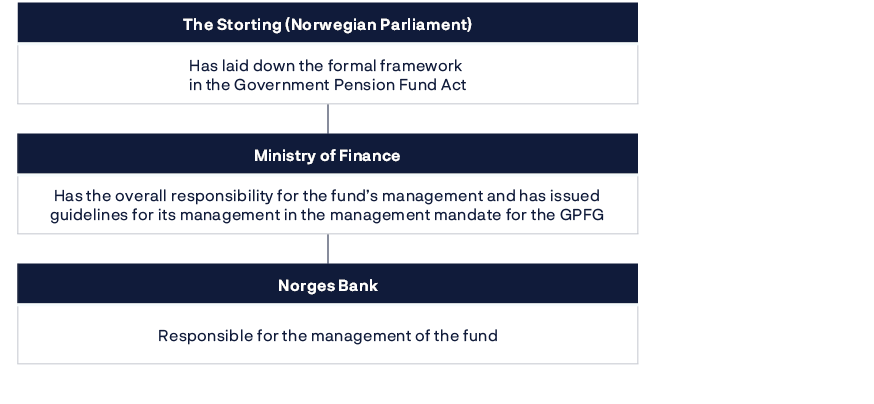
Norges Bank’s governance structure
The Executive Board of Norges Bank has delegated responsibility for the management of the GPFG to the Chief Executive Officer (CEO) of Norges Bank Investment Management.
The CEO of Norges Bank Investment Management is authorised through a job description and an investment mandate. The Executive Board has issued principles for, among other things, risk management, responsible investment and remuneration for employees in Norges Bank Investment Management. Internationally recognised standards are applied for valuation and performance measurement, as well as for the management, measurement and control of risk. Reporting to the Executive Board is carried out monthly, and more extensively on a quarterly basis. The Governor of Norges Bank and the Executive Board are notified immediately in the event of special events or significant matters.
Investment responsibilities within Norges Bank Investment Management are further delegated through investment mandates. Responsibility for processes and personnel is delegated through job descriptions, while process requirements are described in policies and guidelines. The composition of the leader group and the delegation of authority shall ensure segregation of duties between the investment areas, trading, operations, risk management and compliance and control.
Chart 9.2 Norges Bank’s governance structure
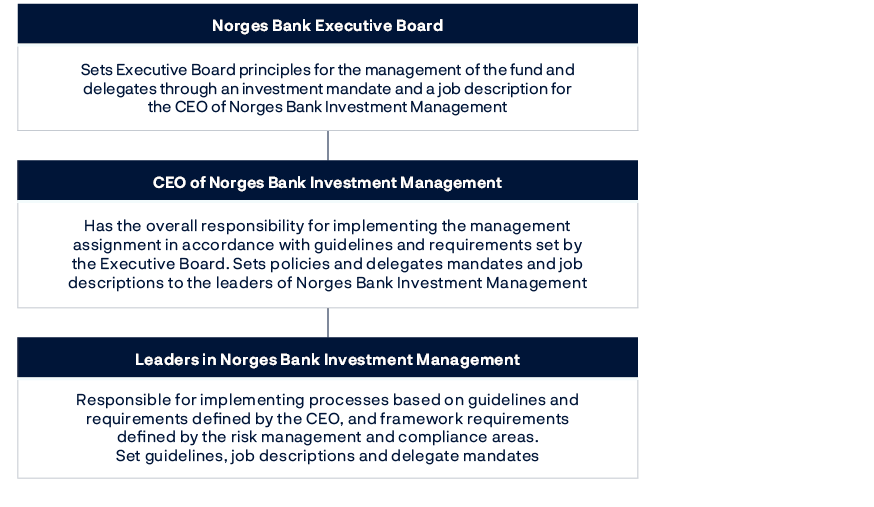
The NBIM leader group investment committee complements the delegation of responsibility by advising on investment risk management and the portfolio’s investment universe.
Requirements for internal risk reporting are set by the CEO of Norges Bank Investment Management, through job descriptions within the risk area. Reporting to the CEO is done on a daily, weekly and monthly basis. The CEO shall be notified immediately of any special events or serious breaches of the investment mandate.
Framework for investment risk
The management mandate for the GPFG includes several limits and restrictions for the combined equity and bond asset class, as well as within the individual asset classes. Investments in unlisted real estate and unlisted renewable energy infrastructure are regulated by a separate management framework in the investment mandate. The framework underpins how a diversified exposure to unlisted real estate and unlisted infrastructure shall be established and managed.
Clear roles and responsibilities are a cornerstone of process design at Norges Bank Investment Management. Changes to investment mandates, the portfolio hierarchy and new counterparties are monitored and require approval from the Chief Risk Officer (CRO), or a person authorised by the CRO.
The Executive Board’s principles for risk management are further described in policies and guidelines. Responsibility for effective processes related to risk management is delegated to the CRO and the Chief Corporate Governance & Compliance Officer.
Risk management is defined as the management of market risk, credit risk, counterparty risk, operational risk and risk related to environmental, social and governance factors. The first three are defined as investment risk. The investment area in Norges Bank Investment Management is responsible for managing risk in the portfolio and in individual mandates, while the risk management areas independently measure, manage and report investment risk across the portfolio, at asset class level and other levels within the portfolio that reflect the investment process. Separate risk assessments are required in advance of investments in unlisted real estate and unlisted infrastructure.
Table 9.1 Investment risk
|
Type |
Market risk |
Credit risk |
Counterparty risk |
|---|---|---|---|
|
Definition |
Risk of loss or a change in the market value of the portfolio, or parts of the portfolio, due to changes in financial market variables, real estate and infrastructure values |
Risk of loss due to a bond issuer not meeting its payment obligations |
Risk of loss due to counterparty bankruptcy or other events leading to counterparties defaulting |
|
Main dimensions |
Measured both absolute and relative to the benchmark - Volatility and correlation risk - Systematic factor risk - Liquidity risk |
Measured at single issuer and portfolio levels - Probability of default - Loss given default - Correlation between instruments and issuers at portfolio level |
Measured risk exposure by type of position - Derivatives including FX contracts - Securities lending - Unsecured bank deposits - Repurchase and reverse repurchase agreements - Prime brokerage - Settlement risk towards counterparties and long-settlement transactions |
Investment risk - market risk
Norges Bank Investment Management defines market risk as the risk of loss or a change in the market value of the portfolio, or parts of the portfolio, due to changes in financial market variables, as well as real estate and infrastructure values. Market risk for the investment portfolio, both absolute and relative to the benchmark, is measured along the dimensions concentration risk, volatility and correlation risk, systematic factor risk and liquidity risk. For unlisted real estate, this involves measurement of the share of real estate under construction, vacancy, tenant concentration and geographical concentration. For unlisted infrastructure, this involves measurement of exposure towards different sectors, share of income from government subsidies, construction exposure and geographical concentration. Market risk is actively taken to generate investment returns in line with the objectives of the investment mandates.
Investment risk – credit risk
Norges Bank Investment Management defines credit risk as the risk of loss resulting from a bond issuer defaulting on their payment obligations. Credit risk is measured both in relation to individual issuers, where the probability of default and loss given default are taken into account, and at portfolio level, where the correlation of credit losses between instruments and issuers is taken into account. Credit risk is actively taken to generate investment returns in line with the objectives of the investment mandates.
Investment risk – counterparty risk
Norges Bank Investment Management defines counterparty risk as the risk of loss due to counterparty bankruptcy or other events leading to counterparties defaulting. Counterparties are necessary to ensure effective liquidity management and effective trading and management of market and credit risk. Counterparty risk also arises in connection with securities lending and the management of the equity and bond portfolios, as well as the real estate and infrastructure portfolios. Counterparty risk is controlled and limited to the greatest extent possible, given the investment strategy.
Risk management process
Norges Bank Investment Management employs several measurement methodologies, processes and systems to control investment risk. Robust and recognised risk management systems and processes are complemented by internally developed measurement methodologies and processes.
Market risk
Norges Bank Investment Management measures market risk both for the actual portfolio, and the relative market risk for holdings in the GPFG.
Continuous monitoring, measurement and assessment of market risk is carried out across multiple risk dimensions, using various methods and approaches. By combining different and complementary risk measures, greater insight is gained into the risk profile of the GPFG’s holdings.
Concentration risk
Concentration analysis complements statistical risk estimation by describing the concentration of a single exposure or a group of exposures. More concentrated portfolios tend to contribute to less diversification. Concentration is measured across different dimensions depending on the asset class, including country, currency, sector, issuer and company exposure.
The portfolio is invested across several asset classes, countries and currencies, as shown in table 9.2.
Table 9.2 Allocation by asset class, country and currency
|
Asset class |
Market value in percent by country and currency1 |
Market value by asset class in percent |
Market value by asset class in NOK million |
||||||
|---|---|---|---|---|---|---|---|---|---|
|
31.12.2025 |
31.12.2024 |
||||||||
|
Market |
31.12.2025 |
Market |
31.12.2024 |
31.12.2025 |
31.12.2024 |
||||
|
Equities |
Developed |
89.0 |
Developed |
89.2 |
|||||
|
US |
53.6 |
US |
54.7 |
||||||
|
Japan |
6.4 |
Japan |
6.6 |
||||||
|
UK |
4.8 |
UK |
5.2 |
||||||
|
Germany |
3.3 |
Switzerland |
3.2 |
||||||
|
Switzerland |
3.2 |
Germany |
3.2 |
||||||
|
Total other |
17.7 |
Total other |
16.3 |
||||||
|
Emerging |
11.0 |
Emerging |
10.8 |
||||||
|
China |
3.6 |
China |
3.3 |
||||||
|
Taiwan |
2.7 |
India |
2.5 |
||||||
|
India |
2.1 |
Taiwan |
2.5 |
||||||
|
South Africa |
0.6 |
Brazil |
0.4 |
||||||
|
Brazil |
0.4 |
South Africa |
0.4 |
||||||
|
Total other |
1.6 |
Total other |
1.7 |
||||||
|
Total equities |
71.28 |
71.44 |
15 173 080 |
14 112 924 |
|||||
|
Bonds |
Developed |
99.8 |
Developed |
100.0 |
|||||
|
US dollar |
53.8 |
US dollar |
54.4 |
||||||
|
Euro |
27.6 |
Euro |
27.4 |
||||||
|
Japanese yen |
5.4 |
Japanese yen |
5.9 |
||||||
|
British pound |
4.6 |
British pound |
4.6 |
||||||
|
Canadian dollar |
4.0 |
Canadian dollar |
3.8 |
||||||
|
Total other |
4.4 |
Total other |
4.0 |
||||||
|
Emerging2 |
0.2 |
Emerging2 |
0.0 |
||||||
|
Total bonds |
26.54 |
26.59 |
5 649 375 |
5 253 095 |
|||||
|
Unlisted real estate |
US |
43.6 |
US |
50.0 |
|||||
|
UK |
23.6 |
UK |
20.1 |
||||||
|
France |
17.4 |
France |
14.8 |
||||||
|
Germany |
5.2 |
Germany |
5.0 |
||||||
|
Switzerland |
3.0 |
Switzerland |
3.0 |
||||||
|
Total other |
7.2 |
Total other |
7.2 |
||||||
|
Total unlisted real estate |
1.75 |
1.84 |
372 377 |
363 583 |
|||||
|
Total unlisted infrastructure |
0.43 |
0.13 |
91 335 |
25 348 |
|||||
|
Market value investment portfolio3 |
21 286 167 |
19 754 950 |
|||||||
1 Market value in percentage by country and currency includes derivatives and cash. At year-end 2025, the difference between market value for the unlisted infrastructure asset class and balance sheet value is NOK 31 billion. This is cash allocated to the asset class that has not yet been distributed to the subsidiaries.
2 The share of individual emerging market currencies in the fixed income portfolio is insignificant.
3 Market value investment portfolio is exclusive of Management fee payable and Deferred tax.
At the end of 2025, the equity portfolio’s share of the fund was 71.3 percent, down from 71,4 percent at year-end 2024. The bond portfolio’s share of the fund was 26.5 percent, down from 26.6 percent at year-end 2024. Unlisted real estate amounted to 1.7 percent of the fund at year-end, compared to 1.8 percent at year-end 2024. Unlisted infrastructure amounted to 0.4 percent of the fund at year-end, an increase from 0.1 percent at year-end 2024.
For equity investments, concentration in the portfolio is further measured by sector. Table 9.3 shows the composition of the equity asset class by sector.
Table 9.3 Allocation of equity investments by sector1, percent
|
Sector |
31.12.2025 |
31.12.2024 |
|---|---|---|
|
Technology |
28.5 |
27.9 |
|
Financials |
16.9 |
15.9 |
|
Consumer discretionary |
13.2 |
14.8 |
|
Industrials |
12.7 |
13.1 |
|
Health care |
9.3 |
10.2 |
|
Real estate |
4.2 |
5.1 |
|
Consumer staples |
3.8 |
4.8 |
|
Basic materials |
3.4 |
3.2 |
|
Telecommunications |
2.9 |
3.0 |
|
Energy |
2.8 |
3.3 |
|
Utilities |
2.4 |
2.4 |
1 Does not sum up to 100 percent because cash and derivatives are not included.
The GPFG has substantial investments in government-issued bonds. Table 9.4 shows the largest holdings in bonds issued by governments. These include government bonds issued in local and foreign currency and inflation-linked bonds issued in local currency.
Table 9.4 Largest holdings within the segment government bonds
|
Amounts in NOK million |
Market value 31.12.2025 |
Amounts in NOK million |
Market value 31.12.2024 |
|
|---|---|---|---|---|
|
US |
2 010 684 |
US |
1 788 943 |
|
|
Japan |
267 116 |
Japan |
275 041 |
|
|
Germany |
249 680 |
Germany |
267 331 |
|
|
UK |
201 926 |
Singapore |
221 803 |
|
|
Canada |
95 902 |
UK |
174 860 |
|
|
Singapore |
95 491 |
Canada |
120 290 |
|
|
France |
94 301 |
France |
96 876 |
|
|
Netherlands |
84 137 |
Italy |
92 413 |
|
|
Italy |
82 936 |
Netherlands |
78 868 |
|
|
Spain |
64 632 |
Spain |
56 684 |
The portfolio is also invested in companies that issue both equities and bonds. Table 9.5 shows the portfolio’s largest holdings of non-government issuers, including both bond and equity holdings. Covered bonds issued by financial institutions and debt issued by other underlying companies are included in the bonds column.
Table 9.5 Largest holdings excluding sovereigns, both bonds and equities
|
Amounts in NOK million, 31.12.2025 |
Sector |
Equities |
Bonds |
Total |
|---|---|---|---|---|
|
NVIDIA Corp |
Technology |
573 855 |
2 725 |
576 580 |
|
Apple Inc |
Technology |
496 547 |
3 081 |
499 628 |
|
Microsoft Corp |
Technology |
458 595 |
661 |
459 256 |
|
Alphabet Inc |
Technology |
439 314 |
8 099 |
447 413 |
|
Amazon.com Inc |
Consumer discretionary |
307 904 |
5 844 |
313 748 |
|
Taiwan Semiconductor Manufacturing Co Ltd |
Technology |
228 828 |
- |
228 828 |
|
Broadcom Inc |
Technology |
215 637 |
4 308 |
219 945 |
|
Meta Platforms Inc |
Technology |
195 643 |
11 257 |
206 901 |
|
Tesla Inc |
Consumer discretionary |
161 449 |
- |
161 449 |
|
JPMorgan Chase & Co |
Financials |
113 138 |
22 882 |
136 020 |
|
Amounts in NOK million, 31.12.2024 |
Sector |
Equities |
Bonds |
Total |
|---|---|---|---|---|
|
Apple Inc |
Technology |
524 828 |
3 729 |
528 557 |
|
Microsoft Corp |
Technology |
496 984 |
1 152 |
498 136 |
|
NVIDIA Corp |
Technology |
488 070 |
3 949 |
492 019 |
|
Alphabet Inc |
Technology |
332 449 |
2 224 |
334 672 |
|
Amazon.com Inc |
Consumer discretionary |
306 414 |
6 372 |
312 786 |
|
Meta Platforms Inc |
Technology |
224 314 |
9 466 |
233 780 |
|
Broadcom Inc |
Technology |
189 808 |
3 768 |
193 575 |
|
Taiwan Semiconductor Manufacturing Co Ltd |
Technology |
174 541 |
- |
174 541 |
|
Tesla Inc |
Consumer discretionary |
161 402 |
- |
161 402 |
|
JPMorgan Chase & Co |
Financials |
92 806 |
32 365 |
125 172 |
Table 9.6 shows the composition of the unlisted real estate asset class by sector.
Table 9.6 Distribution of unlisted real estate investments by sector, percent
|
Sector |
31.12.2025 |
31.12.2024 |
|---|---|---|
|
Office |
47.5 |
48.0 |
|
Logistics |
35.0 |
37.0 |
|
Retail |
15.6 |
12.6 |
|
Other |
1.8 |
2.4 |
|
Total |
100.0 |
100.0 |
Volatility and correlation risk
Norges Bank Investment Management uses models to quantify the risk of fluctuations in value for all or parts of the portfolio. Volatility is a standard risk measure based on the statistical concept of standard deviation, which takes into account the correlation between different investments in the portfolio. Expected volatility is defined as one standard deviation. This risk measure provides an estimate of how much the current portfolio value can be expected to fluctuate during the course of a year, based on market conditions over the past three years. In two out of three years, the portfolio’s return is expected to fall within the negative and positive value of the metric. Expected volatility can be expressed in terms of the portfolio’s absolute or relative risk. Norges Bank Investment Management uses the same model for both portfolio risk and relative volatility.
All the fund’s investments are included in the calculation of expected relative volatility and are measured against the fund’s benchmark index consisting of global equity and bond indices.
Modelling unlisted investments is challenging due to limited or no historical prices. For investments in unlisted real estate, the exposure to a group of relevant risk factors is mapped in MSCI’s Barra Private Real Estate 2 (PRE2) model framework. These factors are determined by key attributes such as location and property type. The model uses time series of valuations and actual transactions as a starting point, but also incorporates listed real estate shares to establish representative, daily time series. For investments in unlisted infrastructure, the approach is based on a combination of time series available in the existing framework for listed markets. The exposure to generic listed risk factors is mapped for each project based on attributes such as the share of contractually agreed prices, project lifetime, project phase, sector, country, and counterparty quality.
MSCI’s risk model then uses these mapped factors for unlisted investments in the same way as standard equity and fixed-income risk factors, to calculate expected absolute and relative volatility, as well as expected shortfall for the fund’s investments.
Calculation of expected volatility
Expected volatility of the portfolio, and volatility relative to the benchmark index, is estimated using a parametric calculation method based on current investments. The model equally weights weekly return data over a sampling period of three years.
Tables 9.7 and 9.8 present risk both in terms of the portfolio’s absolute risk and relative risk.
Table 9.7 Portfolio risk, expected volatility, percent
|
Expected volatility, actual portfolio |
||||||||
|---|---|---|---|---|---|---|---|---|
|
31.12.2025 |
Min 2025 |
Max 2025 |
Average 2025 |
31.12.2024 |
Min 2024 |
Max 2024 |
Average 2024 |
|
|
Portfolio |
10.9 |
10.5 |
11.5 |
11.2 |
11.2 |
10.2 |
11.3 |
10.8 |
|
Equities |
13.2 |
12.7 |
13.9 |
13.5 |
13.9 |
12.4 |
14.0 |
13.1 |
|
Bonds |
10.1 |
10.1 |
11.2 |
10.5 |
10.7 |
10.7 |
11.1 |
10.9 |
|
Unlisted real estate |
13.7 |
13.6 |
14.1 |
13.9 |
13.8 |
12.7 |
13.9 |
13.1 |
|
Unlisted infrastructure |
11.3 |
9.8 |
25.7 |
13.0 |
23.9 |
23.9 |
54.0 |
39.6 |
Table 9.8 Relative risk measured against the fund's reference index, expected relative volatility, basis points
|
Expected relative volatility |
||||||||
|---|---|---|---|---|---|---|---|---|
|
31.12.2025 |
Min 2025 |
Max 2025 |
Average 2025 |
31.12.2024 |
Min 2024 |
Max 2024 |
Average 2024 |
|
|
Portfolio |
37 |
37 |
45 |
42 |
44 |
34 |
44 |
37 |
Risk measured as expected volatility indicates an expected annual value fluctuation in the fund of 10.9 percent, or approximately NOK 2 300 billion at the end of 2025, down from 11.2 percent at year-end 2024. Expected volatility for the equity portfolio was 13.2 percent at year-end, down from 13.9 percent at year-end 2024, while expected volatility for the fixed-income portfolio was 10.1 percent, compared to 10.7 percent at year-end 2024.
The management mandate stipulates that expected relative volatility for the fund shall not exceed 1.25 percentage points. The measurement of risk and monitoring of the limit is done based on the risk model described above. The fund’s expected relative volatility was 37 basis points at the end of 2025, down from 44 basis points at year-end 2024. The decrease in the fund’s expected relative volatility in 2025 is mainly due to decreased relative volatility from equity investments.
In addition to the aforementioned model, other risk models are used that take greater account of recent market dynamics and models that measure tail risk.
Expected shortfall is a tail risk measure that quantifies the expected loss of a portfolio in extreme market situations. The measure is calculated using historical simulations. The Executive Board has determined that the fund shall be managed so that the annual expected shortfall measured against the benchmark index does not exceed 3.75 percentage points. Expected shortfall is measured and monitored based on the risk model described above. At year-end, expected shortfall was 1.01 percentage points, compared to 1.18 percentage points at year-end 2024.
Calculation of expected shortfall
Expected shortfall for the portfolio, measured against its benchmark index, is estimated using historical simulations based on current investments. The model equally weights weekly returns over a sampling period from January 2007 to the end of the last accounting period, so that the measure can capture extreme market movements. Expected shortfall is calculated as the average of losses beyond the 97.5th percentile, i.e. the expected loss when the outcome belongs to the worst 2.5 percent of weekly returns.
Strengths and weaknesses
The strength of these types of risk model is that one can estimate the risk associated with a portfolio across different asset classes, markets, currencies, securities and derivatives, and express this risk as a single numerical value that takes into account the correlation between different asset classes, securities and risk factors, as well as capturing deviations from a normal distribution.
The model-based risk estimates are based on historical relationships in the markets and are expected to provide reliable forecasts in markets without significant changes in volatility and correlation. Estimates will be less reliable in periods marked by significant changes in volatility and correlation. Calculated volatility gives a point estimate of risk but provides little information on the overall risk profile and potential tail risk. Annualisation implies that volatility and the composition of the portfolio are assumed to be constant over time. To compensate for these shortcomings, complementary models and methods are employed, such as stress tests and analyses of concentration risk and realised returns.
Verification of models
Risk models used in estimating and controlling investment risk are continuously evaluated and verified for their ability to estimate risk. The special nature of the investment portfolio and the investment universe, as well as the GPFG’s long-term investment horizon, are taken into account when evaluating the models.
Credit risk
Credit risk is the risk of losses resulting from issuers of bonds defaulting on their payment obligations. Fixed-income instruments in the portfolio’s benchmark index are all rated investment grade by one of the major credit rating agencies. Investments in bonds are made based on internal assessments with regards to expected return and risk profile.
Table 9.9 Bond portfolio specified by external credit rating
|
Amounts in NOK million, 31.12.2025 |
AAA |
AA |
A |
BBB |
BB+ and |
Total |
|---|---|---|---|---|---|---|
|
Government bonds |
576 052 |
2 040 965 |
451 447 |
89 207 |
28 986 |
3 186 656 |
|
Government-related bonds |
246 443 |
194 223 |
46 408 |
22 117 |
3 900 |
513 092 |
|
Inflation-linked bonds |
63 886 |
224 239 |
27 216 |
26 483 |
738 |
342 561 |
|
Corporate bonds |
5 168 |
98 910 |
669 435 |
615 070 |
24 281 |
1 412 864 |
|
Securitised bonds |
302 672 |
24 826 |
2 763 |
- |
- |
330 261 |
|
Total bonds1 |
1 194 221 |
2 583 164 |
1 197 267 |
752 876 |
57 905 |
5 785 434 |
|
Amounts in NOK million, 31.12.2024 |
AAA |
AA |
A |
BBB |
BB+ and |
Total |
|---|---|---|---|---|---|---|
|
Government bonds |
729 896 |
1 925 725 |
345 833 |
128 129 |
35 051 |
3 164 634 |
|
Government-related bonds |
266 286 |
168 844 |
33 055 |
22 088 |
2 392 |
492 665 |
|
Inflation-linked bonds |
52 249 |
216 988 |
16 470 |
18 084 |
- |
303 792 |
|
Corporate bonds |
10 371 |
93 141 |
614 581 |
565 884 |
18 375 |
1 302 352 |
|
Securitised bonds |
270 150 |
32 744 |
2 102 |
- |
- |
304 996 |
|
Total bonds1 |
1 328 952 |
2 437 443 |
1 012 041 |
734 185 |
55 818 |
5 568 439 |
1 At year-end 2025, bonds received as collateral amounting to NOK 13.7 billion were sold. At year-end 2024, NOK 1.5 billion were sold. These bonds are presented in the balance sheet as a liability under Secured borrowing.
The market value of the bond portfolio increased to NOK 5 785 billion at year-end 2025, from NOK 5 568 billion at year-end 2024. The share of holdings in corporate bonds increased by 1.0 percentage point during the year, to 24.4 percent of the bond portfolio at year-end 2025. Government bonds, including inflation-linked bonds, constituted 61.0 percent of the bond portfolio at year-end, a reduction of 1.3 percentage points compared to year-end 2024.
The share of bonds with credit rating AAA was reduced by 3.3 percentage points during the year, to 20.6 percent at year-end 2025. The decrease was mainly due to a reduction in the holdings of Singapore government bonds in the period. The share of the bond portfolio with credit rating A increased by 2.5 percentage points during the year, mainly driven by a downgrade of French government bonds to A from AA. The share of the bond portfolio with credit rating BBB decreased by 0.2 percentage point compared to year-end 2024, to 13.0 percent at year-end 2025.
The share of bonds in the category BB+ and lower was 1.0 percent at year-end 2025, unchanged from year-end 2024. The largest holding of bonds in this category was government bonds issued by South Africa. Defaulted bonds had a market value of NOK 7.1 million at year-end 2025, compared to NOK 13.8 million at year-end 2024. Defaulted bonds are grouped under BB+ and lower.
Table 9.10 Bond portfolio by external credit rating and currency, percent
|
31.12.2025 |
AAA |
AA |
A |
BBB |
BB+ and |
Total |
|---|---|---|---|---|---|---|
|
US dollar |
0.6 |
36.5 |
7.4 |
7.0 |
0.3 |
51.7 |
|
Euro |
12.0 |
2.3 |
7.3 |
4.5 |
0.2 |
26.2 |
|
British pound |
0.1 |
3.6 |
0.5 |
0.6 |
- |
4.8 |
|
Japanese yen |
- |
- |
4.6 |
0.0 |
- |
4.7 |
|
Canadian dollar |
2.6 |
1.0 |
0.4 |
0.4 |
- |
4.3 |
|
Other currencies |
5.4 |
1.3 |
0.5 |
0.6 |
0.5 |
8.2 |
|
Total |
20.6 |
44.6 |
20.7 |
13.0 |
1.0 |
100.0 |
|
31.12.2024 |
AAA |
AA |
A |
BBB |
BB+ and |
Total |
|---|---|---|---|---|---|---|
|
US dollar |
0.9 |
34.0 |
7.6 |
6.8 |
0.2 |
49.4 |
|
Euro |
12.3 |
4.6 |
4.5 |
4.5 |
0.1 |
26.0 |
|
Japanese yen |
- |
- |
5.0 |
0.0 |
- |
5.0 |
|
Canadian dollar |
3.3 |
0.9 |
0.5 |
0.3 |
- |
5.0 |
|
British pound |
0.1 |
3.2 |
0.4 |
0.5 |
- |
4.4 |
|
Other currencies |
7.3 |
1.2 |
0.2 |
1.0 |
0.6 |
10.2 |
|
Total |
23.9 |
43.8 |
18.2 |
13.2 |
1.0 |
100.0 |
At year-end 2025, investments in purchased credit default swaps had a nominal value of NOK 209.3 billion, an increase from NOK 173.8 billion at year-end 2024. 15.0 percent of these were in the category where the underlying issuers have a low credit rating. See table 5.3 in note 5 Holdings of equities, bonds and financial derivatives for further information. When investing in purchased credit default swaps, the credit risk in the bond portfolio is reduced when the portfolio has investments in the same underlying bonds as the credit default swaps. At year-end 2025, credit risk exposure was reduced by NOK 100.6 billion as a result of purchased credit default swaps, compared to a reduction of NOK 79.5 billion at year-end 2024.
In addition to credit ratings from credit rating agencies, credit risk measurement is complemented by two credit risk models, one of which is based on credit ratings and the other on observable credit premiums. Both of these methods also take into account the correlation and expected value of bonds in a bankruptcy situation. The models also consider credit default swaps, which reduce or increase credit risk depending on whether credit risk is purchased or sold. The models are used for risk measurement and monitoring of credit risk in the fixed-income portfolio. The overall credit quality of the bond portfolio was virtually unchanged from year-end 2024 to year-end 2025.
Counterparty risk
Counterparties are necessary for trading in markets and for ensuring effective management of liquidity, market and credit risk. Counterparty risk exposure is related to trading in derivatives and foreign exchange contracts, securities lending, and repurchase and reverse repurchase agreements. Counterparty risk also arises in connection with unsecured bank deposits and the daily liquidity management of the fund, as well as purchases and sales of unlisted real estate and unlisted infrastructure. There is further exposure to counterparty risk related to counterparties in the international settlement and custody systems where transactions are settled. This can occur both in currency trading and in the purchase and sale of securities. Settlement risk and exposure from trades with a long settlement period are also defined as counterparty risk.
Multiple counterparties are used to reduce concentration and there are strict requirements for counterparty credit rating. Credit rating requirements are generally higher for counterparties to unsecured deposits in banks than where collateral is received. Changes in counterparty credit ratings are monitored continuously.
To reduce counterparty risk, netting agreements are used for trades in OTC derivatives, currency contracts, as well as repurchase and reverse repurchase agreements. Many derivatives are also cleared, such that counterparty risk is primarily towards the clearing house instead of banks. Further reduction of counterparty risk is ensured by requirements for collateral for counterparty net positions with a positive market value. For instruments where collateral is used, minimum requirements have been set relating to the credit quality, time to maturity and concentration of the collateral. Netting and collateral agreements are entered into for all approved counterparties for these types of trades.
Requirements are also set for how real estate and infrastructure transactions are conducted, to ensure acceptable counterparty risk. Counterparty risk that arises during the acquisition process is analysed in advance of the transaction and requires approval from the CRO. In 2025, 16 real estate transactions were analysed and approved by the CRO through this process, compared to 14 transactions in 2024. In 2025, 6 investments in unlisted infrastructure were analysed and approved by the CRO through this process, compared to 4 in 2024.
Counterparty risk is also limited by setting exposure limits for individual counterparties. In most instances, the exposure limit is determined by the counterparty’s credit rating, where counterparties with strong credit rating have a higher limit than counterparties with weaker credit rating. Exposure per counterparty is measured daily against established limits set by the Executive Board and the CEO of Norges Bank Investment Management.
The methods used to calculate counterparty risk are in accordance with internationally recognised standards. As a rule, the Basel regulations for banks are used for measuring counterparty risk, with some adjustments based on internal analyses. The risk model calculates the expected counterparty exposure in the event of a counterparty default. The Standardised Approach in the Basel regulations (SA-CCR) is used for derivatives and foreign exchange contracts. The Standardised Approach takes into account collateral received and netting arrangements when calculating counterparty risk.
For repurchase agreements, securities lending transactions executed through an external agent and securities posted as collateral in derivative trades, a method is used where a premium is added to the market value to reflect the position’s volatility. When determining counterparty risk exposure for these positions, an adjustment is also made for netting and actual collateral received and posted. There is also counterparty risk in connection with investment strategies for equities facilitated by prime brokers.
Exposure to counterparty risk is linked to counterparties in the settlement and custody systems, both for currency trades and for the purchase and sale of securities. Settlement risk is reduced using the currency settlement system CLS (Continuous Linked Settlement), or by trading directly with the settlement bank. For some currencies, Norges Bank is exposed to settlement risk when the sold currency is delivered to the counterparty before the receipt of currency is confirmed. This type of exposure is included on the line Settlement risk towards counterparties and long settlement transactions in table 9.11.
Total counterparty risk increased to NOK 310.3 billion at year-end 2025, from NOK 296.7 billion at year-end 2024. The largest increase in counterparty risk exposure came from securities lending, while there was a decrease in the counterparty risk exposure from derivatives including foreign exchange contracts. Derivatives including foreign exchange contracts accounted for 43.4 percent of the total counterparty risk at year end, and decreased by 17.3 billion compared to year-end 2024. The decrease is due to lower risk exposure from both foreign exchange contracts and derivatives throughout the year.
Counterparty risk exposure from the securities lending programme increased to NOK 120.8 billion at year-end 2025, from NOK 105.9 billion at year-end 2024. The increase was mainly due to higher equity lending in the programme at year-end 2025. Both equities and bonds are lent through the securities lending programme. Counterparty risk exposure from securities lending accounted for 38.9 percent of the fund’s total counterparty risk exposure at the end of 2025, compared to 35.7 percent at the end of 2024.
In table 9.11, exposure is broken down by type of activity/instrument associated with counterparty risk.
Table 9.11 Counterparty risk by type of position
|
Amounts in NOK million |
Risk exposure |
|
|---|---|---|
|
31.12.2025 |
31.12.2024 |
|
|
Derivatives including foreign exchange contracts |
134 734 |
152 047 |
|
Securities lending |
120 786 |
105 908 |
|
Unsecured bank deposits1 |
29 176 |
23 518 |
|
Repurchase and reverse repurchase agreements |
11 754 |
14 316 |
|
Prime brokerage |
6 409 |
554 |
|
Settlement risk towards counterparties and long-settlement transactions |
7 443 |
344 |
|
Total |
310 301 |
296 687 |
1 Includes bank deposits in non-consolidated subsidiaries.
Norges Bank’s counterparties have a credit rating from independent credit rating agencies or a documented internal credit rating. Credit ratings for counterparties are monitored and complemented by alternative credit risk indicators.
Table 9.12 shows approved counterparties classified according to credit rating category. The table also includes brokers used when purchasing and selling securities.
Table 9.12 Counterparties by credit rating1
|
Norges Bank's counterparties |
Brokers |
|||
|---|---|---|---|---|
|
31.12.2025 |
31.12.2024 |
31.12.2025 |
31.12.2024 |
|
|
AAA |
3 |
3 |
1 |
1 |
|
AA |
45 |
43 |
45 |
45 |
|
A |
71 |
64 |
91 |
88 |
|
BBB |
10 |
9 |
36 |
34 |
|
BB |
2 |
2 |
28 |
25 |
|
B |
- |
- |
4 |
5 |
|
Total |
131 |
121 |
205 |
198 |
1 The table shows the number of legal entities. The same legal entity can be included as both broker and counterparty.
The total number of counterparties and brokers increased slightly during the year. There were 131 counterparties at year-end 2025, compared to 121 at year-end 2024. The number of brokers increased to 205 at year-end 2025, from 198 at year-end 2024. The overall credit quality of brokers and counterparties remained unchanged from year-end 2024.
Leverage
Leverage may be used to ensure efficient management of investments within the equity and bond portfolios, but not with the aim of increasing the economic exposure to risky assets. The use of leverage is regulated both in the management mandate and in the investment mandate. Leverage is the difference between total net exposure and market value of the portfolio. Net exposure is determined by including securities at market value, cash at nominal value and positions in derivatives by converting them to the underlying exposure. When the exposure is greater than market value, the portfolio is leveraged.
The GPFG’s leverage was 0.1 percent for the aggregated equity and bond portfolio at the end of 2025, compared to 1.2 percent at the end of 2024. For investments in unlisted real estate, requirements are set in the investment mandate, limiting the maximum leverage of the portfolio to 25 percent. The unlisted real estate investments had a debt ratio of 9.3 percent at the end of 2025, compared to 8.0 percent at the end of 2024. For investments in unlisted infrastructure, the maximum leverage of the portfolio is limited to 60 percent. At year-end 2025, the investments in unlisted infrastructure had a debt ratio of 12.9 percent, compared to 29.4 percent at year end 2024.
Sale of securities Norges Bank does not own
Sale of securities not owned by Norges Bank (short sales) can only be carried out if there are established borrowing agreements to cover a negative position. Such transactions amounted to NOK 48.7 billion at year-end 2025.
Note 10 Tax
Accounting policy
Investment income and gains of the GPFG are exempt from income tax in Norway, but may be subject to taxes in foreign jurisdictions.
Tax expense in the income statement represents income taxes that are not reimbursed through local tax laws or treaties, and consists of taxes on dividends, interest income and capital gains related to the GPFG’s investments in equities and bonds, tax on fee income from secured lending and taxes in consolidated subsidiaries. The majority of these taxes are collected at source.
Withholding taxes, net of deductions for refundable amounts, are recognised at the same time as the related dividend or interest income. See the accounting policy in note 4 Income/expense from equities, bonds and financial derivatives.
Other income tax, which is not collected at source, is recognised in the income statement in the same period as the related income or gain and presented in the balance sheet as a liability within Other liabilities, until it has been settled. Deferred tax in the balance sheet mainly consists of capital gains tax. Capital gains tax is recognised as a liability based on the expected future payment when the GPFG is in a gain position in the applicable market. No deferred tax asset is presented in the balance sheet when the GPFG is in a loss position, since the recognition criteria are not considered to be met.
Tax incurred in subsidiaries presented in the balance sheet lines Unlisted real estate and Unlisted infrastructure is recognised in the income statement as Income/expense from unlisted real estate and Income/expense from unlisted infrastructure, respectively. Only the tax expense in consolidated subsidiaries is included in the income statement line Tax expense. This is specified in table 10.1 in the line Other.
All uncertain tax positions, such as disputed withholding tax refunds, are assessed each reporting period. The best estimate of the probable reimbursement or payment is recognised in the balance sheet.
Table 10.1 shows tax expense by type of investment and type of tax.
Table 10.1 Specification tax expense
|
Amounts in NOK million, 2025 |
Gross income before taxes |
Income tax on dividends, interest and fees |
Capital gains tax |
Other |
Tax expense |
Net income after taxes |
|---|---|---|---|---|---|---|
|
Income/expense from: |
||||||
|
Equities |
2 115 405 |
-8 846 |
-2 070 |
- |
-10 916 |
2 104 489 |
|
Bonds |
243 405 |
-5 |
-39 |
- |
-44 |
243 361 |
|
Secured lending |
20 801 |
-187 |
- |
- |
-187 |
20 614 |
|
Other |
- |
- |
- |
-10 |
-10 |
- |
|
Tax expense1 |
-9 038 |
-2 109 |
-10 |
-11 157 |
1 The rules on global minimum taxation (Pillar 2) have no economic impact for the GPFG, and the tax expense for the period included no Pillar 2 income taxes.
|
Amounts in NOK million, 2024 |
Gross income before taxes |
Income tax on dividends, interest and fees |
Capital gains tax |
Other |
Tax expense |
Net income after taxes |
|---|---|---|---|---|---|---|
|
Income/expense from: |
||||||
|
Equities |
2 454 653 |
-8 522 |
-8 393 |
- |
-16 915 |
2 437 738 |
|
Bonds |
70 889 |
-36 |
-4 |
- |
-40 |
70 849 |
|
Secured lending |
21 622 |
-246 |
- |
- |
-246 |
21 376 |
|
Other |
- |
- |
- |
-10 |
-10 |
- |
|
Tax expense1 |
-8 804 |
-8 397 |
-10 |
-17 211 |
1 The rules on global minimum taxation (Pillar 2) have no economic impact for the GPFG, and the tax expense for the period included no Pillar 2 income taxes.
Table 10.2 shows receivables and liabilities recognised in the balance sheet related to tax.
Table 10.2 Specification balance sheet items related to tax
|
Amounts in NOK million |
31.12.2025 |
31.12.2024 |
|---|---|---|
|
Withholding tax receivable |
11 594 |
17 938 |
|
Tax payable1 |
30 |
40 |
|
Deferred tax |
10 744 |
13 170 |
1 Included in the balance sheet line Other liabilities.
Table 10.3 specifies the line Net payment of taxes in the statement of cash flows.
Table 10.3 Specification net payment of taxes
|
Amounts in NOK million |
2025 |
2024 |
|---|---|---|
|
Receipt of refunded withholding tax |
14 512 |
8 494 |
|
Payment of taxes |
-20 086 |
-29 204 |
|
Net payment of taxes |
-5 574 |
-20 710 |
Note 11 Foreign exchange gains and losses
In accordance with the management mandate, the fund is not invested in securities issued by Norwegian companies, securities denominated in Norwegian kroner nor real estate or infrastructure located in Norway. The fund’s returns are measured primarily in the fund’s currency basket, which is a weighted combination of the currencies in the fund’s benchmark index for equities and bonds. The fund’s market value in Norwegian kroner is impacted by changes in exchange rates, but this has no bearing on the fund’s international purchasing power.
Accounting judgement
The GPFG’s functional currency is the Norwegian krone. Owner’s equity, in the form of the GPFG krone account, is denominated in Norwegian kroner and returns on the investment portfolio are reported both internally and to the owner in Norwegian kroner. The percentage return is measured both in Norwegian kroner and in the currency basket defined in the management mandate. Furthermore, there is no single investment currency that stands out as dominant within the investment management.
Accounting policy
Foreign currency transactions are recognised in the financial statements using the exchange rate prevailing on the transaction date. Assets and liabilities in foreign currencies are translated into Norwegian kroner using the exchange rate at the balance sheet date. The foreign exchange element linked to realised and unrealised gains and losses on assets and liabilities is disaggregated in the income statement and presented on a separate line, Foreign exchange gain/loss. This presentation is considered to provide the best informational value, based on the objective of the investment strategy of the GPFG which is to maximise the international purchasing power of the fund.
Accounting policy
Gains and losses on financial instruments are due to changes in the price of the instrument (security element) and changes in foreign exchange rates (foreign exchange element). These are presented separately in the income statement. The method used to allocate the total gain/loss in Norwegian kroner to a security element and a foreign exchange element is described below.
Foreign exchange element
Unrealised gain/loss due to changes in foreign exchange rates is calculated based on the cost of the holding in foreign currency and the change in the exchange rate from the time of purchase until the balance sheet date. If the holding has been purchased in a prior period, previously recognised gain/loss is deducted to arrive at the gain/loss in the current period. Upon realisation, the exchange rate on the date of sale is used when calculating the realised gain/loss.
Security element
Unrealised gain/loss due to changes in the security price is calculated based on the change in the security price from the purchase date to the balance sheet date, and the exchange rate at the balance sheet date. If the holding has been purchased in a prior period, previously recognised gain/loss is deducted to arrive at the gain/loss in the current period. Upon realisation, the selling price is used when calculating the realised gain/loss.
The change in the fund’s market value due to changes in foreign exchange rates is presented in table 11.1.
Table 11.1 Specification foreign exchange gain/loss
|
Amounts in NOK million |
2025 |
2024 |
|---|---|---|
|
Foreign exchange gain/loss - USD/NOK |
-883 982 |
758 950 |
|
Foreign exchange gain/loss - EUR/NOK |
21 126 |
119 705 |
|
Foreign exchange gain/loss - GBP/NOK |
-40 526 |
81 057 |
|
Foreign exchange gain/loss - JPY/NOK |
-103 818 |
3 936 |
|
Foreign exchange gain/loss - CHF/NOK |
6 027 |
13 967 |
|
Foreign exchange gain/loss - other |
-154 124 |
94 593 |
|
Foreign exchange gain/loss |
-1 155 299 |
1 072 207 |
Table 11.2 gives an overview of the distribution of the market value of the investment portfolio for the main currencies the GPFG is exposed to. This supplements the overview of the allocation by asset class, country and currency shown in table 9.2 in note 9 Investment risk.
Table 11.2 Specification of the investment portfolio by currency
|
Amounts in NOK million |
31.12.2025 |
31.12.2024 |
|---|---|---|
|
US dollar |
11 059 763 |
10 632 003 |
|
Euro |
3 589 013 |
3 168 468 |
|
British pound |
1 343 999 |
1 212 905 |
|
Japanese yen |
1 139 206 |
1 098 646 |
|
Swiss franc |
723 685 |
637 326 |
|
Other currencies |
3 430 501 |
3 005 601 |
|
Market value investment portfolio |
21 286 167 |
19 754 950 |
Table 11.3 gives an overview of exchange rates at the balance sheet date for the main currencies the GPFG is exposed to.
Table 11.3 Exchange rates
|
31.12.2025 |
31.12.2024 |
Percent change |
|
|---|---|---|---|
|
US dollar |
10.09 |
11.36 |
-11 |
|
Euro |
11.85 |
11.76 |
1 |
|
British pound |
13.57 |
14.22 |
-5 |
|
Japanese yen |
0.06 |
0.07 |
-11 |
|
Swiss franc |
12.73 |
12.53 |
2 |
Note 12 Management costs
Accounting policy
Management fee is recognised in the GPFG’s income statement as an expense when incurred.
Performance-based fees to external managers are based on achieved excess returns relative to the applicable benchmark index over time. The provision for performance-based fees is based on the best estimate of the incurred fee to be paid. The effect of changes in estimates is recognised in profit or loss in the current period.
Management costs comprise all costs relating to the management of the fund. These are mainly incurred in Norges Bank, but management costs are also incurred in subsidiaries of Norges Bank that are exclusively established as part of the management of the GPFG’s investments in unlisted real estate and unlisted renewable energy infrastructure.
Management costs in Norges Bank
The Ministry of Finance reimburses Norges Bank for costs incurred in connection with the management of the GPFG, in the form of a management fee. The management fee is equivalent to the actual costs incurred by Norges Bank, including performance-based fees to external managers, and is expensed in the income statement line Management fee. Costs included in the management fee are specified in table 12.1.
Table 12.1 Management fee
|
Amounts in NOK million |
2025 |
2024 |
||
|---|---|---|---|---|
|
Basis points |
Basis points |
|||
|
Salary, social security and other personnel-related costs1 |
2 476 |
2 218 |
||
|
Custody costs |
447 |
483 |
||
|
IT services, systems, data and information |
858 |
815 |
||
|
Research, consulting and legal fees |
287 |
255 |
||
|
Other costs |
274 |
282 |
||
|
Allocated costs Norges Bank |
257 |
241 |
||
|
Base fees to external managers |
1 756 |
1 554 |
||
|
Management fee excluding performance-based fees |
6 355 |
3.2 |
5 848 |
3.3 |
|
Performance-based fees to external managers |
1 182 |
1 543 |
||
|
Management fee |
7 537 |
3.8 |
7 390 |
4.1 |
1 Costs increased by NOK 235 million in 2025 due to an accounting transition effect related to a change in practice for payment of performance-based pay, which affects the timing of expense recognition.
Management costs in subsidiaries
Management costs incurred in wholly owned subsidiaries consist of costs related to the management of the investments in unlisted real estate and unlisted renewable energy infrastructure. These costs are expensed directly in the portfolio result and are not part of the management fee.
Management costs incurred in non-consolidated subsidiaries are presented in the income statement lines Income/expense from unlisted real estate and Income/expense from unlisted infrastructure. Management costs incurred in consolidated subsidiaries are presented in the income statement line Other income/expense. These costs are specified in table 12.2.
Table 12.2 Management costs subsidiaries
|
Amounts in NOK million |
2025 |
2024 |
||
|---|---|---|---|---|
|
Basis points |
Basis points |
|||
|
Salary, social security and other personnel-related costs |
48 |
35 |
||
|
IT services, systems, data and information |
7 |
6 |
||
|
Research, consulting and legal fees |
90 |
59 |
||
|
Other costs |
99 |
49 |
||
|
Total management costs, subsidiaries1 |
244 |
0.1 |
149 |
0.1 |
|
Of which management costs non-consolidated subsidiaries |
157 |
88 |
||
|
Of which management costs consolidated subsidiaries |
87 |
61 |
||
1 Costs in 2025 consisted of NOK 203 million related to investments in unlisted real estate and NOK 41 million related to investments in unlisted infrastructure. In 2024, NOK 137 million was related to investments in unlisted real estate and NOK 12 million was related to investments in unlisted infrastructure.
Upper limit for reimbursement of management costs
Every year the Ministry of Finance establishes an upper limit for the reimbursement of management costs. Norges Bank is only reimbursed for costs incurred within this limit. Norges Bank is also reimbursed for performance-based fees to external managers. These fees are not measured against the upper limit.
For 2025, total management costs incurred in Norges Bank and its subsidiaries, excluding performance-based fees to external managers, were limited to NOK 8 100 million. In 2024, the limit was NOK 7 100 million.
Total management costs measured against the upper limit amounted to NOK 6 600 million in 2025. This consisted of management costs in Norges Bank, excluding performance-based fees to external managers, of NOK 6 355 million and management costs in subsidiaries of NOK 244 million. Total management costs including performance-based fees to external managers amounted to NOK 7 781 million in 2025.
Costs measured as a share of assets under management
Costs are also measured in basis points, as a share of average assets under management. Average assets under management are calculated based on the market value of the portfolio in Norwegian kroner at the start of each month in the calendar year.
In 2025, management costs incurred in Norges Bank and its subsidiaries, excluding performance-based fees to external managers, corresponded to 3.3 basis points of assets under management. Management costs including performance-based fees to external managers corresponded to 3.9 basis points of assets under management.
Other operating costs in subsidiaries
In addition to the management costs presented in table 12.2, other operating costs are also incurred in subsidiaries related to the ongoing maintenance, operation and development of the investments. These are not costs related to investing in real estate or renewable energy infrastructure but are costs for operating the underlying investments once they are acquired. Therefore, they are not defined as management costs. Other operating costs are expensed directly in the portfolio result and are not part of the management fee. They are also not included in the costs measured against the upper limit.
Other operating costs incurred in non-consolidated subsidiaries are presented in the income statement lines Income/expense from unlisted real estate and Income/expense from unlisted infrastructure. For further information, see table 6.4 in note 6 Unlisted real estate and table 7.4 in note 7 Unlisted renewable energy infrastructure. Other operating costs incurred in consolidated subsidiaries are presented in the income statement line Other income/expense.
Note 13 Secured lending and borrowing
Secured lending and borrowing consists of collateralised (secured) transactions, where the GPFG posts or receives securities or cash to or from a counterparty, with collateral in the form of other securities or cash. These transactions take place under various agreements such as securities lending agreements, repurchase and reverse repurchase agreements and equity swaps in combination with purchases or sales of equities.
The objective of secured lending and borrowing is primarily to provide an incremental return on the GPFG’s holdings of securities and cash. These transactions are also used in connection with liquidity management.
Principles for presentation
Income and expense from secured lending and borrowing
Income and expense mainly consist of interest and net fees. These are recognised on a straight-line basis over the term of the agreement and are presented in the income statement as Income/expense from secured lending and Income/expense from secured borrowing.
Table 13.1 Income/expense from secured lending and borrowing
|
Amounts in NOK million |
2025 |
2024 |
|---|---|---|
|
Income/expense from secured lending |
20 801 |
21 622 |
|
Income/expense from secured borrowing |
-22 889 |
-24 810 |
|
Net income/expense from secured lending and borrowing |
-2 088 |
-3 188 |
Accounting policy
Transferred financial assets
Securities transferred to counterparties are not derecognised when the agreement is entered into, as the derecognition criteria are not met. Since the counterparty has the right to sell or pledge the security, the security is considered to be transferred. Transferred securities are presented separately in the balance sheet lines Equities lent and Bonds lent. During the lending period, the underlying securities are accounted for in accordance with accounting policies for the relevant securities.
When an equity is sold in combination with the purchase of an equivalent equity swap, the sold equity is presented in the balance sheet as Equities lent, since the GPFG’s exposure to the equity is virtually unchanged. The equity swap (derivative) is not recognised in the balance sheet, since this would lead to recognition of the same rights twice. When an equity is purchased in combination with the sale of an equivalent equity swap, the GPFG has virtually no exposure to the equity or the derivative and neither the equity nor the derivative are recognised in the balance sheet.
Secured lending
Cash collateral posted to counterparties is derecognised, and a corresponding receivable reflecting the cash amount that will be returned is recognised as a financial asset, Secured lending. This receivable is measured at fair value.
Secured borrowing
Cash collateral received from counterparties is recognised as Deposits in banks. A corresponding financial liability is recognised under Secured borrowing, representing the obligation to return the cash collateral. This liability is measured at fair value.
Securities transferred from counterparties and subsequently sold in the market (short positions), give rise to a financial liability representing the obligation to return equivalent securities at the end of the borrowing period. This liability is recognised under Secured borrowing and measured at fair value.
Collateral received in the form of securities
Collateral received in the form of securities, where the GPFG has the right to sell or pledge the security is not recognised in the balance sheet.
Table 13.2 shows the amount presented as Secured lending, and the associated collateral received in the form of securities.
Table 13.2 Secured lending
|
Amounts in NOK million |
31.12.2025 |
31.12.2024 |
|---|---|---|
|
Secured lending |
1 374 213 |
1 020 455 |
|
Total secured lending |
1 374 213 |
1 020 455 |
|
Associated collateral in the form of securities (off balance sheet) |
||
|
Equities received as collateral |
949 641 |
690 154 |
|
Bonds received as collateral1 |
445 178 |
336 265 |
|
Total collateral received in the form of securities related to secured lending |
1 394 820 |
1 026 419 |
1 At year-end 2025, bonds received as collateral amounting to NOK 13.7 billion were sold (2024: NOK 1.5 billion)
Table 13.3 shows transferred securities with the associated liability presented as Secured borrowing, and collateral received in the form of securities or guarantees.
Table 13.3 Transferred financial assets and secured borrowing
|
Amounts in NOK million |
31.12.2025 |
31.12.2024 |
|---|---|---|
|
Transferred financial assets |
||
|
Equities lent |
1 011 469 |
862 197 |
|
Bonds lent |
811 514 |
1 088 846 |
|
Total transferred financial assets |
1 822 984 |
1 951 043 |
|
Secured borrowing |
||
|
Cash received as collateral for transferred financial assets |
1 321 603 |
1 316 345 |
|
Securities sold short |
48 725 |
3 547 |
|
Total secured borrowing |
1 370 328 |
1 319 892 |
|
Collateral in the form of securities or guarantees (off balance sheet) |
||
|
Equities received as collateral |
286 391 |
320 398 |
|
Bonds received as collateral |
232 231 |
361 132 |
|
Guarantees |
2 969 |
5 406 |
|
Total collateral received in the form of securities or guarantees related to transferred financial assets |
521 591 |
686 936 |
Note 14 Collateral and offsetting
Accounting policy
Cash collateral derivative transactions
Cash collateral posted in connection with derivative transactions is derecognised and a corresponding receivable, reflecting the cash amount that will be returned, is recognised in the balance sheet as Cash collateral posted. Cash collateral received in connection with derivative transactions is recognised in the balance sheet as Deposits in banks with a corresponding liability, Cash collateral received. Both Cash collateral posted and Cash collateral received are measured at fair value.
Offsetting
Financial assets and liabilities are offset and presented net in the balance sheet when there is a legal right to offset and the intention is to settle net or realise the asset and settle the liability simultaneously.
Collateral
For various counterparties and transaction types, cash collateral is both posted to and received from the same counterparty. Therefore, received cash collateral can be netted against posted cash collateral and vice-versa as shown in table 14.1. The balance sheet lines Cash collateral posted and Cash collateral received are related exclusively to derivative transactions. Collateral in the form of cash or securities is also posted and received in connection with secured lending and borrowing transactions. See note 13 Secured lending and borrowing for further information.
Offsetting
Table 14.1 shows an overview of financial assets and liabilities, the effect of legally enforceable netting agreements and related collateral to reduce counterparty risk. The column Assets/Liabilities in the balance sheet subject to netting shows the carrying amounts for financial assets and liabilities that are subject to legally enforceable netting agreements. These amounts are adjusted for the effect of potential netting of recognised financial assets and liabilities, as well as collateral posted or received, against the same counterparty. This results in a net exposure, which is shown in the column Assets/Liabilities after netting and collateral.
Some netting agreements could potentially not be legally enforceable. Transactions under the relevant contracts are shown in the column Assets/Liabilities not subject to enforceable netting agreements.
In the event of counterparty default, a collective settlement between Norges Bank and the bankruptcy estate could be agreed for certain groups of instruments, irrespective of whether the instruments belong to the GPFG or Norges Bank’s foreign exchange reserves. Such a settlement will be allocated proportionately between these portfolios and is not adjusted for in the table.
Table 14.1 Assets and liabilities subject to netting agreements
|
Amounts in NOK million, 31.12.2025 |
Amounts subject to enforceable master netting agreements |
||||||||
|---|---|---|---|---|---|---|---|---|---|
|
Description |
Gross financial assets recognised in the balance sheet |
Gross financial liabilities offset in the balance sheet |
Net financial assets in the balance sheet |
Assets not subject to enforceable netting agreements1 |
Assets in the balance sheet subject to netting |
Financial liabilities related to same counterparty |
Cash collateral received (recognised as liability) |
Security collateral received (not recognised) |
Assets after netting and collateral |
|
Assets |
|||||||||
|
Secured lending |
1 374 213 |
- |
1 374 213 |
931 363 |
442 850 |
- |
115 993 |
326 092 |
765 |
|
Cash collateral posted |
20 426 |
- |
20 426 |
- |
20 426 |
10 849 |
8 527 |
- |
1 051 |
|
Financial derivatives |
28 394 |
797 |
27 597 |
277 |
27 320 |
21 497 |
5 689 |
- |
134 |
|
Total |
1 423 033 |
797 |
1 422 236 |
931 640 |
490 596 |
32 346 |
130 209 |
326 092 |
1 950 |
|
Amounts in NOK million, 31.12.2025 |
Amounts subject to enforceable master netting agreements |
||||||||
|---|---|---|---|---|---|---|---|---|---|
|
Description |
Gross financial liabilities recognised in the balance sheet |
Gross financial assets offset in the balance sheet |
Net financial liabilities in the balance sheet |
Liabilities not subject to enforceable netting agreements2 |
Liabilities in the balance sheet subject to netting |
Financial assets related to same counterparty |
Cash collateral posted (recognised as asset) |
Security collateral posted (not derecognised) |
Liabilities after netting and collateral |
|
Liabilities |
|||||||||
|
Secured borrowing |
1 370 328 |
- |
1 370 328 |
241 329 |
1 128 999 |
- |
116 124 |
998 681 |
14 194 |
|
Cash collateral received |
129 608 |
- |
129 608 |
117 873 |
11 735 |
11 606 |
- |
- |
129 |
|
Financial derivatives |
27 280 |
797 |
26 483 |
48 |
26 435 |
21 497 |
4 759 |
- |
179 |
|
Total |
1 527 216 |
797 |
1 526 419 |
359 250 |
1 167 169 |
33 103 |
120 883 |
998 681 |
14 502 |
|
Amounts in NOK million, 31.12.2024 |
Amounts subject to enforceable master netting agreements |
||||||||
|---|---|---|---|---|---|---|---|---|---|
|
Description |
Gross financial assets recognised in the balance sheet |
Gross financial liabilities offset in the balance sheet |
Net financial assets in the balance sheet |
Assets not subject to enforceable netting agreements1 |
Assets in the balance sheet subject to netting |
Financial liabilities related to same counterparty |
Cash collateral received (recognised as liability) |
Security collateral received (not recognised) |
Assets after netting and collateral |
|
Assets |
|||||||||
|
Secured lending |
1 020 455 |
- |
1 020 455 |
726 830 |
293 624 |
- |
117 987 |
175 637 |
- |
|
Cash collateral posted |
11 340 |
- |
11 340 |
526 |
10 814 |
8 819 |
1 939 |
- |
57 |
|
Financial derivatives |
37 245 |
4 342 |
32 904 |
76 |
32 827 |
25 630 |
5 911 |
- |
1 286 |
|
Total |
1 069 040 |
4 342 |
1 064 699 |
727 432 |
337 265 |
34 449 |
125 837 |
175 637 |
1 343 |
|
Amounts in NOK million, 31.12.2024 |
Amounts subject to enforceable master netting agreements |
||||||||
|---|---|---|---|---|---|---|---|---|---|
|
Description |
Gross financial liabilities recognised in the balance sheet |
Gross financial assets offset in the balance sheet |
Net financial liabilities in the balance sheet |
Liabilities not subject to enforceable netting agreements2 |
Liabilities in the balance sheet subject to netting |
Financial assets related to same counterparty |
Cash collateral posted (recognised as asset) |
Security collateral posted (not derecognised) |
Liabilities after netting and collateral |
|
Liabilities |
|||||||||
|
Secured borrowing |
1 319 892 |
- |
1 319 892 |
356 652 |
963 240 |
- |
119 909 |
830 109 |
13 222 |
|
Cash collateral received |
103 193 |
- |
103 193 |
94 213 |
8 980 |
8 980 |
- |
- |
- |
|
Financial derivatives |
35 571 |
4 342 |
31 229 |
20 |
31 209 |
25 630 |
5 554 |
- |
25 |
|
Total |
1 458 656 |
4 342 |
1 454 314 |
450 885 |
1 003 429 |
34 610 |
125 463 |
830 109 |
13 247 |
1 Secured lending includes amounts related to shares purchased in combination with equity swaps. In 2025, this amounted to NOK 873 billion (NOK 671 billion in 2024). See note 13 Secured lending and borrowing for further information.
2 Secured borrowing includes amounts related to shares sold in combination with equity swaps. In 2025, this amounted to NOK 179 billion (NOK 194 billion in 2024). See note 13 Secured lending and borrowing for further information.
Note 15 Related parties
Accounting policy
Norges Bank is owned by the Norwegian government and is, in accordance with IAS 24 Related party disclosures, exempt from the disclosure requirements regarding transactions and outstanding balances, including commitments, with the Norwegian government as a related party. This includes transactions with other entities that are related parties because the Norwegian government has control of, joint control of, or significant influence over both Norges Bank and the other entities.
Norges Bank, including the GPFG, is a separate legal entity that is wholly state-owned through the Ministry of Finance. See note 1 General information for information regarding the relationship between the Ministry of Finance, Norges Bank and the GPFG. All transactions are conducted at market terms.
Transactions with the government
In accordance with the management mandate for the GPFG, monthly transfers are made to and from the krone account. See further information regarding the inflow/withdrawal for the period in the Statement of changes in owner’s capital.
Transactions with Norges Bank
Norges Bank bears no financial risk related to the management of the GPFG.
Inflows to or withdrawals from the Ministry of Finance's krone account
Inflows to or withdrawals from the krone account are made through monthly transfers between the GPFG and Norges Bank. Five percent of the transferred amount is withheld until the following month, to adjust the transferred amount in transaction currency to the Ministry of Finance’s instructed amount stated in Norwegian kroner. Unsettled transfer constitutes an outstanding balance between the GPFG and Norges Bank and is presented in the balance sheet line Other assets or Other liabilities. At the end of 2025, NOK 303 million was presented in Other assets related to unsettled inflow. At the end of 2024, there was no unsettled inflow between the GPFG and Norges Bank.
Management fee
The Ministry of Finance reimburses Norges Bank for costs incurred in connection with the management of the GPFG in the form of a management fee. See note 12 Management costs for further information. In 2025, NOK 190 million was deducted from the krone account to pay accrued management fee, while NOK 7 032 million was deducted in 2024. The timing of the deduction of management fee was changed with effect from 2025 and the management fee for 2025 will be settled in 2026. Management fee payable was NOK 7 537 million at the end of 2025, compared to management fee payable of NOK 190 million at the end of 2024.
Transactions between the GPFG and Norges Bank’s foreign exchange reserves
Internal trades in the form of money market lending or borrowing between the GPFG and Norges Bank’s foreign exchange reserves are presented as a net balance between the two portfolios in the balance sheet lines Other assets and Other liabilities. At the end of 2025, the net balance between the portfolios represented a receivable for the GPFG of NOK 299 million, compared to a receivable of NOK 301 million at the end of 2024. Related income and expense items are presented net in the income statement as Interest income/expense.
Transactions with subsidiaries
Subsidiaries of Norges Bank are established as part of the management of the GPFG’s investments in unlisted real estate and unlisted renewable energy infrastructure. For an overview of the companies that own and manage the investments, as well as consolidated subsidiaries, see note 16 Interests in other entities. For further information regarding transactions with subsidiaries, see note 6 Unlisted real estate and note 7 Unlisted renewable energy infrastructure.
Note 16 Interests in other entities
Investments in unlisted real estate and unlisted renewable energy infrastructure are made through subsidiaries of Norges Bank, exclusively established as part of the management of the GPFG. All subsidiaries are 100 percent owned. These subsidiaries invest, through holding companies, in entities that invest in properties and renewable energy infrastructure. These entities may be subsidiaries or jointly controlled entities.
The overall objective of the ownership structures used for investments in unlisted real estate and unlisted infrastructure is to safeguard the financial wealth under management and to ensure the highest possible net return after costs, in accordance with the management mandate. Key criteria when deciding the ownership structure are legal protection, governance and operational efficiency. Taxes may represent a significant cost for the unlisted investments. Expected tax expense for the fund is therefore one of the factors considered when determining the ownership structure.
Table 16.1 shows the companies that own and manage the properties and infrastructure assets, as well as consolidated subsidiaries. The ownership or voting interest in the table represents the share at year end.
Table 16.1 Real estate and infrastructure companies
|
Company |
Area |
Business address |
Property address1 |
Ownership share and voting right in percent 31.12.2025 |
Effective ownership share of underlying properties in percent 31.12.2025 |
Recognised from |
|---|---|---|---|---|---|---|
|
Non-consolidated companies |
||||||
|
United Kingdom |
||||||
|
NBIM George Partners LP2 |
Unlisted real estate |
London |
London |
100.00 |
25.00 |
2011 |
|
MSC Property Intermediate Holdings Limited |
Unlisted real estate |
London |
Sheffield |
100.00 |
100.00 |
2012 |
|
NBIM Edward Partners LP |
Unlisted real estate |
London |
London |
100.00 |
100.00 |
2014 |
|
NBIM Caroline Partners LP |
Unlisted real estate |
London |
London |
100.00 |
100.00 |
2015 |
|
NBIM Henry Partners LP |
Unlisted real estate |
London |
London |
100.00 |
100.00 |
2016 |
|
NBIM Elizabeth Partners LP |
Unlisted real estate |
London |
London |
100.00 |
100.00 |
2016 |
|
NBIM Eleanor Partners LP |
Unlisted real estate |
London |
London |
100.00 |
100.00 |
2018 |
|
WOSC Partners LP |
Unlisted real estate |
London |
London |
75.00 |
75.00 |
2019 |
|
PELP UK Limited |
Unlisted real estate |
Solihull |
Multiple British cities |
50.00 |
50.00 |
2022 |
|
Longfellow Strategic Value UK I LP |
Unlisted real estate |
Bristol |
Cambridge |
47.50 |
47.50 |
2022 |
|
Firebolt RB Holdings Limited |
Unlisted infrastructure |
Swanley |
Race Bank |
75.00 |
37.50 |
2024 |
|
The Pollen Estate LP |
Unlisted real estate |
London |
London |
72.27 |
72.27 |
2025 |
|
Covent Garden Real Estate Holdings Ltd |
Unlisted real estate |
London |
London |
25.00 |
25.00 |
2025 |
|
Mayfair Estate London LP |
Unlisted real estate |
London |
London |
24.99 |
24.99 |
2025 |
|
NBIM Jane Limited |
Unlisted real estate |
London |
London |
100.00 |
100.00 |
2025 |
|
Luxembourg |
||||||
|
NBIM S.à r.l. |
Unlisted real estate |
Luxembourg |
N/A |
100.00 |
N/A |
2011 |
|
Copenhagen Infrastructure V |
Unlisted infrastructure, fund |
Luxembourg |
Multiple locations in OECD countries |
9.00 |
N/A |
2024 |
|
France |
||||||
|
NBIM Louis SAS |
Unlisted real estate |
Paris |
Paris |
100.00 |
50.00 |
2011 |
|
SCI 16 Matignon |
Unlisted real estate |
Paris |
Paris |
50.00 |
50.00 |
2011 |
|
Champs Elysées Rond-Point SCI |
Unlisted real estate |
Paris |
Paris |
50.00 |
50.00 |
2011 |
|
SCI PB 12 |
Unlisted real estate |
Paris |
Paris |
50.00 |
50.00 |
2011 |
|
SCI Malesherbes |
Unlisted real estate |
Paris |
Paris |
50.00 |
50.00 |
2012 |
|
SCI 15 Scribe |
Unlisted real estate |
Paris |
Paris |
50.00 |
50.00 |
2012 |
|
SAS 100 CE |
Unlisted real estate |
Paris |
Paris |
50.00 |
50.00 |
2012 |
|
SCI Daumesnil |
Unlisted real estate |
Paris |
Paris |
50.00 |
50.00 |
2012 |
|
SCI 9 Messine |
Unlisted real estate |
Paris |
Paris |
50.00 |
50.00 |
2012 |
|
SCI Pasquier |
Unlisted real estate |
Paris |
Paris |
50.00 |
50.00 |
2013 |
|
NBIM Marcel SCI |
Unlisted real estate |
Paris |
Paris |
100.00 |
100.00 |
2014 |
|
NBIM Victor SCI |
Unlisted real estate |
Paris |
Paris |
100.00 |
100.00 |
2016 |
|
NBIM Eugene SCI |
Unlisted real estate |
Paris |
Paris |
100.00 |
100.00 |
2017 |
|
NBIM Beatrice SCI |
Unlisted real estate |
Paris |
Paris |
100.00 |
100.00 |
2018 |
|
NBIM Jeanne SCI |
Unlisted real estate |
Paris |
Paris |
100.00 |
100.00 |
2019 |
|
Rodolphe Paris 1 SCI |
Unlisted real estate |
Paris |
Paris |
65.00 |
65.00 |
2022 |
|
Rodolphe 2 Paris 1 SCI |
Unlisted real estate |
Paris |
Paris |
65.00 |
65.00 |
2024 |
|
Trinity Defense SCI |
Unlisted real estate |
Paris |
Paris |
80.00 |
80.00 |
2025 |
|
AXA Lifestyle Housing SAS |
Unlisted real estate |
Paris |
Paris |
40.00 |
38.56 |
2025 |
|
Germany |
||||||
|
NKE Neues Kranzler Eck Berlin Immobilien GmbH & Co. KG |
Unlisted real estate |
Frankfurt |
Berlin |
50.00 |
50.00 |
2012 |
|
NBIM Helmut 2 GmbH & Co KG |
Unlisted real estate |
Berlin |
Berlin |
100.00 |
100.00 |
2020 |
|
Sochribel GmbH |
Unlisted real estate |
Berlin |
Berlin |
50.00 |
50.00 |
2022 |
|
Rodolphe Berlin 1 GmbH |
Unlisted real estate |
Berlin |
Berlin |
65.00 |
65.00 |
2023 |
|
He Dreith Investor GmbH |
Unlisted infrastructure |
Karlsruhe |
He Dreiht |
33.33 |
16.63 |
2023 |
|
Nordseecluster A GmbH |
Unlisted infrastructure |
Hamburg |
Nordseecluster A |
49.00 |
49.00 |
2025 |
|
Nordseecluster B GmbH |
Unlisted infrastructure |
Hamburg |
Nordseecluster B |
49.00 |
49.00 |
2025 |
|
Switzerland |
||||||
|
NBIM Antoine CHF S.à r.l. |
Unlisted real estate |
Luxembourg |
Zürich |
100.00 |
100.00 |
2012 |
|
Europe |
||||||
|
Prologis European Logistics Partners S.à r.l. |
Unlisted real estate |
Luxembourg |
Multiple European cities |
50.00 |
50.00 |
2013 |
|
United States |
||||||
|
T-C 1101 Pennsylvania Avenue Venture LLC |
Unlisted real estate |
Wilmington, DE |
Washington |
100.00 |
100.00 |
2013 |
|
T-C Franklin Square Venture LLC |
Unlisted real estate |
Wilmington, DE |
Washington |
100.00 |
100.00 |
2013 |
|
T-C 33 Arch Street Venture LLC |
Unlisted real estate |
Wilmington, DE |
Boston |
100.00 |
100.00 |
2013 |
|
No. 1 Times Square Development LLC |
Unlisted real estate |
Wilmington, DE |
New York |
45.00 |
45.00 |
2013 |
|
OFC Boston LLC |
Unlisted real estate |
Wilmington, DE |
Boston |
47.50 |
47.50 |
2013 |
|
425 MKT LLC |
Unlisted real estate |
Wilmington, DE |
San Francisco |
47.50 |
47.50 |
2013 |
|
555 12th LLC |
Unlisted real estate |
Wilmington, DE |
Washington |
47.50 |
47.50 |
2013 |
|
Prologis U.S. Logistics Venture LLC |
Unlisted real estate |
Wilmington, DE |
Multiple American cities |
46.30 |
44.96 |
2014 |
|
OBS Boston LLC |
Unlisted real estate |
Wilmington, DE |
Boston |
47.50 |
47.50 |
2014 |
|
100 Federal JV LLC |
Unlisted real estate |
Wilmington, DE |
Boston |
45.00 |
45.00 |
2014 |
|
Atlantic Wharf JV LLC |
Unlisted real estate |
Wilmington, DE |
Boston |
45.00 |
45.00 |
2014 |
|
BP/CG Center MM LLC |
Unlisted real estate |
Wilmington, DE |
New York |
45.00 |
45.00 |
2014 |
|
T-C 2 Herald Square Venture LLC |
Unlisted real estate |
Wilmington, DE |
New York |
49.90 |
49.90 |
2014 |
|
T-C 800 17th Street NW Venture LP |
Unlisted real estate |
Wilmington, DE |
Washington |
100.00 |
100.00 |
2014 |
|
T-C Foundry Sq II Venture LLC |
Unlisted real estate |
Wilmington, DE |
San Francisco |
100.00 |
100.00 |
2014 |
|
T-C Hall of States Venture LLC |
Unlisted real estate |
Wilmington, DE |
Washington |
49.90 |
49.90 |
2014 |
|
SJP TS JV LLC |
Unlisted real estate |
Wilmington, DE |
New York |
45.00 |
45.00 |
2015 |
|
T-C Republic Square Venture LLC |
Unlisted real estate |
Wilmington, DE |
Washington |
100.00 |
100.00 |
2015 |
|
T-C 888 Brannan Venture LLC |
Unlisted real estate |
Wilmington, DE |
San Francisco |
100.00 |
100.00 |
2015 |
|
Hudson Square Properties LLC |
Unlisted real estate |
Wilmington, DE |
New York |
48.00 |
48.00 |
2015 |
|
ConSquare LLC |
Unlisted real estate |
Wilmington, DE |
Washington |
47.50 |
47.50 |
2016 |
|
100 First Street Member LLC |
Unlisted real estate |
Wilmington, DE |
San Francisco |
44.00 |
44.00 |
2016 |
|
303 Second Street Member LLC |
Unlisted real estate |
Wilmington, DE |
San Francisco |
44.00 |
44.00 |
2016 |
|
900 16th Street Economic Joint Venture (DE) LP |
Unlisted real estate |
Wilmington, DE |
Washington |
49.00 |
49.00 |
2017 |
|
1101 NYA Economic Joint Venture (DE) LP |
Unlisted real estate |
Wilmington, DE |
Washington |
49.00 |
49.00 |
2017 |
|
375 HSP LLC |
Unlisted real estate |
Wilmington, DE |
New York |
48.00 |
48.00 |
2017 |
|
T-C 501 Boylston Venture LP |
Unlisted real estate |
Wilmington, DE |
Boston |
100.00 |
100.00 |
2018 |
|
SVF Seaport JV LLC |
Unlisted real estate |
Wilmington, DE |
Boston |
45.00 |
45.00 |
2018 |
|
OMD Venture LLC |
Unlisted real estate |
Wilmington, DE |
Boston |
47.50 |
47.50 |
2021 |
|
ARE-MA Region No. 102 JV LLC |
Unlisted real estate |
Wilmington, DE |
Boston |
41.00 |
41.00 |
2021 |
|
300 Binney JV LLC |
Unlisted real estate |
Wilmington, DE |
Boston |
45.00 |
45.00 |
2023 |
|
290 Binney JV LLC |
Unlisted real estate |
Wilmington, DE |
Boston |
45.00 |
45.00 |
2024 |
|
Sand Hill Commons Holdings LLC |
Unlisted real estate |
Wilmington, DE |
San Francisco |
97.74 |
97.74 |
2024 |
|
Goodman North American Partnership LP |
Unlisted real estate |
Wilmington, DE |
Multiple American cities |
45.00 |
45.00 |
2025 |
|
Blackstone Americas Logistics L.P. |
Unlisted |
Wilmington, DE |
Multiple American and Canadian cities |
49.89 |
N/A |
2025 |
|
Brookfield Global Transition Fund II |
Unlisted infrastructure, fund |
Wilmington, DE |
Multiple locations in OECD countries |
8.36 |
N/A |
2025 |
|
1177 JV L.P. |
Unlisted real estate |
Wilmington, DE |
New York |
95.00 |
95.00 |
2025 |
|
Japan |
||||||
|
TMK Tokyo TN1 |
Unlisted real estate |
Tokyo |
Tokyo |
70.00 |
70.00 |
2017 |
|
Tokyo MN1 TMK |
Unlisted real estate |
Tokyo |
Tokyo |
100.00 |
39.90 |
2020 |
|
Netherlands |
||||||
|
Borssele Wind Farm C.V. |
Unlisted infrastructure |
Haag |
Borssele 1&2 |
50.00 |
50.00 |
2021 |
|
Spain |
||||||
|
Energías Renovables Romeo, S.L |
Unlisted infrastructure |
Madrid |
Multiple locations |
49.00 |
49.00 |
2023 |
|
Denmark |
||||||
|
Thor Wind JV K/S |
Unlisted infrastructure |
Copenhagen |
Thor |
49.00 |
49.00 |
2025 |
|
Consolidated subsidiaries |
||||||
|
Japan |
||||||
|
NBRE Management Japan Advisors K.K. |
Unlisted real estate |
Tokyo |
N/A |
100.00 |
N/A |
2015 |
|
United Kingdom |
||||||
|
NBRE Management Europe Limited |
Unlisted real estate |
London |
N/A |
100.00 |
N/A |
2016 |
1 For investments in unlisted real estate, the property address is shown. For investments in unlisted infrastructure, the project name is shown.
2 One property in this company, 20 Air Street, has an ownership share of 50 percent.
Activity in the consolidated subsidiaries consists of providing investment-related services to the GPFG. This activity is presented in the income statement line Other costs and included in the balance sheet lines Other assets and Other liabilities.
In addition to the companies shown in table 16.1, Norges Bank has wholly-owned holding companies established in connection with investments in unlisted real estate and unlisted renewable energy infrastructure. These holding companies do not engage in any operations and do not own any properties or infrastructure assets directly. The holding companies have their business address either in the same country as the investments, in connection with NBIM S.à r.l. in Luxembourg, or in Norway for the holding companies established for investments in Japan, continental Europe and fund investments.
Note 17 Other assets and other liabilities
Table 17.1 Other assets
|
Amounts in NOK million |
31.12.2025 |
31.12.2024 |
|---|---|---|
|
Net balance Norges Bank's foreign exchange reserves1 |
299 |
301 |
|
Unsettled inflow krone account1 |
303 |
- |
|
Accrued income from secured lending |
1 315 |
1 289 |
|
Other |
247 |
100 |
|
Other assets |
2 165 |
1 690 |
1 See note 15 Related parties for further information.
Table 17.2 Other liabilities
|
Amounts in NOK million |
31.12.2025 |
31.12.2024 |
|---|---|---|
|
Tax payable |
30 |
40 |
|
Other |
164 |
107 |
|
Other liabilities |
194 |
147 |
Independent auditor’s report
To the Supervisory Council of Norges Bank
Opinion
We have audited the financial reporting for the investment portfolio of the Government Pension Fund Global which is included in Norges Bank’s annual financial statements. The financial reporting comprises the balance sheet as at 31 December 2025, the income statement, statement of changes in owner’s capital and statement of cash flows for the year then ended, and notes to the financial reporting, including material accounting policy information.
In our opinion
- the financial reporting complies with applicable statutory requirements, and
- give a true and fair view of the financial position of the investment portfolio of the Government Pension Fund Global as at 31 December 2025 and its financial performance and cash flows for the year then ended in accordance with IFRS Accounting Standards as adopted by the EU.
Basis for opinion
We conducted our audit in accordance with International Standards on Auditing (ISAs). Our responsibilities under those standards are further described in the Auditor’s responsibilities for the audit of the financial reporting section of our report. We are independent of Norges Bank in accordance with the requirements of the relevant laws and regulations in Norway and the International Ethics Standards Board for Accountants’ International Code of Ethics for Professional Accountants (including International Independence Standards) (the IESBA Code), and we have fulfilled our other ethical responsibilities in accordance with these requirements. We believe that the audit evidence we have obtained is sufficient and appropriate to provide a basis for our opinion.
Key audit matters
Key audit matters are those matters that, in our professional judgment, were of most significance in our audit of the financial reporting for 2025. These matters were addressed in the context of our audit of the financial reporting as a whole, and in forming our opinion thereon, and we do not provide a separate opinion on these matters.
Valuation of investments
Basis for the key audit matter
Listed investments measured at fair value are measured at market value if the investments are traded in what is assessed to be an active market. These investments are classified as level 1 assets in the fair value hierarchy. Listed investments valued based on models which use directly or indirectly observable market data are classified as level 2 assets. Investments classified in level 1 and 2 of the fair value hierarchy as at 31 December amount to NOK 20 851 581 million.
Investments valued based on models which mainly use inputs that are not observable in the market place, are classified as level 3 assets in the fair value hierarchy. These valuations are to a larger extent influenced by judgmental assessments and therefore have a higher inherent risk of misstatement. As of 31 December, these assets amount to NOK 434 584 million.
Investments measured at fair value constitute the most material share of assets as at 31 December. The material amount, the measurement at fair value with occasional use of judgments and the classification to levels 1, 2 or 3 respectively in the fair value hierarchy, and the fact that the return on investment measurement follows from these valuations, we have considered the valuation of these investments to be a key audit matter.
The investments measured at fair value are disclosed in note 8 and 5 in the financial reporting.
Our audit response
For both listed and unlisted investments, we assessed the design and tested the operating effectiveness of internal controls over valuation processes, including controls over management’s determination and approval of the methodology and assumptions used for valuation. For listed investments, we furthermore compared the recognized value at the balance sheet date, with externally observable market prices.
Our audit procedures for unlisted level 3 investments also comprised management’s use of external experts and valuations, including the experts’ expertise and objectivity. We have used EY’s internal valuation specialists to review assumptions and calculations of valuation reports on a sample basis.
We have furthermore evaluated the design and tested the operating effectiveness of internal controls over the classification in the fair value hierarchy. For a sample of investments, we have tested the detailed classification in levels 1, 2 and 3 in the fair value hierarchy.
IT systems that support financial reporting
Basis for the key audit matter
Norges Bank has a highly automated IT environment and is dependent on IT processes for reporting financial information. To ensure complete and accurate processing and reporting of financial information, it is important that controls over access management and system changes are designed and operate effectively. Key IT processes are also dependent on a well-functioning control environment at external service providers. IT systems that support financial reporting are considered to be a key audit matter as the IT environment is important to ensure accuracy, completeness and reliable financial reporting.
Our audit response
We obtained an understanding of Norges Bank’s IT systems, IT environment and controls of importance to the financial reporting. We tested IT general controls over access management, system changes and IT operations. Further, we tested automated controls in the IT environment supporting financial reporting.
For relevant IT systems managed by external service providers, we evaluated third-party systems and organizations controls reports (ISAE 3402 reports) for the service provider’s control environment. We further assessed the design and tested the operating effectiveness of Norges Bank’s own controls relating to outsourced services. We have used our own IT specialists in our work to understand the organization’s IT environment as well as in assessing the design of control activities and conducting the testing of the operating effectiveness of controls.
Other information
Other information consists of the information included in the annual report other than the financial reporting and our auditor’s report thereon. The Executive Board and management (management) is responsible for the other information. Our opinion on the financial reporting does not cover the other information, and we do not express any form of assurance conclusion thereon.
In connection with our audit of the financial reporting, our responsibility is to read the other information, and, in doing so, consider whether the other information is materially inconsistent with the financial reporting or our knowledge obtained in the audit, or otherwise appears to be materially misstated. If, based on the work we have performed, we conclude that there is a material misstatement of this other information, we are required to report that fact. We have nothing to report in this regard.
Responsibilities of management for the financial reporting
Management is responsible for the preparation of the financial reporting that gives a true and fair view in accordance with IFRS Accounting Standards as adopted by the EU, and for such internal control as management determines is necessary to enable the preparation of financial reporting that is free from material misstatement, whether due to fraud or error.
In preparing the financial reporting, management is responsible for assessing Norges Bank’s ability to continue as a going concern, disclosing, as applicable, matters related to going concern and using the going concern basis of accounting unless management either intends to liquidate Norges Bank or to cease operations, or has no realistic alternative but to do so.
Auditor’s responsibilities for the audit of the financial reporting
Our objectives are to obtain reasonable assurance about whether the financial reporting as a whole is free from material misstatement, whether due to fraud or error, and to issue an auditor’s report that includes our opinion. Reasonable assurance is a high level of assurance, but is not a guarantee that an audit conducted in accordance with ISAs will always detect a material misstatement when it exists. Misstatements can arise from fraud or error and are considered material if, individually or in the aggregate, they could reasonably be expected to influence the economic decisions of users taken on the basis of this financial reporting.
As part of an audit in accordance with ISAs, we exercise professional judgment and maintain professional scepticism throughout the audit. We also:
- Identify and assess the risks of material misstatement of the financial reporting, whether due to fraud or error, design and perform audit procedures responsive to those risks, and obtain audit evidence that is sufficient and appropriate to provide a basis for our opinion. The risk of not detecting a material misstatement resulting from fraud is higher than for one resulting from error, as fraud may involve collusion, forgery, intentional omissions, misrepresentations, or the override of internal control.
- Obtain an understanding of internal control relevant to the audit in order to design audit procedures that are appropriate in the circumstances, but not for the purpose of expressing an opinion on the effectiveness of Norges Bank’s internal control.
- Evaluate the appropriateness of accounting policies used and the reasonableness of accounting estimates and related disclosures made by management.
- Conclude on the appropriateness of management’s use of the going concern basis of accounting and, based on the audit evidence obtained, whether a material uncertainty exists related to events or conditions that may cast significant doubt on Norges Bank’s ability to continue as a going concern. If we conclude that a material uncertainty exists, we are required to draw attention in our auditor’s report to the related disclosures in the financial reporting or, if such disclosures are inadequate, to modify our opinion. Our conclusions are based on the audit evidence obtained up to the date of our auditor’s report. However, future events or conditions may cause Norges Bank to cease to continue as a going concern.
- Evaluate the overall presentation, structure and content of the financial reporting, including the disclosures, and whether the financial reporting represents the underlying transactions and events in a manner that achieves fair presentation.
We communicate with the Executive Board regarding, among other matters, the planned scope and timing of the audit and significant audit findings, including any significant deficiencies in internal control that we identify during our audit.
From the matters communicated with the Executive Board, we determine those matters that were of most significance in the audit of the financial reporting of the current period and are therefore the key audit matters. We describe these matters in our auditor’s report unless law or regulation precludes public disclosure about the matter or when, in extremely rare circumstances, we determine that a matter should not be communicated in our report because the adverse consequences of doing so would reasonably be expected to outweigh the public interest benefits of such communication.
Oslo, 5 February 2026
ERNST & YOUNG AS
Kjetil Rimstad
State Authorised Public Accountant (Norway)
(This translation from Norwegian has been prepared for information purposes only)